Senior year is usually the first serious year of one’s life. It is the first time students connect classes, applications, and college entrance exams. Many students I work with describe the same feeling — pressure from every direction. Still, beneath that anxiety lies something powerful: the chance to shape your future.
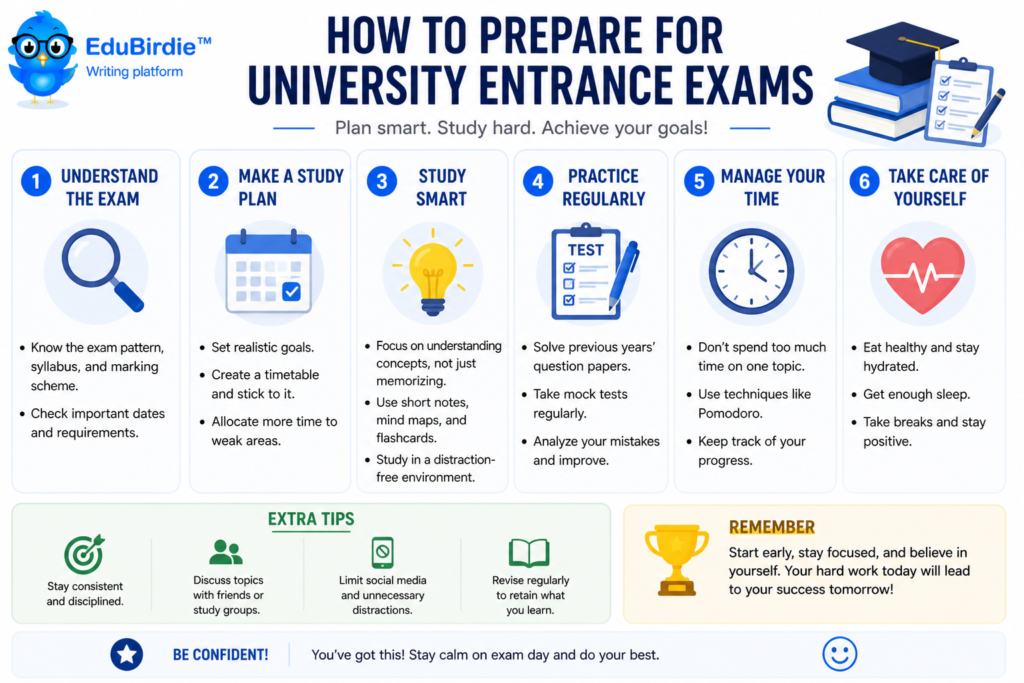
When I think back to my own students taking these tests, I remember the mix of hope and nerves they felt right before opening their first practice exam. The key to a successful entrance exam is smart preparation. You don’t need to spend endless nights memorizing formulas or facts. Instead, you must learn how to:
Create a realistic study plan that aligns with your schedule and personal commitments.
Use proven standardized test-taking tips and prep resources.
Stay calm and confident on exam day.
Enhance your focus with habits that yield optimal results.
Quick meet-up or I am who’ll be walking you through this
Hello, future grad, my name is Deborah Nelson! I am an experienced writer, educator, and test prep tutor who has dedicated myself to assisting high school students in achieving admission to their dream schools for the past five years. Today, I’ll walk you through how to prepare for university entrance exams: from understanding what you’ll face to creating a study rhythm that works.
But if you ever need professional writing guidance, you can explore resources like pay for essays to see how experts structure academic work (it’s a surprisingly useful way to learn).
Are you ready? Let’s begin!
SAT, GRE, and ACT exams: What’s the difference?
When it comes to preparing for entrance exams, one of the first things I always tell my students is this: you can’t plan for what you don’t understand.
Unfortunately for all of us, these exams aren’t just another set of school standardized tests. They’re designed to measure how ready you are for college-level work. Therefore, it is important to understand the logic behind such exams.
So, a college entrance exam evaluates your academic skills, problem-solving ability, and reasoning under pressure. Depending on the path you decided on, there are a few exams you can choose to pass: the American College Test (ACT), the Scholastic Assessment Test (SAT), or a graduate-level GRE. These exams play a huge role in university admissions, scholarships, and sometimes even course placement.
Exam
Purpose
Skills Tested
Who Takes It
SAT
College readiness
Math, Reading, Writing
U.S. high school students
ACT
Academic achievement
Science, Reading, English
U.S. college applicants
UCAT
Medical aptitude
Critical thinking, ethics
Future medical students
GRE
Graduate admissions
Quantitative, verbal
Graduate school applicants
What skills do college entrance exams test?
In reality, these tests are about a wide set of skills, the kind you’ll need to succeed in college and beyond:
Analytical thinking — breaking problems into smaller, logical steps.
Time management — learning how to perform under tight deadlines.
Reading comprehension — identifying the main idea and argument quickly.
Problem solving — using reasoning rather than guessing to find the correct answer.
Step-by-step guide for american college test preparation
Now we move to the most important part of today’s text: how to actually prepare for your exam?
Always keep in mind that college entrance exams aren’t just about memorizing formulas or practicing multiple-choice questions. Over the years, I’ve seen how a clear plan, reliable resources, and confidence on exam day can make all the difference. Here is my favorite, step-by-step strategy, checked by years, that will help you start preparing with focus and less stress!
Step 1: The format and rules.
Before you dive into practice tests or textbooks, take time to determine the college entrance exam you’ll be taking. Therefore, scroll up a bit and check if you take the ACT, the SAT, or a specific college entrance test.
The ACT, for example, has sections for English, math, reading, and science-based passages, as well as an optional writing section. The SAT focuses on math and evidence-based reading and writing, with a strong emphasis on verbal reasoning and critical thinking.
When you’ve made a decision, you can confidently move forward.
Step 2: Create a realistic study plan.
The next step is to create a plan you can actually follow. Many high schools don’t teach students how to plan long-term, but the key to success in any college entrance exam is consistent effort over time.
Break your schedule into months and weeks. Here’s a quick example of how a weekly timetable of an example study schedule for 3 months before the exam might look:
Thursday: Science-based passages or verbal reasoning (45 min).
Friday: Review mistakes from the week (30 min).
Saturday: Take a full practice test (2–3 hours).
Sunday: Rest and review, or read articles or essays for enjoyment.
Creating a study plan is a great start, but mastering complex engineering concepts and staying consistent can be challenging. That’s where online tutoring support for engineering students, like My Engineering Buddy, can help you stay on track and truly understand difficult topics.
Step 3: Gather reliable resources.
Here is where more students can make a mistake. Never compromise on preparation materials: the better your prep book is — the better your results are!
Find materials that will challenge you and cover all topics!
Step 4: Take a practice exam early.
The hardest part for students, but it’s also the most revealing. Taking a full-length practice exam early in your preparation helps you identify your strengths and areas for improvement.
I’ve seen many students hesitate to try a practice test because they “don’t feel ready.” But that’s exactly the point: your first attempt isn’t about getting a perfect score, it’s about establishing a baseline. Once you know your strengths and weaknesses, you can adjust your study plan accordingly.
What you can do after the test:
Review every section carefully.
Analyze which questions you got wrong and why.
Identify your target weak areas.
Work even harder but smarter before the main exam. Now you know which topic you need to focus on more.
Step 5: Practice tests and identify and focus on weak areas.
Once you’ve taken a few practice exams, it’s time to dive into score analysis. This is where real progress begins. Answer these questions to help you improve the score:
Which question types took the longest to answer?
Which topics did I guess on?
Did I misread any multiple-choice questions?
How did my focus hold up after two hours?
What section needs the most review next week?
Step 6: Study for entrance exam at university efficiently.
Once your weak spots are clear, you can finally study smarter, not harder. Don’t forget to use digital tools or test prep apps, about which I will talk more later.
The more you organize ideas under time pressure, the easier it becomes to write a confident personal statement later.
Above all, be intentional. Every reading section you finish, every math question you solve, and every review session you complete adds up to a stronger foundation for college entrance exams!
Step 7: Stay consistent and organized.
No study plan works without consistency. Keep your schedule visible. A digital planner or calendar app can help you balance school, test prep, and personal time. Color-code your study blocks and include reminders for full-length practice exams, score reviews, and rest days.
Step 8: Learn from others’ experiences.
Learning from peers can be just as valuable as studying alone. When I help students study for university entrance exams, I encourage them to combine solo learning with collaborative study.
Working with a friend or small study group can make even advanced mathematics or critical analysis sections less intimidating. You can quiz each other, explain tricky concepts aloud, and keep one another accountable.
Quick tip: If you’re polishing your essays or need guidance on tone and structure, explore college admission essay writers for real examples and expert advice!
Step 9: Manage stress and anxiety before exam day
Although tests are vital, your mental health is even more important. I always remind my students that the goal is not perfection, but performance. If you overprepare and lose sleep, you will not do well!
Stay centered, trust your preparation, and remember that calm confidence often does more for your score than any extra page of notes.
Begin every study session with a deep breath. Practice short mindfulness breaks: two minutes of focused breathing or a quick stretch can reset your focus completely.
On college entrance exam day, these small rituals will feel familiar, and familiarity is the most potent antidote to anxiety.
Smart study techniques that work
I will repeat it once again: smart studying beats long studying.
Techniques such as active recall (testing yourself instead of rereading), spaced repetition (reviewing material over time), and the Pomodoro method (conducted in focused 25-minute sessions with short breaks) help you learn more efficiently. Summarizing notes in your own words also strengthens memory and critical thinking.
My favorite tools:
Quizlet: build and review flashcards for vocabulary and concepts.
Khan Academy: free lessons for math, reading, and writing.
Exam simulators: practice tests that recreate real exam pressure.
These resources help you perform under real conditions and track your progress without stress.
4 Quick Daily Habits to Boost Focus:
Review one topic before bed.
Keep your phone out of reach while studying.
Take short breaks after each 30-minute session.
End each day by listing what you mastered.
Consistency, achieved through small steps, fosters long-term success. Study for university entrance exams smart, not hard. That’s how you stay confident on test day.
4 common mistakes to avoid
Even the most dedicated students can fall into habits that hinder their progress. I’ve seen brilliant students fail because they treated this as a sprint, not a marathon.
❌ Mistake
⚠️ Why It Hurts
Cramming before college entrance exam day
Overloads memory, reduces retention
Ignoring rest and nutrition
Weakens focus and performance
Focusing only on strong subjects
Leaves major score gaps
Forgetting to simulate real conditions
Causes panic during the actual test
Learning is about balance: planning, rest, and regular review. The right strategies determine whether your knowledge turns into confidence when it matters most!
Ace your college entrance exam!
I’ve seen it time and time again: the students who make it aren’t always the fastest or the smartest, but the ones who keep showing up. Progress is built one focused study session at a time, not through all-nighters or panic-driven cramming.
Your dream school isn’t a distant fantasy! It’s the reward waiting at the end of your consistent effort.
And when you’re ready to strengthen your application, take a look at these scholarship essay topics to make your story stand out.
I believe in you! Just remember that EduBirdie and I are always by your side in case you need any help with preparing for entrance exams!
FAQ
When Should I Start Preparing for Entrance Exams?
Ideally, 6–12 months before your test date. Starting early allows slow, consistent improvement without burnout.
How Much Should I Study Daily?
It is recommended to dedicate around 2–3 focused hours on weekdays and 4–5 on weekends for studying. Still, I always say that it’s not about hours! It’s about focused effort and balance.
Deborah Nelson is an experienced educator and writing specialist who has supported high school students with admission and scholarship writing for over six years. Her work focuses on developing clear personal statements and academically sound texts through structured guidance and constructive feedback.
Need pay someone to do paper?
EduBirdie’s experts are ready to help whenever you need support.
Starting to work on your first academic research projects, you may feel overwhelmed by the abundance of technical concepts that are commonly used. You may encounter terms like “research methods,”…
ACT Essay Step by Step: What to Expect from the Writing Section An ACT essay is the optional writing section of the ACT college admission test. You get one writing…
Types of narrative writing are some of the most popular and powerful ways to tell a story. From short stories and novels to personal essays and realistic fiction, narrative writing…