Writing a narrative essay allows you to tell a story while showing your creativity and reflection skills. Unlike other academic assignments, this format encourages you to draw from real-life experiences, emotions, or fictional events to make a point or deliver a message.
If you’ve ever wondered how to write a narrative essay, this guide breaks it down into simple steps:
- Choose a meaningful, specific topic
- Create a clear outline
- Write the first draft in a logical timeline
- Add depth with dialogue, sensory detail, and reflection
- Revise and edit for clarity and flow
Before diving into the full guide, let’s define a narrative essay and why it matters for college students.
What is a Narrative Essay
A narrative essay is a type of academic writing that tells a personal story to illustrate a broader idea, insight, or life lesson. Instead of just listing events, a good narrative conveys meaning and emotional depth so readers can connect with your experience. Whether assigned in class or as part of a college application, this form allows you to express yourself while still following academic rules.
Key characteristics of a narrative paper:
- Written in first person (using “I”)
- Has a clear structure: beginning, middle, end
- Has a central theme or message
- Has characters, setting, conflict, and resolution
- Uses vivid sensory details and dialogue
- Based on real or realistic experiences (non-fiction)
In short, what is a narrative essay? It’s more than a personal story—it’s a structured reflection on your growth and communication to your audience. And if you’re finding it hard to begin or organize your ideas, our write my essay for me cheap service might offer the guidance you need without putting pressure on your budget.
Why Do Students Write Narrative Essays?
In high school and college, instructors assign narrative essays to help you reflect on life experiences and build writing skills. Reasons include:
- Building storytelling skills – learn to organize events logically
- Personal reflection – analyze growth, decisions, moments
- College or scholarship applications – show personal values and character
- Improve academic performance – creativity, clarity, emotional expression
According to any good narrative writing guide, a typical essay has a clear structure: an intro with a hook and thesis, a body that unfolds the story, and a conclusion that reflects or summarizes.
Need more writing assistance?
Order you first paper and join EduBirdie club to receive discounts and updates.
Step-by-Step Guide: How to Write Narrative Essay
Writing a narrative essay allows you to tell a meaningful story based on real experiences. When done right, it combines emotional impact, structure, and clarity. Below is a complete guide to help you master each step of the process.
Step 1: Choose a Compelling Topic
Before you start writing, choose one of the narrative essay topics that resonates with you. The best stories are based on personal experiences with emotional or life-changing impacts.
💡Tips for Choosing a Topic:
- Focus on personal growth, challenges, or defining moments.
- Choose something you remember vividly and can describe with enough details.
- Pick a topic that has a clear takeaway or moral.
Examples of Popular Narrative Essay Topics:
- The day that changed my life
- A moment I overcame fear
- My biggest failure and what I learned
- Moving to a new city or country
- A time I stood up for something I believed in
- My most embarrassing moment
- The impact of a teacher or mentor
- A travel experience that opened my eyes
- Learning something the hard way
- A family tradition that shaped my identity
Helpful tip: Explore more inspiring ideas in our personal narrative essay topics guide.
Step 2: Create a Narrative Structure Outline
It’s essential to organize your thoughts using a narrative essay outline. This structure will help ensure your essay flows naturally and includes all the critical components of a strong story.
Narrative Essay Format Overview:
A typical format of a narrative essay includes:
- Introduction – Sets the scene; includes the hook, background, and thesis.
- Body – Covers chronological events, climax, and resolution.
- Conclusion – Offers reflection and lessons learned.
☝️Here’s a practical outline example for the topic: “My First Time Giving a Public Speech”
| Section |
Content + Example |
| Intro |
Hook: “My palms were sweating, my heart was racing, and the crowd in front of me looked terrifyingly endless.”
Context: It was my first time speaking publicly during a school debate competition.
Thesis Statement: That experience challenged my fear of public speaking and taught me the value of preparation and self-confidence. |
| Body Paragraph 1 |
Set the stage: Describe the lead-up to the event – being selected to speak, your reaction, and how you prepared. |
| Body Paragraph 2 |
The key moment: Describe the moment you stepped on stage, initial nervousness, and how you managed to start speaking. |
| Body Paragraph 3 |
Turning point and growth: How the speech unfolded, audience reaction, and how your confidence grew. Reflect on the realization that came after you finished. |
| Conclusion |
Reflection: Looking back, what did you learn? Emphasize how the experience helped you overcome fear and boosted your self-assurance for future challenges. |
Step 3: Write the First Draft
Start writing with your outline in hand. Your narrative essay introduction should engage readers right away.
Tips for a Strong Intro:
- Start with a vivid description or emotional moment (hook) to capture the reader’s attention.
- Provide enough context to orient the reader.
- End the paragraph with a thesis.
In the Body:
- Stick to chronological order (start-to-end structure).
- Focus on one main event or turning point.
- Use sensory language, emotional appeal, and specific examples.
- Keep characters and dialogue realistic and relevant.
Helpful tip: Write your narrative essay in the first person and keep it focused on one theme or message.
Step 4: Add Depth and Details
This is where you add personal details to make it more relatable and memorable.
☝️Ways to Add Depth:
- Dialogue: Use real conversation to bring characters to life.
- Internal thoughts: Show what you were thinking or feeling.
- Symbolism or imagery: Use metaphors and creative language to represent ideas or emotions.
Your goal is to make readers feel like they were there with you.
Step 5: Revise and Edit
Editing makes your essay clearer and stronger. Focus on:
- ✅Grammar, punctuation, spelling, and sentence structure.
- ✅Paragraph flow and logical transitions.
- ✅Reinforce your thesis in the concluding paragraph.
- ✅Make sure your main theme stands out clearly.
It’s always helpful to read your essay out loud or have someone else read it carefully before preparing your final draft.
Note: Avoid using references unless they serve an important informational purpose, and always ensure that you quote them correctly according to your academic style.
Remember, your narrative essay is not fictional, so the plagiarism risk is low with this type. But if you want to quote from the news or include something not written by you, it’s best to use references to be safe.
Narrative Essay Structure and Format Explained
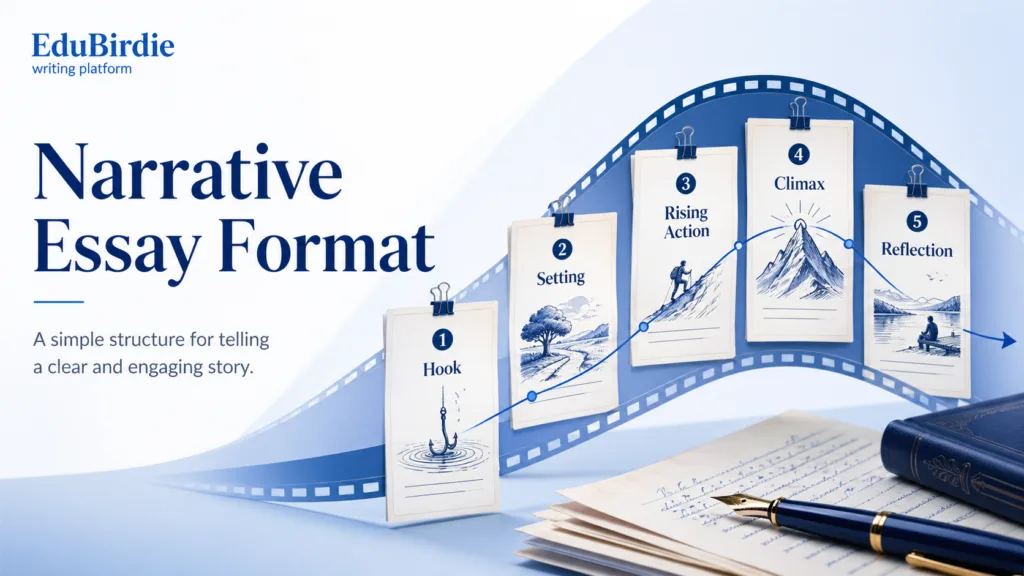
Understanding the narrative essay structure is key to creating a good story. Whether writing a short piece for class or a longer assignment, a well-organized essay helps the reader follow along and get your message. Most narrative essays follow the classic 5-paragraph format, but instructors may allow flexibility depending on the topic and purpose, while still expecting core writing conventions. These include clear organization, consistent tense and point of view, correct punctuation, and smooth transitions.
Here’s the standard format of a narrative essay:
📍 Introduction
This is where your story begins. Knowing how to start a narrative essay is important—it should open with a strong hook to grab attention, give some background information about the event or experience, and end with a clear thesis statement that reflects the main theme or life lesson.
🧱 Body (Usually 3 Paragraphs)
Each paragraph should support the flow and emotional progression of your story:
- First Body Paragraph—Introduce the rising action. Set up the scene and develop characters or tension related to your thesis.
- Second Paragraph—Build to the climax. This is often your story’s most intense or meaningful moment—describe it with sensory details.
- Third Body Paragraph: Show the falling action and resolution. Then, start wrapping up your paper by leading into the reflection or final takeaway.
🎯 Conclusion
End your essay by reflecting on what you learned or how the experience changed you. Revisit the main idea from your thesis and emphasize the key points clearly. A good ending offers insight or personal growth.
How Long is a Narrative Essay?
The answer to that should be provided in your essay instructions or specified by your course professor. Generally, a narrative essay will vary from 500 to 700 words, yet in some cases, your writing may be up to 1000 words.
If you’re unsure how to structure your story or want a better idea of tone, pacing, and organization, reviewing a personal narrative essay example can be extremely helpful.
Narrative Essay Example for Students
Here’s a clear narrative essay example to illustrate the structure and emotional impact you should aim for:
Topic: How Volunteering Changed My Life Essay
Introduction
When I first began volunteering in high school, it felt like another task to check off my list. Babysitting for neighbors or helping out around the community was more about meeting the forty-eight required service hours than anything meaningful. I didn’t see the point—until my junior year, when I started directly helping people in real need. That experience opened my eyes to how much I had taken for granted and sparked a deeper understanding of selflessness and purpose.
First Paragraph
Everything changed when I volunteered at CHKD’s transitional care unit for three weeks. The children I worked with couldn’t breathe independently or communicate like other kids. Some couldn’t even sit up without assistance. Yet, despite these challenges, their smiles and strength left a lasting impression on me. Watching their courage shifted my entire perspective. That experience didn’t just make me a better volunteer—it made me a more grateful and self-aware person.
The Types of Narrative Essay
When it comes to narrative essay writing, students are often asked to choose one of several types, depending on the course or assignment requirements. Each type of storytelling essay requires a unique narrative approach and specific storytelling techniques. The most common narrative essay types include:
| Type |
Description |
Goal |
Sample Topics |
| Personal Narrative (Autobiographical) |
A real-life story told from the writer’s point of view. Focuses on a single moment or experience that had a personal impact. |
Reflect on personal growth or a life lesson. |
My first day at a new school
A challenge that changed me
The moment I realized I was wrong |
| Descriptive Narrative |
Focuses on vividly describing an event, scene, or experience using sensory details and imagery. |
Help the reader visualize and feel the story emotionally. |
A rainy day in New York City
Walking through a war memorial
A magical night at a concert |
| Prompt-Based Narrative |
Responds to a specific question or issue while including a personal perspective or experience. Often used in academic, journalistic, or exam contexts. |
Blend storytelling with analysis or reflection on a topic. |
What I learned during my first protest
Volunteering during a health crisis
How a school debate changed my views |
Each of these essays follows a distinct structure and storytelling purpose. When writing a narrative essay, choose the type that best matches your assignment and message.
Expert Narrative Essay Tips for Powerful Students
Whether you’re writing for class or a personal project, mastering the narrative essay requires more than just retelling events. You need clarity, purpose, and style. Below are narrative essay tips to help you create a clear, engaging essay.
1. Know Your Purpose
Before you begin writing, define what message or insight you want to share. This becomes the core of your essay and should connect directly to your thesis. Your story must lead to a reflection or ending that communicates your main idea.
2. Focus on a Single Event
Avoid writing about multiple experiences. A strong narrative zooms in on one specific incident and explores it in depth, giving your essay coherence and emotional impact.
3. Create a Strong Hook
A good introduction captures attention immediately. Use creative language, an intriguing scene, a question, or a bold statement to draw readers in from the first line.
Example: “My palms were sweating as I stepped onto the stage. The microphone stood taller than I expected, and for a brief moment, I forgot my name.”
This hook places the reader directly into the moment of tension and curiosity.
4. Structure Your Thoughts
Outline your paper before you start. Even a good narrative essay can become confusing without structure. Stick to a beginning (setup), middle (climax), and end (resolution) to ensure a coherent story. Each part should serve the flow of your main message.
5. Use Vivid Language and Dialogue
Bring your story to life with sensory details, strong verbs, and natural dialogue.
Example: Instead of writing “I was nervous,” try “My heart pounded like a drum, and I kept adjusting my sleeves to hide my shaking hands.”
Add dialogue to humanize your story: “‘You’ve got this,’ my coach whispered. ‘Just breathe.’”
6. Stay Personal, But Clear
Use the first-person point of view (“I”), but don’t ramble. Everything should serve the narrative’s goal.
Following these strategies makes writing a narrative essay less overwhelming and more rewarding. Organize your thoughts, stay focused, and remember—your story is valuable when told well.
Common Mistakes to Avoid in Narrative Essays
Even experienced writers can make errors that weaken their essays. Here are the most frequent mistakes students make — and how to avoid them:
❌ Turning the essay into a descriptive essay – While both forms share vivid language, a descriptive essay focuses only on imagery. A narrative, however, must include a clear storyline and personal reflection.
❌ Lack of structure – Forgetting to include a beginning, middle, and end can confuse readers and weaken your message.
❌ Too many events – Don’t try to tell your whole life story. Focus on one key moment and explore it deeply.
❌ Weak or missing thesis – Your essay needs a clear main point or lesson. Without it, your essay feels incomplete.
❌ Flat characters or vague settings – Make sure the people and places in your story feel real and specific.
❌ Overusing dialogue – While dialogue adds life, too much of it can clutter the story. Use it purposefully.
❌ Not reflecting – Simply telling what happened isn’t enough. Include insights, growth, or emotions connected to the event.
❌ Shifting tenses – Stick to one tense (past or present) to maintain clarity and flow.
Avoiding these pitfalls will help you craft compelling narrative essays that engage your reader and leave a lasting impression.
Final Thoughts on How to Write a Narrative Essay
Writing a strong story takes planning, reflection, and a clear message. When you write narrative essays, focus on one meaningful experience, keep a consistent tone, and use vivid details to connect with your readers. Structure matters — every story should have a beginning, middle, and end, supported by a clear thesis.
Narrative essays are more than just storytelling; they help you develop communication skills and showcase personal growth. Whether for school or a college application, a good story can leave a lasting impact.
A well-written narrative essay reflects who you are and reveals how your experiences have shaped you.
FAQ
What makes a good narrative essay?
A good narrative essay has a clear theme, vivid storytelling, strong structure, and emotional connection with the reader.
How to start a narrative essay?
Begin with a hook — a vivid scene, quote, or question — and introduce the topic and thesis clearly.
How personal should a narrative essay be?
It should reflect your personal experience, but stay relevant and focused on the main message.
What’s the difference between a narrative and a descriptive essay?
A narrative essay tells a story with a plot and characters; a descriptive essay focuses on sensory imagery without a whole storyline.