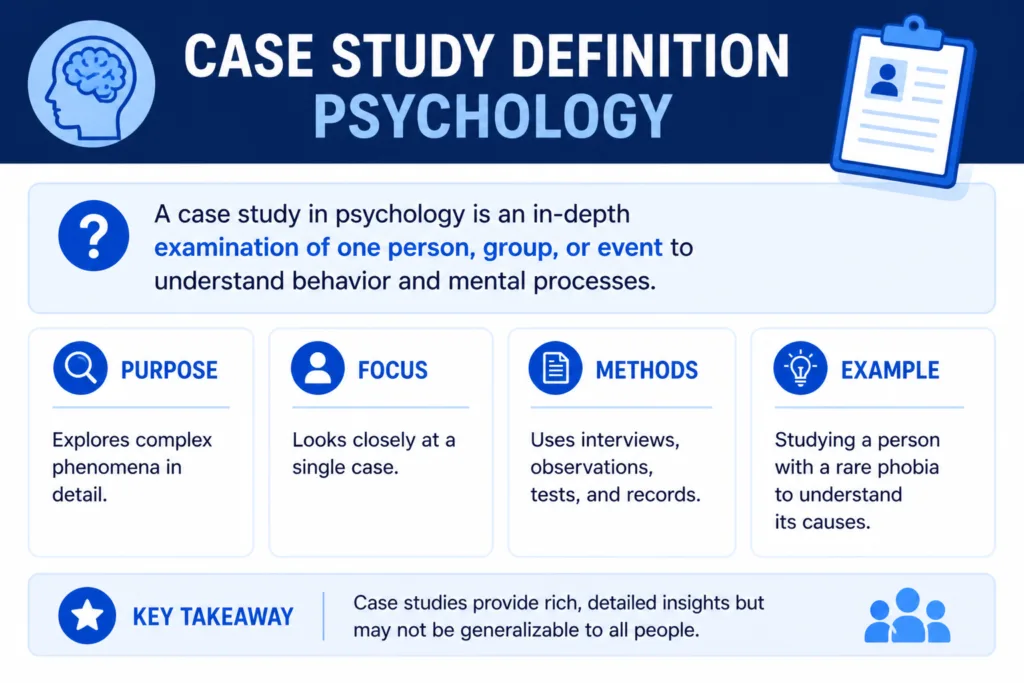
A psychology case study examines a person, group, or situation using psychological theory and evidence. Introduce the case and presenting problem, provide relevant background, analyze behavior through appropriate concepts, discuss assessment or intervention options, and address ethics and limitations. Protect identities and avoid diagnosing without sufficient professional evidence.
What is a case study in psychology?
A case study in psychology is a detailed investigation of an individual, group, or specific event to understand the “how” and “why” of behavior.
The difference between a case study and an experiment lies in their approach: experiments test cause-and-effect relationships under controlled conditions, while case studies focus on in-depth observation without manipulating variables.
A particular scenario may require in-depth research or direct observations to come up with diagnostic criteria. Moreover, clinical psychology usually borders experimental research with clinical practices. The primary goal, however, is to generate further research based on previous studies and an existing dataset. Typically, a general paper focuses on specific details and includes clinical notes derived from established literature. For instance, you may be working with psychological theories with clearly defined guidelines.
In certain situations with case study definition psychology scenarios, you may deal with multiple fields where a detailed description is needed in all cases. The purpose is not only to present the problem correctly but also to create a clinical impression. The most challenging is gathering information and discovering all the unique characteristics that must be present. Thankfully, once you master all the key components, dealing with a case study psych will become much clearer.
This guide will teach you how to create an excellent paper and ensure that it has all the necessary sections, starting with data collection and ending with a discussion section.

Types of Case Studies Psychology Definition Areas
Before proceeding further, let’s get to know more about the main types of writing you may use and encounter as a student. Learning how to write a case study for psychology always starts with choosing your type.
-
Descriptive Case Studies.
In this situation, we have a detailed observation focusing on descriptions. If we have an individual’s life, the trick is to shed light on the context and explain things well. Talking about overall well-being to shape your report is not enough. Treatment goals and a connection to some real-world phenomena are necessary. For example, if a person is going through psychological distress, talk about specific reasons and support your arguments with journal articles.
-
Exploratory Case Studies in Psychology.
If you plan on investigating new issues, study phenomena must be present first. The challenge with exploratory studies is that they need more than the subject’s symptoms or a story about the subject’s life. The key is to explore your subject’s background in greater depth. Identify new patterns, and do not ignore a case history (if there is one!).
-
Explanatory Case Studies.
As the title implies, this type explains causes or behaviors at play. It fits well with social relationships, where you collect information and talk about the key takeaways. When you find data that can help better understanding, you may use a pharmacological approach with the current research. Always provide background and an in-depth analysis!
It is about a single case study psychology versus multiple approaches. They still require specific details. In fact, collective studies may focus on rare conditions like life in a digital world or practical applications of machine learning systems.
Tip: If you find it overly complex and need someone to help you, you can share your
do my case study request and get immediate help 24/7! When you get a helping hand, things get much easier!
-
Intrinsic vs Instrumental.
Intrinsic studies are related to a unique interest, while instrumental studies focus on a general problem of understanding.
6 Preparatory Steps Before You Learn How to Write a Case Study Psychology Report
Before you dive into writing, you need to prepare the groundwork that defines the success of your psychology case study:
- Choosing your case: always choose relevant and informative examples. It must be something that you know well. Choosing good psychology paper ideas is already half of the task done.
- Collecting background information: When applicable, collect information about personal details, symptoms, relevant diagnoses, and treatment approaches.
- Literature review part: the key is to use certain sources to support your arguments. Treat them as teaching tools to explain human behavior based on theories. It works not only for a descriptive theory but also for all scenarios with relevant references. A case study allows a more detailed look at the life of a single subject than any other study.
- Clarify your purpose: define clear objectives and research questions. This part must work like a thesis with all the clinical implications of your work. If you refer to specific psychological theories, make it known.
- Collect vital data: This can be either qualitative or quantitative. You may also include interviews, video footage, or anything that helps to understand research participants. It must be done clearly to allow other researchers to see future research directions. Remember to specify a treatment approach for your future discussion section.
- Analyze gained information: This is where you focus on the subject’s symptoms or talk about human behavior patterns that you have noticed. Ask yourself what is case study in psychology in your field. All the key themes must be known and outlined before you start any writing or editing work.
Completing these essential steps will give you a clear direction, a strong foundation, and relevant data for writing a structured and insightful case study psychology report.
Need more writing assistance?
Order your first paper and join EduBirdie to receive discounts and updates.
Try EduBirdie
10 Things to Focus on When Choosing a Psychology Case Study
Most students who have to work on a specific study for the first time often question the value of such academic work. Still, this type of writing can be helpful in various ways. Our experts at EduBirdie came up with a list of things you must consider for a case study meaning psychology bits:
| Academic insights |
One can provide vital information and work on similar or rare patterns. |
| Holistic understanding |
You gain a comprehensive understanding of human behaviors and more. |
| Theoretical value of case studies psychology |
Researchers can connect theories and practice. |
| Personalized analysis |
A specific study can help highlight vital issues. |
| Practical value |
Practical implementations are especially popular in clinical psychology and help develop new methods. |
| Real-world application |
Studying real events helps to minimize harm and apply theories accordingly. |
| Qualitative data |
It offers a deeper understanding of your subject matter via a case study psychology definition. |
| Hypothesis analysis |
It can help guide further investigations in the field of psychology. |
| Ethical research |
It helps to discover ethical implications and see its value in practice. |
| Educational importance |
A study can help a student like you learn how a theory can be applied in practice. |
The most important thing in how to write a case study is to gather information in advance and study your subject. It is both relevant for intrinsic case studies, where you focus on a single scenario, and group investigations like instrumental case studies. If you are unsure about your psychology case study, make sure to ask one of our EduBirdie experts. We know how to help you with a case report and provide in-depth academic assistance!
A Step-by-Step Guide to a Case Study Structure
Step 1. Introduction or Background
Briefly and clearly introduce your subject and context. Some examples may include a person’s age, clinical background, and other important things. The key is understanding why the research plan is pivotal to a research project. Make a plan first with all the background and continue then.
For example:
Thomas P. is a 15-year-old from Tulsa, Oklahoma, with ADHD syndrome. As a child, Thomas was placed on the autism spectrum, but then the diagnosis changed as he grew older.
Step 2. Presenting the Chosen Problem
While this may be easier with explanatory case studies, things can get more complex with any other psychology case study. You must present symptoms that affect a person’s life to explain what goes on in a psychological investigation.
For example:
Social Psychology: Learning through case studies
The problems in social psychology are quite diverse. Using machine learning among office employees shows us psychological laziness and a lack of motivation as people turn to automatic solutions.
Step 3. Diagnosis and Analysis of a Case Study in Psychology
Explain some diagnosis in question and provide analytical information. You may use a cognitive behavioral approach to explain your patterns.
For example:
Sarah N. has been diagnosed with Asperger’s syndrome because of childhood trauma and genetic disorders. According to the recent MRT scans, one can conclude that she also has generative disorders that have been beyond the medical radar.
Step 4. Treatment Plan and Intervention
Here is where you explain therapy methods and discuss broader implications supported by sources. If some talk therapy has been involved, you must mention it, too. It will help to define case study in psychology.
For example:
It has been quite difficult to choose between the mental and physical solutions. Since we are dealing with Psychology, a mixture of meditation and personal interviews has been chosen. The case study shows that no single method or treatment will be effective as the patient is still too young and developing.
Step 5. Results and Outcomes Part
It may be an improvement or no change at all. This is the part where the psychological case’s results must be mentioned. For example, it must be mentioned if the talk therapy did not succeed.
Examples of case studies in Psychology:
Thomas has been placed in a group with ADHD children with a special care teacher. Three different specialists have observed his results. The similarities include his tendency to do better in arts while the physical activities have not brought a desired result.
Step 6. Lab Report Discussion Section
The most challenging part of such a study is the discussion. You must discuss your psychology case and explain your case report. Interpret findings with an in-depth analysis. Compare your gained data to existing theories/research and acknowledge limitations.
Case study psychology example:
According to Konrad Lorenz’s theory on Human Aggression, Joan tends to stay violent in challenging situations. One can see that as a victim of domestic violence, she needs to go through therapy courses to control her natural aggression.
Step 7. Conclusion or Final Words
This is where you summarize all the findings and provide information for future research. If there were some limitations, mention them again.
Certain psychology case study examples for students will look this way:
The case study has shown us that autistic children are not always locked and fit under psychological theories.
Step 8. Bibliography and References
Famous psychology case studies always provide peer-reviewed sources that relate to at least one theory. Even if you work with your interviews and personal observations, an additional source must be present. Be sure to watch your grading rubric closely. It is vital to use a writing style like APA or MLA. Referencing must be accurate and ethical to a point. It also prevents plagiarism when working with a case study or seeking psychology case study format rules.
6 Common Writing Mistakes You Must Avoid
Any work with a case study is a challenging task! If you are still asking what are case studies in psychology or If you are worried about the most common pitfalls, be sure to check with the following points:
- Avoid adding too much detail. The key is to stay focused. It is always good to narrow things down and ensure that you stay on topic. The main purpose of adding background information is to help fellow students or college professors understand what is happening.
- Use symptoms and details in a certain order. If you place them all over the paper, it will make it hard to read. A good psychology case study will have a certain structure.
- It is useful to apply paraphrasing. There are many risks of unintentional plagiarism when you learn how to write a psychology case study. When you need to quote, add a source and use it accurately. If you are unsure how to paraphrase, ask any of our experts.
- Stay objective! Do not add personal bias unless you are discussing a discussion section. Psychology is a complex field of science where you must support arguments with a theory or a relevant case study.
- Use a clear case study structure. If you do not follow any logic or jump from theory to theory in your case study examples psychology bits, you may end up with a poor assignment.
- Make sure to proofread your psychology case report twice. It is recommended to do so aloud because it allows you to see if something is wrong.
Conclusion and Extra Helpful Writing Tips
Now that we are done with our case study psychology guide make sure that we sum up all the vital things we have learned:
- Remember the value of detailed preparation and use structured writing.
- Practice clarity all the time.
- Stay objective and show respect when dealing with a case study subject. Every definition of case study in psychology focuses on being concise.
- Do not forget that practice makes perfect, so make sure you take your time to learn.
Most importantly, when you need inspiration, do not forget to ask one of our EduBirdie experts to help you review sample case studies. Having a good example and knowing when and how to start is always easier. You can also check some topics for case study in Psychology to have a good start. These will provide you with initial ideas before you start your assignment preparation.
In case you wish to get immediate assistance with psychology case studies, just give us a call!
FAQ
Should I choose an explanatory or a descriptive case study?
A descriptive case study always focuses on a particular event or scenario. The explanatory case is always about how and why questions. It aims to explain why something has happened and how it went on. Unlike descriptive case studies definition psychology in the area that focuses on specifics might be more challenging.
How many sources should I add for a psychology case study?
Use one to three sources per page of a case study-format psychology assignment if necessary. Introduce your case study source first and explain it after the quote.
What style formatting should I use for my case study?
Such things are usually mentioned in your grading rubric. You may use the typical APA style format or any other format, like MLA (for certain cases). It will depend on your university and the task requirements. If anything, we can always help you out!
Should I use an intrinsic or an instrumental psychology case study?
It is usually about a specific theory where a general approach is taken. It is the one for you if you need to illustrate something or use an instrumental approach. An intrinsic approach is more about an individual approach. You can check social psychology research topics for college students if you need to see certain case examples.