A narrative essay is a form of narrative writing where you tell a story, often based on personal experience, to make a point or share a lesson. To write a good narrative essay, you need a clear structure and vivid descriptions that bring your story to life. The best way to achieve this is by starting with a well-organized narrative essay outline.
This article will guide you on how to craft a solid narrative paper outline and structure your essay effectively. We’ll also provide a sample outline to guide you through the writing process with confidence.
Need more writing assistance?
Order you first paper and join EduBirdie club to receive discounts and updates.
What Is a Narrative Essay Outline?
A narrative essay outline is a structured plan that organizes your story into logical sections. It helps you brainstorm ideas, arrange events chronologically, and ensure your essay stays focused on the main theme. Whether you’re writing a personal narrative essay or a story about someone else, a strong outline is the foundation of a well-structured narrative essay.
Why Use a Narrative Essay Outline?
- Organizes your thoughts and ideas
- Ensures your story flows logically
- Helps you include all essential narrative elements
- Saves time during the writing process
- Makes narrative essay writing less overwhelming
☝️Tip: Keep a consistent first person point of view in your outline to make your narrative essay more authentic and engaging.
Standard Narrative Essay Outline Structure
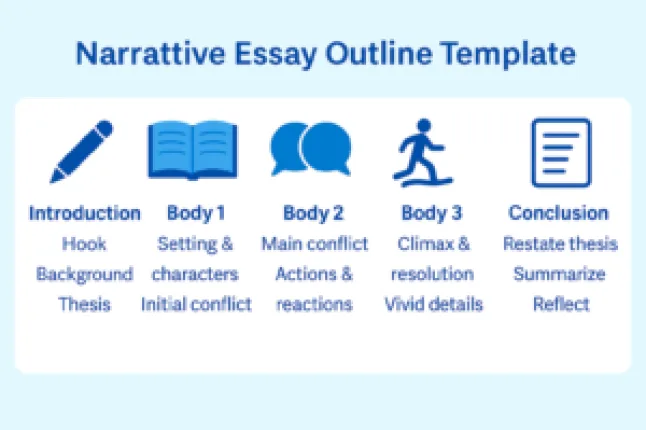
A typical outline for a narrative essay is a structured five-paragraph essay containing an introduction, a clear thesis statement, descriptive body paragraphs, and a strong conclusion. Below is a narrative essay outline template showing the key elements required in a narrative paper. Use it as an example or a checklist as you learn how to write a narrative essay outline:
Introduction
- Hook (provide a context and create a general outline).
- Background/scene setting (describe various aspects as you start writing).
- Thesis statement (main message or lesson that has a profound impact).
Body Paragraphs
- Background of your descriptive paper (you can introduce the main characters here).
- The main conflict or challenge (it may be a specific challenge, like your academic goals).
- A turning point is a personal growth (provide context and at least one crucial point).
- Provide the resolution that shows how the conflict was resolved (it must have a lasting impression).
- Descriptions with vivid details, dialogue, and transitions (provide more key elements and link them to character development and initial feelings).
Conclusion
- Restate the thesis with the key lessons and insights gained.
- Summarize key points and all significant moments.
- Reflect on the lesson learned and talk about some future endeavors.

Before you start with the outline of a narrative essay, think about the main idea of your personal narrative and the thesis statement. This will help you to shape a paper effectively. The same principles apply to every body paragraph and a conclusion to capture the reader’s interest.
Tip from EduBirdie: Start your introduction with an engaging anecdote to hook readers and set the tone for your personal story.
How to Write a Narrative Essay Outline: Step-by-Step Guide
Effective narrative writing generally involves clear characters, settings, a central conflict, and resolutions presented logically, often in chronological order. This helps capture the reader’s attention and clearly communicates the main theme.
Creating a narrative essay outline is essential to ensure your story remains coherent and engaging. Let’s clearly break down the necessary steps for crafting a narrative essay outline:
Step 1: Choose Your Narrative Topic and Thesis. Begin by selecting an engaging topic based on a personal experience or meaningful event. Personal narrative topics should naturally lead to a clear thesis statement, communicating the central lesson or message of your narrative. For example, your thesis could be: “My first volunteering experience taught me the profound value of empathy and community service.”
❗️Pick a topic that offers a thought-provoking insight to make your narrative essay meaningful.
Step 2: Identify Key Characters and Setting. Next, identify who the main characters in your story are and describe your setting in detail. Clearly outlining these elements provides context for readers. For instance, your characters might include yourself, family members, or friends, while your setting might be a community center or a specific event location.
Step 3: Outline Events Chronologically. List out all significant events in your narrative in clear, chronological order. This creates a logical flow and helps readers easily follow your story. Example:
Arriving at the community center → Meeting other volunteers → Initial feelings of nervousness → Facing challenges → Learning and resolving issues.
Step 4: Define the Main Conflict or Turning Point. Clearly outline the main conflict or turning point of your narrative. This will form the emotional core of your story, offering insight into your personal growth or the key lesson learned. For example, “My main conflict was overcoming my fear of speaking publicly when I had to present in front of a large group.”
Step 5: Develop Detailed Body Paragraphs. Each body paragraph should have a clear focus: background introduction, exploration of the main conflict, and description of the resolution. Use vivid descriptions, sensory details, emotions, and dialogue to enhance clarity and reader engagement. For example:
“My hands trembled as I approached the microphone, heart pounding loudly in my ears.”
Step 6: Outline the Resolution Paragraph. Your resolution paragraph clearly shows how you resolved the conflict and conveys your personal insights or lessons learned. It should directly link to your thesis. For instance:
“After successfully completing my presentation, I realized that embracing vulnerability allowed me to connect deeply with my audience.”
Step 7: Plan a Strong Conclusion. Summarize your main points, restate your thesis, and reflect on broader implications. The concluding paragraph provides closure and highlights your growth. Example:
“My volunteering experience not only taught me empathy but also instilled confidence in my abilities, shaping me profoundly.”
Step 8: Revise for Clarity, Flow, and Conciseness. Finally, carefully review your outline. Check for clear transitions and logical structure, and remove repetition or vague details. Read your essay aloud to improve your writing skills by catching grammar and spelling errors and ensuring your narrative flows smoothly and logically.
Summary checklist for creating your narrative essay outline:
✔️ Select an engaging and meaningful topic.
✔️ Formulate a clear and impactful thesis.
✔️ Identify and detail key characters and setting.
✔️ Chronologically organize significant events.
✔️ Clearly define the main conflict or challenge.
✔️ Write descriptive, detailed body paragraphs.
✔️ Clearly outline the resolution linked to your thesis.
✔️ Summarize insights clearly in the conclusion.
✔️Revise meticulously for coherence and conciseness.
☝️Tip from EduBirdie: Exploring additional narrative essay examples can inspire your writing and provide further clarity on structuring your own story effectively!
Narrative Essay Outline Example
Let’s continue with a clear narrative essay outline sample.
Topic: “My First Day at a New School”
Introduction
- Hook: Begin with a vivid scene or memorable moment from your first day at the new school.
- Background Setting: Briefly describe why you moved and your feelings about starting at a new school.
- Thesis Statement: Clearly state what important lesson or insight you gained from your experience at the new school.
Body Paragraphs
Paragraph 1: Scene Setting & Background
- Setting: Describe the bright, bustling classroom filled with unfamiliar faces and colorful decorations on the walls.
- Characters Introduced: Introduce myself, my kind but shy new classmate Anna, and our welcoming teacher Ms. Lopez.
- Initial Conflict: Express my initial feelings of loneliness and anxiety, noticing how everyone else seemed comfortable and friendly with each other.
Paragraph 2: Main Conflict & Turning Point
- Internal Struggle: Explain my worries about not being accepted and my hesitation to approach others.
- Turning Point: Clearly describe the moment Anna shyly asked me to join her group during lunchtime, making me realize that taking a chance could lead to positive outcomes.
Paragraph 3: Climax & Resolution
- Action Taken: Detail how I decided to accept Anna’s invitation, taking a deep breath and stepping outside my comfort zone.
- Supporting Evidence: Provide vivid descriptions of friendly conversations and laughter shared with Anna and her friends, creating a comfortable atmosphere.
- Resolution: Explain how this positive interaction resolved my initial fears and showed me the importance of being open to new experiences.
Conclusion
- Restate Thesis: Reaffirming courage and openness can turn unfamiliar situations into positive experiences.
- Summarize Key Moments: Briefly recap entering the classroom nervously, meeting Anna, and enjoying lunch with new friends.
- Reflect on Lessons Learned: Highlight the key lesson of overcoming fears through courage and the benefits of stepping outside my comfort zone.
- Closing Insight: Express my commitment to continue approaching new experiences with openness and positivity, building friendships and growing personally.
If you’re struggling with the conclusion, a write my conclusion tool can help you finish it.
Narrative Essay Outline Format
As a way to help you write a narrative essay, we have prepared the main aspects that you must consider with this type of essay writing:
- A narrative essay always follows a strict organizational structure. It means that this type of essay writing has a standard 5-paragraph narrative essay outline.
- Font and size must be readable. Use Times New Roman or Arial, point 12, to ensure high readability and academic standards.
- Essay spacing. Your narrative essay must be double-spaced. It helps to outline different sections and headers.
- Essay text alignment. Your essay writing must be aligned to the left. It allows you to keep things neat.
- Margins. Follow your grading rubric and the writing style guidelines.
- Style formatting. A narrative essay can be in APA, MLA, Chicago, Vancouver, or any other style.
- Label your sections. Keep the headers clear to make your narrative essay writing more accessible to your readers. Your paper may have various structures and sections, yet always check with the grading rubric to avoid trouble.
❗️Keep in mind that your essay should balance storytelling with descriptive language.
Wrapping Up the Importance of a Good Narrative Essay
Creating a well-structured narrative essay begins with crafting an effective narrative essay outline. A solid outline ensures your ideas and events are organized logically, making your narrative essays coherent and engaging. Following a clear narrative essay template allows you to vividly describe your experiences, articulate your thoughts, and express your central message effectively.
Consistently using an outline will greatly improve your own writing by providing a reliable framework that helps you clearly communicate your story and personal insights. This structured approach minimizes confusion, ensures key elements like characters and settings are thoroughly developed, and allows your narrative to naturally flow from introduction to resolution. If you are lost with the composition of narrative essays, you can always ask one of our EduBirdie experts. We know how to make things perfect and eliminate mistakes and challenges.
Ultimately, a thoughtful and carefully prepared narrative essay outline is your blueprint for successful storytelling. Start applying these outlined steps today, and see how significantly they enhance the clarity, impact, and overall quality of your writing. If you need further assistance, expert guidance is always available to help you excel.