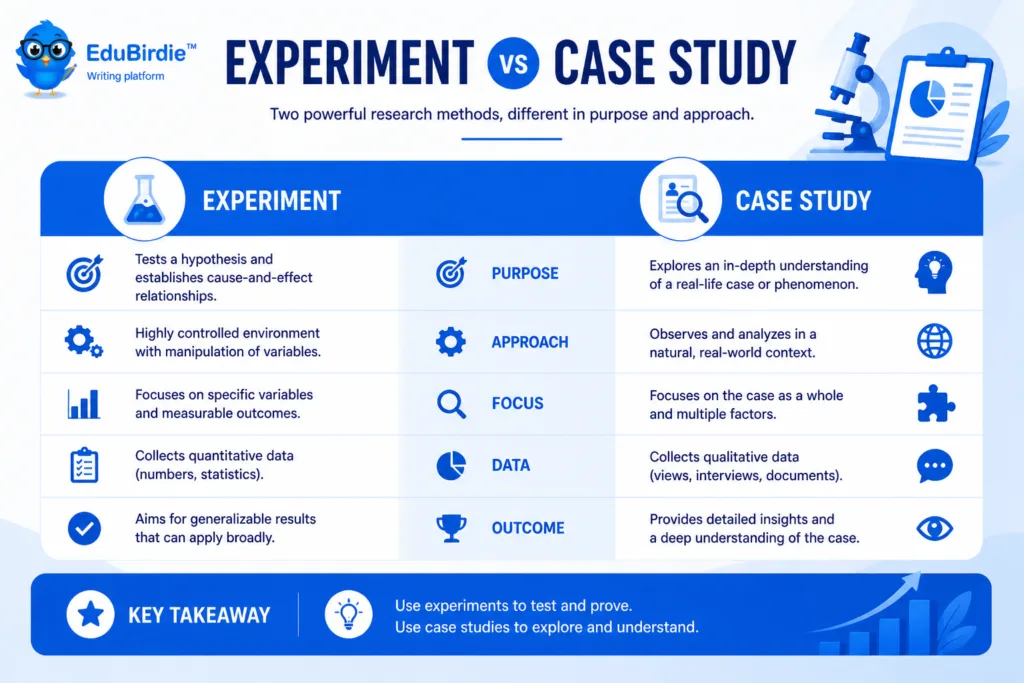
Shortly, a case study explores a real-life scenario to build a deep, contextual understanding, while an experiment tests specific hypotheses under controlled conditions.
Choosing between case study vs experimental approach is a significant part of the research process, as these methods address research questions in fundamentally different ways.
The following sections examine these differences in more detail.
What is a Case Study?
To more fully comprehend the difference between case study and experiment, I recommend examining the specifics of each method separately.
A case study is a research method that provides an in-depth examination of a specific instance, individual, group, or event.
Instead of testing hypotheses in a controlled environment like experiments do, a case study focuses on understanding complex issues within a real-life context. Because many variables inherently interact, this method provides researchers with a profound understanding that other study methods typically cannot.
This approach helps:
- generate hypotheses;
- identify patterns;
- develop a contextualized understanding for future studies.
To build this deep perspective, the case study method relies on several complementary tools. Researchers typically combine interviews, the observation method, document analysis, and sometimes archival records to gather qualitative data from multiple sources. Using credible sources for research is essential, as they provide trustworthy and reliable information, such as peer-reviewed articles, academic books, and official reports.
Thus, they can investigate naturally occurring variables because of this methodical methodology.
🔎For example, a case study might investigate how a particular individual adapts to remote learning, or how one company responds to environmental factors in its market.
In short, a case study provides a deep understanding of complex phenomena through in-depth investigation. It is the best method when your research goals require detail, context, and insight rather than numerical data or hypothesis testing.
You can also explore more about what is a case study paper on the EduBirdie blog resource!
What is an Experiment?
Now that we’ve covered the case study method, let’s look at experiments — the second major approach in the research.
While a case study explores events in a natural setting, an experiment relies on a controlled environment where researchers can test a specific hypothesis by manipulating certain variables.
In simple terms, an experiment is a research method designed to establish cause-and-effect relationships. Researchers intentionally change one independent variable and observe how it influences a dependent variable.
This structured research design allows them to:
- gather quantitative data;
- maintain internal validity;
- evaluate whether their findings support or reject the initial hypothesis.
The purpose of experimental research is clear:
- to test ideas systematically;
- remove the influence of occurring variables;
- generate empirical evidence that can be replicated.
To achieve this, experiments must include:
- a controlled setting;
- controlled variables;
- random assignment;
- quantitative measures;
- a clearly defined subject group.
This method is standard in psychology, health sciences, education, and social sciences, especially when the research question requires precise measurement (rather than broad contextual understanding).
🔎For example, a researcher may test whether background music affects reading comprehension by dividing students into a control group (silence) and an experimental group (music).
By the way, experiments work best when your goal is to:
- test a specific hypothesis;
- isolate the effect of certain variables;
- collect numerical data that leads to clear, measurable conclusions.
Case Study vs Experiment: Side-by-side Comparison
Now that we’ve explored each method separately, it becomes much easier to understand how case study and experiment approaches differ when placed next to each other.
Both are valuable research methods, but they address different types of research questions and employ very different designs. Case studies help you understand complex issues within a real-life context, while experiments are ideal when you need to test a hypothesis under controlled manipulation.
| Aspect |
Case Study |
Experiment |
| Purpose |
To explore a particular instance in depth and build contextual understanding. |
To test a specific hypothesis and determine cause and effect relationships. |
| Approach |
Researchers use a qualitative, flexible, and interpretive approach to observe natural elements. |
Quantitative research methods with structured procedures and controlled variables. |
| Control |
No controlled environment; the subject is examined in a real-life context. |
High level of control through a controlled environment and controlled manipulation. |
| Data Collection |
Multiple data sources: interviews, observations, documents, and archival records. |
Numerical data gathered through tests, measurements, or experiments designed for statistical analysis. |
| Context |
Rich, detailed, and focused on complex issues and environmental factors. |
Narrower context focused on isolating certain variables for clear results. |
| Sample Size |
Often small: one individual, one group, or one organization. |
Typically, larger sample sizes are employed to enhance reliability and internal validity. |
| Outcome |
Deep, descriptive findings that help generate hypotheses and connect to existing theories. |
Empirical evidence that supports or rejects a hypothesis. |
| Example |
Studying how a single school adapts to new digital tools. |
Testing whether sleep affects memory by comparing two subject groups. |
In short, when deciding between a case study and an experiment, think about your research goals:
➔ Do you need a detailed understanding built from qualitative data? ➔ Case study
➔ Do you need clear measurements that can be tested and repeated? ➔ Experiment
If you ever feel overwhelmed choosing the best method for your project, you can always send EduBirdie a request, “I want to pay someone to write my case study,” and receive a personal approach!
Let me guide you directly to the next section, where we will together choose the best method for your topic based on what you want to discover.
When to Use a Case Study?
Case studies are the best choice when your goal is to understand a complex subject in depth. They are instrumental in research situations where multiple variables interact simultaneously. It makes it impossible to isolate a single independent variable. Researchers focus on observing actual actions, choices, or processes as they occur, rather than testing theories.

Because of this, case studies are widely used in:
- social sciences;
- education;
- business;
- psychology;
- health-related fields.
These areas often require insights derived from qualitative data, whereas data from purely quantitative research is more often based on experiments.
🔎 For instance, some
case study ideas include the situations when researchers want to explore how individuals adapt to new learning environments, understand organizational culture, or examine how communities respond to social change. A case study design provides the depth and context that other research methods may overlook.
A case study is also appropriate when your research requires:
- multiple sources of data (interviews, observations, documents, archival records);
- an understanding of naturally occurring variables;
- detailed findings that reveal patterns, motivations, and relationships;
- a research design focused on “how” and “why” questions rather than cause-and-effect relationships.
This approach reveals how different factors (customer loyalty, employee flexibility, local policies) interact to shape the bakery’s decisions. The result is not a set of numerical findings, but a rich narrative that shows how the business adapted in its real-world environment.
In summary, I recommend conducting a case study when you need depth, context, and a detailed examination of real-world processes that cannot be captured through experiments or quantitative data alone.
When to Choose an Experiment?
While case studies shine in real-world contexts, experiments are the best choice when your research aims to test clear relationships between variables. Suppose you want to know whether one factor directly influences another. An experiment will provide the level of control and precision that other research methods cannot offer. You can choose an experiment to understand if a teaching method improves student performance.
Experiments follow the scientific method. It means you:
- start with a hypothesis;
- manipulate an independent variable;
- observe how it affects the dependent variable.
☝️This controlled setup helps researchers isolate cause-and-effect patterns that would be difficult to detect in natural settings.
Compared to the more flexible approach of a case study, an experiment focuses on:
- measurable outcomes;
- structured data collection;
- replicable procedures.
In short, choose an experiment when clarity, control, and quantifiable results matter most.
Experiments are also useful when refining or testing findings from other research approaches. In many cases, a topic first explored through a case study or an action research method can later be examined experimentally. As a result, it helps confirm whether the observed patterns hold under more controlled conditions. This layered approach strengthens the reliability of your research. Additionally, it provides a deeper understanding of how and why certain outcomes occur.
Strengths and Limitations of Each Method
You now know the difference between case study and experiment. At this point, I hope it becomes easier for you to identify what each method excels at and where it falls short.
Nevertheless, I wanted to leave some cheatsheets for you. Below, I have listed the pros and cons of both methods. You can go through them any time and finally decide what suits you better for your future research!
| Method |
Pros 🟩➕ |
Cons 🟥➖ |
| Case Studies |
- Rich, detailed insights
- Real-world relevance
- Flexible and adaptive
- Useful for under-researched topics
|
- Limited generalizability
- Harder to control variables
- Risk of researcher bias
- Time-consuming
|
| Experiments |
- Strong control over variables
- Replicable methodology
- Supports statistical analysis
- Effective for testing hypotheses
|
- Artificial settings
- Narrow focus
- Ethical or practical constraints
- May oversimplify complex issues
|
So, How to Choose the Suitable Method for Your Research?
After all, I am ready to answer the question you probably ask yourself: how to choose the correct method? Well, I recommend thinking about your project as a simple decision tree.
When you compare an experiment vs case study, the right choice usually depends on what you want to discover. Also, how much control do you need over the situation?
Remember, if you feel stuck while making the correct choice, you can always pay for essay on EduBirdie. We will take care of all your struggles!
Do you want to explore a problem in depth (case study) or test a specific hypothesis (experiment)?
- Determine the number of variables you need to control.
If your topic requires manipulating conditions or isolating factors, an experiment will be more beneficial.
- Consider the research setting.
Real-life complexity → case study.
Controlled environment → experiment.
Mostly interviews, observations, or documents? Case study.
Mostly numerical measurements? Experiment.
If experimenting is unsafe, unethical, or unrealistic, a case study is the practical alternative.
- Align with your research question.
“Why and how does this happen?” → case study.
“Does X cause Y?” → experiment.
To help you more, check the case study vs experiment examples below. I assure you that after reading and analyzing them, you will definitely know which method to choose.
Case Study vs Experiment Examples
Case study example:
🍏A researcher wants to understand why Gen Z consumers remain loyal to Apple despite higher prices. They conduct interviews, analyze social media discussions, review marketing materials, and observe purchasing behaviors. This in-depth exploration of real life provides a rich, contextual understanding of the motivations behind brand loyalty.
If you decide to focus on the case study, here are some psychology case study topics to provide you with more ideas about what it entails and how to write it.
Experiment example:
🎵A researcher wants to test whether background music affects reading comprehension. One group of students reads a text in silence, while another group reads with soft music playing in the background. Both groups take the same quiz afterward. The results can measure the direct effect of music on performance under controlled conditions.
Make the Right Choice Between the Research Methods
Dear researcher, I hope this article comes at the right moment in your research and supports your next steps!
Now the question of what to choose between an experiment vs case study is not a problem for you. Remember, it all comes down to what you want your research to achieve.
- 📘Case studies help you understand real-life situations in depth.
- 🔬Experiments let you test clear hypotheses under controlled conditions.
Once you know your question, your data needs, and the level of control required, the correct method becomes obvious.
At the end, EduBirdie is always by your side to help you choose, research, and write!
FAQ
Is a case study non-experimental?
Yes. A case study is considered a non-experimental research method. It does not manipulate independent variables or create a controlled experimental environment. Instead, it involves observing a subject, group, or situation in its natural context and gathering multiple sources of qualitative and quantitative data to gain a deep understanding of it.
Which is better — a case study or an experiment?
Neither is universally “better.” The choice depends on your research design and goals.
- Use an experiment when you want to test cause-and-effect relationships, control variables, or focus on testing hypotheses.
- Select a case study when you require an in-depth, context-rich understanding of a real-world situation. Or in cases when manipulating variables is impossible or unethical.
Can a study include both methods?
Yes. Researchers sometimes combine case study vs experiment approaches in a mixed-methods design. For example, they may conduct a case study to explore a problem in detail and then run an experiment to test one specific finding.
What are examples of case studies and experiments?
Case study example: A psychologist examines how a single child with dyslexia improves using a new reading intervention, collecting interviews, classroom observations, and performance records over several months.
Experiment example: A researcher manipulates the independent variable (type of instructional method) to measure its effect on the dependent variable (students’ test scores) within a controlled classroom setting.