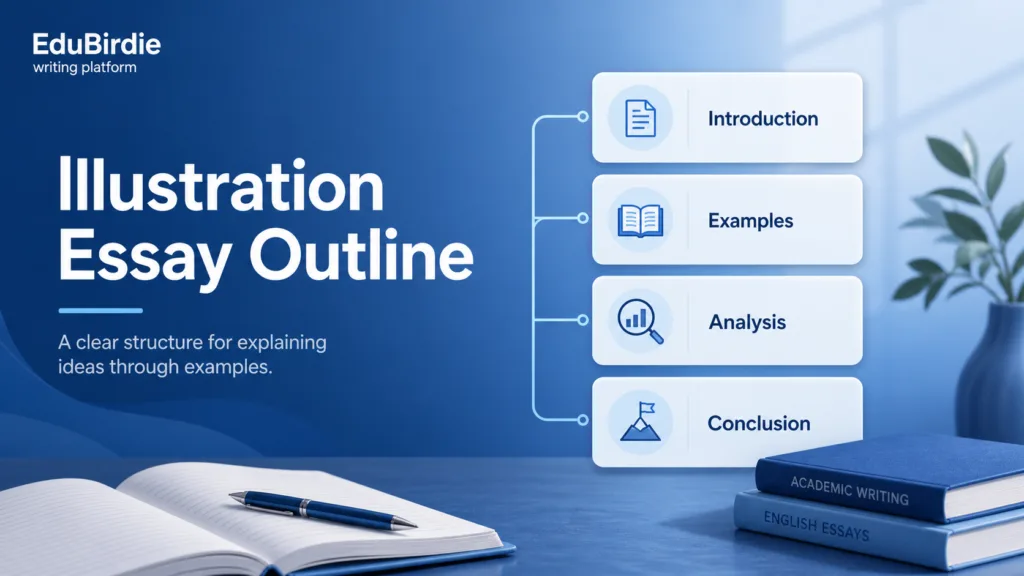
An illustration essay explains a general idea through detailed examples. Begin with a clear thesis, select examples that are specific and representative, and organize them in a logical order. After each example, explain how it supports the main point instead of letting the evidence speak for itself.
Learning how to write an illustrative essay is a practical exercise before tackling your future thesis or more complex research papers. An illustration essay, also known as an exemplification essay, demonstrates a particular idea or phenomenon through clear and relatable examples. In this article, you will learn how to write an illustration essay by understanding its definition, purpose, and the step-by-step process involved.
Many students consider it their first step toward the excitement of discovering new information and perspectives. Practicing and writing an illustration essay is an effective way to develop your writing skills, as it encourages you to use fresh, engaging ideas, find solid supportive arguments, and focus on thorough research.
Below, you’ll discover essential tips and guidelines designed to help you craft an excellent essay, achieve higher grades, or, if you need additional support, turn to EduBirdie with a write my research paper for me request.
Illustration Essay Definition
If you’re wondering what is an illustration essay, it is a type of informative writing designed to demonstrate that a particular idea or phenomenon exists and behaves in a specific way. An illustration essay, also commonly called an exemplification essay, summarizes empirical data and provides clear definitions through relevant, vivid examples. In academic settings, an illustration essay is sometimes referred to as an ‘illustration paper,’ which involves providing examples and evidence to support a particular topic or argument.
Unlike discovery-oriented essays, an illustration essay doesn’t introduce new ideas or groundbreaking findings. Instead, it uses practical examples drawn from real-life experiences to clarify complex or abstract issues, making them more understandable and relatable.
When writing an illustration essay, your main goal isn’t to explore sensations or make original discoveries. Your task is to illustrate your topic clearly by offering strong, supporting facts and scenarios. You should choose relatable examples – such as familiar situations, personal experiences, or specific events – that help your readers visualize and understand the issue clearly, effectively illustrating your main ideas.
Need more writing assistance?
Order your first paper and join EduBirdie to receive discounts and updates.
Try EduBirdie
Illustration Essay Writing: Step-by-Step
Step 1: Choose a topic. Think of something that really interests or bothers you. Clearly identify your main subject or a specific object related to your topic, then write about it. If you’re wondering what does illustration mean in writing, it’s basically using specific examples to support your point. We provided a list of illustration essay topics below to get you started.
Step 2: Conduct thorough research. Even if you’re familiar with your topic, take some time to read recent news or articles about it. Research is a big part of writing illustration essays because it helps you gather evidence, find new ideas, gather relevant examples and possibly change your perspective.
Step 3: Create a clear outline. Outline your main points and essential ideas first. Write down as many examples as possible, selecting the most relevant ones. When outlining, be sure to sequence evidence logically, using transitional phrases to show the order and strength of your clear supporting details. Your outline should ultimately include an introductory paragraph, several body paragraphs, and a solid conclusion.
Step 4: Develop your essay content. Turn your outline into an illustration essay. Formulate a clear and concise thesis statement in your intro and restate it briefly in your conclusion. Use detailed examples in each main paragraph to illustrate your thesis and support your arguments.
Step 5: Proofread your essay. Always run grammar and plagiarism check. While your ideas and examples are the core of your essay, poor grammar, spelling, punctuation or cohesion can ruin your writing process. Make sure each part flows logically.
Step 6: Do a final review. Read your essay one more time before submitting. Make sure your writing illustrates the main points and answers all the questions you’ve raised throughout the paper. Good illustrative writing means your essay grabs the reader’s immediate consideration and remains interesting.
How to Get Inspired for Your Illustration Essay
So how do you make your illustration essay really interesting? Start by finding strong inspiration and solid evidence. With so much information available today, choosing only three or four examples might even become challenging, especially when there are so many examples to consider.
⭐ Where to Find Ideas and Inspiration
The biggest source of ideas for your illustration essay is often the media. Check out trending hashtags on social media like TikTok, Instagram or Twitter and look at posts from popular influencers or thought leaders. Short-form content like reels and shorts can spark creativity and new ideas fast.
Inspiration comes from everyday life: a casual conversation, a trip to the supermarket or a story from a friend can easily become the basis of your essay. Pay attention to what’s around you, watch the news or follow topics that resonate with your audience. Even reading about how to write a creative essay or finding a quote in a book can give you new perspectives. And modern resources like AI writing assistants (like ChatGPT) can give you interesting angles on familiar topics.
⭐ How to Get the Right Evidence
Once you have your inspiration, it’s time to get the evidence. When deciding how much evidence to include, remember a typical three-paragraph illustration essay needs at least three clear examples.
But don’t limit yourself – it’s a good idea to list at least five to ten potential illustrations first. Having more options means you can choose sufficient evidence that’s strong and impactful. Make sure the evidence you get is relevant to both your subject and your audience so your essay is focused and persuasive. Even one example can make a big impact if chosen well.
⭐ Keep it Brief and Clear
The word count will usually be specified in your assignment. If not, a standard illustration essay should not be more than three pages (about 750 words). Don’t try to cram everything into your essay – focus on choosing the most illustrative and relevant evidence.
⭐ Why Use Specific Examples
Your examples should always be simple, vivid and relatable. Avoid ambiguous or symbolic examples that make your readers guess what you mean. Instead, examples that matter immediately to your readers immediately, that are memorable and impactful. Personal experiences or well-known situations work especially well, making your illustration essay relatable and engaging for your audience.
Basic Illustration Essay Structure
A clear understanding of the illustration essay structure will help you effectively organize your ideas. Identifying and organizing the main points is essential for creating a well-structured essay, as it ensures each paragraph remains focused and supports your overall argument. Like most essays, an illustration essay consists of three key parts: an introduction, body paragraphs, and a conclusion. The essay’s body paragraphs are crucial for supporting the thesis with evidence, helping to clearly present and develop your supporting points. Each part plays a distinct role in illustrative writing, and here are some important details to keep in mind:
Introduction
An interesting introduction presents your main idea or topic to your readers. Begin by briefly introducing the concept you will explore. Clearly state a strong thesis statement giving a concise summary of your main idea, forming the foundation of your entire essay. A strong introduction also hooks the reader’s attention. You can achieve this by starting with:
- An intriguing fact or surprising statistic;
- A memorable quote or anecdote;
- A relatable real-life scenario.
Body Paragraphs
The body paragraphs are the meat of your essay where you explain your thesis with detailed examples. Think of your introduction as the doorway – body paragraphs show what’s inside. Each body paragraph follows a structure:
- Topic sentence: Introduces the main supporting argument or example for this paragraph.
- Background sentence: Gives background information, sets the scene for your illustrative examples (up to 3 supporting sentences).
- Research sentence: Provides evidence by citing facts, statistics, quotes or summarised information.
- Analysis: Adequately explains how your examples support your thesis and topic sentence so the reader understands the connection.
- Conclusion or transition sentence: Provides a brief summary and smoothly connects to the next idea.
When structuring your body paragraphs consider presenting your points with increasingly stronger evidence, using transitional words and phrases to guide the reader and make your essay more persuasive.
Conclusion
Your conclusion restates your thesis and the main points discussed from your essay. Usually you don’t introduce new information. Your conclusion should reinforce your thesis by summarising the points you’ve already made. This short and sweet paragraph leaves the reader with your essay’s message and makes your illustration memorable and persuasive.
Read also: Good Exploratory Essay Topics for Choosing The Best One
Creating an Illustration Essay Outline
When you are working on your illustration essay outline, it’s important to remember that topics will define the structural nuances of your paper. A good illustration essay topic should be specific, relevant, and allow for clear examples that effectively support your main idea. These include the number of examples, logical flow, and how your arguments will be connected. However, if you’re struggling to make an outline or simply don’t know where to start, use the template below for guidance.
Paper Topic: How to Choose a College
Introduction:
Choosing a college has a significant impact on your future. The right choice can set you on a path toward career success. In your illustration essay, start by introducing the importance of making an informed decision when selecting an educational institution. A good illustration essay topic in this context would focus on a subject that allows you to provide clear, relatable examples.
Paragraph I: Focus on Your Academic Goals
This paragraph should explain how your college choice affects your academic ambitions.
- Example 1: Choosing the right college helps you create a shortlist of institutions that align with your academic interests.
- Example 2: It is the first step toward building a strong foundation for a successful career.
Note: In this paragraph, the examples support the main idea by illustrating how academic goals influence the college selection process.
Paragraph II: Seek Personal Recommendations
In this paragraph, you’ll discuss the value of personal insights and recommendations when choosing a college.
- Example 1: Older students who are already enrolled in college can share their experiences, both positive and negative.
- Example 2: Professors and students offer unique insights that online reviews or rankings may not provide.
Paragraph III: Attend a College Fair
In this section, you will explain why attending a college fair can offer invaluable firsthand experience.
- Example 1: Don’t rely too heavily on brochures and online rankings. There are many versions of “the truth.”
- Example 2: Attend fairs to feel the atmosphere of different colleges and get immersed in real experiences.
Conclusion:
Choosing a college may seem overwhelming, but you can minimize mistakes by focusing on key factors when narrowing down your options. By following a structured approach, such as creating a detailed illustration essay outline, you can make a confident, informed decision.
Illustration Essay Topics That Will Get You An A+
Choosing a suitable topic begins with a brief overview of your interests, ensuring you select the best illustrative essay idea. Select something familiar, personally engaging, or timely. Strong topics simplify the process of finding compelling, relatable examples. When selecting examples, ensure they relate to the same subject as your essay topic to effectively support your main idea. Consider these updated and relevant illustration essay ideas.
College
College topics help students illustrate relatable experiences, providing readers with insights into everyday campus life.
- Describe common challenges students face throughout college life.
- How to maintain friendships after graduation or when studying abroad.
- Illustrate a unique or special college tradition in your community.
- Effective ways for students to plan their budget when living on campus.
- Share your experiences and tips on adjusting to a new college environment.
Sports
Sports illustrative essay topics allow students to explore physical activity, teamwork, competition, and its impacts on mental and physical health.
- Step-by-step preparation for a major baseball game.
- How the FIFA World Cup and Lionel Messi boosted soccer’s popularity in the USA.
- Illustrate your first day as part of a new sports team or competing in your first game.
- What life is like for professional athletes who stay in reserve.
- A detailed guide on learning how to swim effectively.
Careers
Career-focused topics give students an opportunity to explore professional pathways and practical life skills.
- How to successfully land a job in New York and prepare for an interview.
- Describe a typical day in the life of a waitress, accountant, marketing manager, or janitor.
- Ideas on how to transform your hobby into a profitable career.
- How to determine the career that fits your personality and ambitions.
- Pros and cons of starting to work while still at school or college.
Communities
Community-focused topics for illustration essay provide an excellent opportunity to illustrate social issues, challenges, and how individuals interact within society.
- The impact of gadgets and screen time on today’s children.
- Provide examples to illustrate why climate change is a real and urgent problem, referencing recent or significant historical events.
- Illustrate how an individual’s environment influences their decision-making strategies.
- Explore how friendship contributes to personal growth, offering meaningful life lessons and well-being.
- Ideas and examples of effective community actions to support the homeless.
Academic Life
Topics related to academic life help students understand and illustrate common experiences, challenges, and strategies for success.
- How procrastination impacts academic performance among American students.
- Illustrate the importance of balancing studying, sports, and leisure activities.
- Why students should critically question what they learn in the classroom by illustrating lessons learned from prominent historical events.
- Practical ways to stay motivated throughout your college years.
- Describe effective teaching techniques and methods used by your professors.
Read also: 99+ Evaluation Paper Topics
Illustration Essay Examples
Below is a brief yet clear illustrated essay example designed to help you understand how a good example essay should look. Pay attention to how the specific examples effectively illustrate the main thesis, making the idea understandable and engaging to readers.
Example Essay Topic: How Social Media Affects Communication Skills of Teenagers
Introduction: Social media has undeniably transformed how teenagers communicate today. While it makes instant interaction possible, many argue that it negatively impacts the development of essential communication skills. To better understand this issue, let’s explore some interesting examples illustrating social media’s influence on teenagers’ interpersonal interactions.
Body Paragraph: Social media platforms like TikTok and Instagram heavily rely on short-form content, encouraging quick and superficial interactions. For instance, teenagers often prefer texting or posting emojis rather than engaging in face-to-face conversations. Here is a specific example: a teenager might choose to send a quick emoji instead of expressing their feelings in person, which can hinder the development of deeper communication skills. According to recent studies, approximately 60% of teenagers admit they feel anxiety during real-life conversations due to excessive online communication. This statistic clearly shows how virtual interactions shape their interpersonal skills negatively. Additionally, teenagers who spend most of their day online report difficulty expressing their emotions or maintaining eye contact in offline settings. One example is a student who struggles to maintain eye contact during presentations after spending hours communicating online. These detailed examples effectively illustrate the real impact social media has on the development of vital communication skills.
Why This Example is Good:
This brief illustrative example is effective because it clearly demonstrates the main idea through specific and relatable scenarios. It integrates factual evidence (statistics) and everyday examples (TikTok, Instagram) that the target audience – students – can easily connect with.
Additionally, it follows the recommended illustrative essay structure: presenting a clear thesis, providing relevant and precise examples, and connecting them back to the thesis. Adding a few more pieces of evidence, such as personal stories or analogies, could further strengthen the essay. Use this illustrated essay example support as a reference to create your own engaging and compelling essays.
Illustration Essay Checklist
Before submitting your essay, carefully review the checklist below. It covers all critical aspects of writing an illustration essay, ensuring your paper meets high academic standards.
| ✅ Checklist Item |
Description |
| 🔹 Clear Thesis Statement |
Ensure your thesis is clear, concise, appears in your introduction, and is supported by evidence and examples that reinforce his or her thesis. |
| 🔹 Relevant Examples |
Check if each example directly supports your thesis statement. |
| 🔹 Logical Essay Structure |
Confirm your essay includes an intro, coherent body paragraphs, and a clear conclusion. |
| 🔹 Clarity and Precision |
Make sure your illustrative examples are specific, vivid, and targeted at your audience. |
| 🔹 Absence of Personal Opinions |
Avoid personal judgments; focus on objective illustrations that support your strong thesis statement. |
| 🔹 Grammar and Readability |
Proofread your essay for grammar, punctuation, spelling, and overall readability. |
| 🔹 Overall Effectiveness |
Verify that your final draft illustrates your point effectively and engages your readers. |
Using this checklist ensures your illustrative essay is clear, engaging, well-structured, and academically sound.
Get Expert Help with Your Illustrative Essay
Now you have all the tools you need for successfully writing an illustration essay. Remember, crafting an effective illustration essay means choosing clear, vivid, and relatable illustrative examples. If you still feel stuck or pressed for time, EduBirdie’s professional writers are here to support you.
Our team puts significant effort into providing high-quality, custom-written illustration essays on any topic. Just fill out a simple order form, specify your requirements and deadlines, and let our experts handle the rest, ensuring your essay is clear, compelling, and perfectly structured.
Illustration Essay FAQ
What is the difference between an illustrative essay and a descriptive essay?
An illustration essay explains an idea with clear examples. A descriptive essay describes a person, place, event or experience to evoke senses and emotions without proving a point.
How many examples should I include in my illustration essay?
Typically 3-5 strong, well chosen examples. Each example should support your thesis and make your argument persuasive and interesting.
Can I use personal stories in an illustrative essay?
Yes, personal stories and experiences can be good examples if they relate to your thesis and help your reader understand your main point.