The length of an essay is an important component of any good college paper. Following a prompt’s instructions for word count shows your professor that you carefully read and successfully fulfilled the given requirements. It also shows that you put a lot of thought and effort into the writing process. You never want to be under the minimum word or page count for the final draft, so filling up your paper with great content is key.
If you’re struggling with how to make an essay longer, it’s easy to feel overwhelmed. To write a better, longer paper, explore these practical and effective tips to increase the size of your paper!
How to Make Your Essay Longer: Tips
Wondering how to make a paper longer without using obvious tricks like bigger font sizes or wider margins? While formatting changes might temporarily make your essay seem longer, experienced professors easily recognize these techniques. Instead, use our practical and reliable tips to make your essay longer with meaningful content, and you’ll meet the required word count quickly.

Tip 1: Use Multiple Examples.
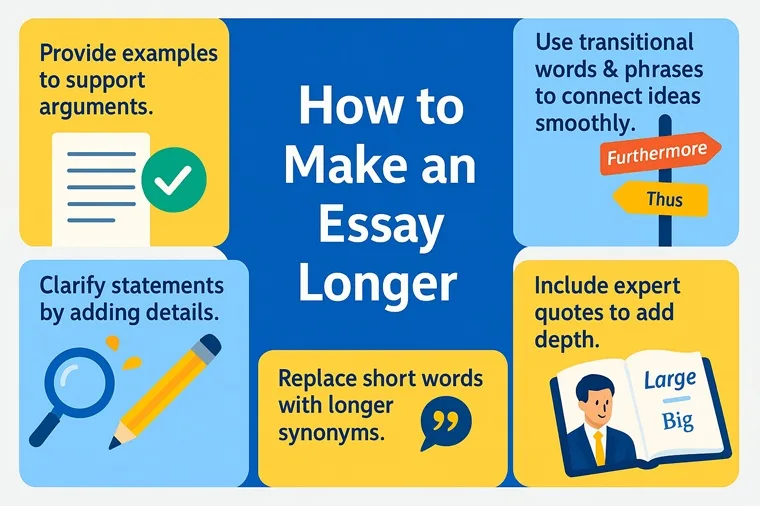
When you’re wondering how to lengthen an essay, you should first look at the claims you made. Go back through and find the ideas you put forward. Did you back those ideas up with examples? If you didn’t, try adding a bit of research that proves your claim is accurate. Not only will this strengthen arguments, but it will lengthen your paper.
For instance, if you claim that UFO sightings are real, you could include specific eyewitness reports or reference credible documentaries on the subject. Ideally, aim to provide more examples for each argument. This will demonstrate to your professor that your claims are well-supported, making your essay longer, stronger, and more convincing.
Tip 2: Use Phrases/Words to Transition Ideas.
A natural and effective way to increase your essay’s length is by incorporating transitional words and phrases. These helpful expressions guide your readers smoothly from one idea to the next, clearly signaling connections between different sections of your paper. Additionally, transitional words enhance your writing’s coherence, allowing readers to follow your arguments more effortlessly. As a result, your essay becomes longer and gains clarity and professionalism. It’s a win/win situation. Try using some of these transitional phrases in your paper:

Read also: Different Types of Sentences
Tip 3: Go Over Your Prompt. Again.
You’ve probably already read your prompt a million times by this point, but reread it if you have a problem with getting a long text. Think—have you answered all of the questions your professor posed? Did you back them up with convincing language? Take the time to make sure you have filled all the requirements. If you haven’t, you should make your document longer with the extra information.
Tip 4: Try Reverse Outlining.
Reverse outlining is exactly what it sounds like. After you’ve written your paper, try reading back through it and creating an outline based on what you’ve already written. This can help you reorganize your paragraphs so they make more sense to readers and highlight areas that need further development.
- ✅ If you see a point you made that you can clarify more, take the opportunity to make your writing longer.
- ✅ If you see large paragraphs introducing more than one idea, try breaking them up into multiple paragraphs and explaining ideas more thoroughly.
Tip 5: Use Personal Anecdotes or Experiences.
Another great tip to make your essay longer is to add personal anecdotes or experiences relevant to your topic. Personal stories naturally increase your essay’s word count and enhance reader engagement by adding authenticity and more depth to your writing. Example:
If your essay discusses the importance of reducing plastic waste, consider briefly sharing your experiences, such as participating in a local cleanup or switching to reusable products. Personal insights create a stronger connection with your readers and demonstrate genuine interest in your topic, resulting in a more compelling and longer essay.
Tip 6: Clarify Your Statements.
Students often overlook how easily they can make their essays longer by clarifying statements they’ve already made. Go back through your essay and check if your arguments are fully explained. If you find vague or brief statements, expand them by saying what you mean, why it matters, and more.
For example, instead of saying “Climate change affects ecosystems,” expand by telling how and why. By clarifying and deepening your explanations, you’ll naturally add length and improve your essay.
Tip 7: Use Synonyms for Shorter Words.
Try replacing short common words with slightly longer synonyms. By swapping out common words for more sophisticated vocabulary, you naturally lengthen your essay without adding unnecessary fluff or repetition. For example:
- Replace “many” with “numerous” or “a lot of.”
- Use “significant” instead of “important.”
- Substitute “show” with “demonstrate” or “illustrate.”
This makes your essay longer and improves its overall academic tone, impressing your professor with your language skills.
Tip 8: Add a Detailed Description.
Another way to reach the required length is to provide detailed explanations of technical terms, key events, or specific concepts you’ve mentioned. Instead of briefly mentioning something, include background information, context, or clear definitions to help the reader fully understand your point.
If you mention a historical event like the Industrial Revolution, briefly explain the time period, significance, key figures, or lasting impact.
Similarly, if you use technical terms or jargon, define and explain those terms. Providing greater details adds length to your paper naturally and helps your professor understand and appreciate your essay.
Tip 9: Use Expert Quotes.
Quotations take up more space and add depth to your writing. While your paper shouldn’t primarily consist of quotations from other authors (you should still have plenty of your own writing), it’s perfectly acceptable to incorporate quotes from experts to enrich your essay. This is a legitimate way to increase overall word count and prove that other writers share and support your viewpoints. Make sure you use formatting correctly to quote and cite sources!
Tip 10: Use Footnotes or Endnotes.
If there are additional points or information you want to include but don’t necessarily fit within the main body of your essay, consider using footnotes or endnotes. They let you add relevant comments, references, or explanations without breaking the flow of your main arguments, naturally extending your paper and enhancing its credibility.
Tip 11: Format Your Paragraphs.
Make sure each of the paragraphs has correct formatting. Each paragraph in the essay structure should have a topic sentence, supporting evidence and/or argument, and a conclusion or transition. If some of your paragraphs are missing parts of this formatting, create sentences that will fill these requirements.
Tip 12: Replace Abbreviations and Contractions.
An easy way to lengthen an essay is to replace abbreviations and contractions with their full forms. This naturally helps you reach the desired word count and gives your essay a more formal, academic style.
Here are a few common examples:
- can’t → cannot
- won’t → will not
- it’s → it is
- e.g. → for example
- i.e. → that is
- etc. → and so on
- vs. → versus
- ASAP → as soon as possible
Tip 13: Use More Words.
It’s similar to a silly suggestion: “Just use more phrases or words!” But hear us out and take a look at your work. There are subtle ways of adding words, such as carefully choosing several terms or phrases instead of just one.
- Include “to be” verbs. Avoid saying “I eat quickly.” Try writing, “I am a quick eater.”
- Be more descriptive. Don’t say: “We had fun at the fair.” Say: “My friend and I went to the fair this weekend. We had so much fun riding the Ferris wheel and eating funnel cakes.”
- Turn verbs into nouns. “I arrived at the conclusion that…” is longer than “I concluded…”
Conclusion
If you’ve gone through all of these steps and are still struggling with how to make your essay longer, have no fear! Visit EduBirdie, where professional online essay writers fix up your paper on time, and where you only pay to write essay. Whether you’re overwhelmed with busy work or struggling with an assignment, EduBirdie handles any type of essay you might have. Simply tell us do my assignment, chat with professionals, choose a writer, and make a deposit. Once you’ve received great results, you can release the funds to your professional writer and turn in a great paper. It’s super simple, and your writer will always meet your professor’s requirements — even that pesky word count.