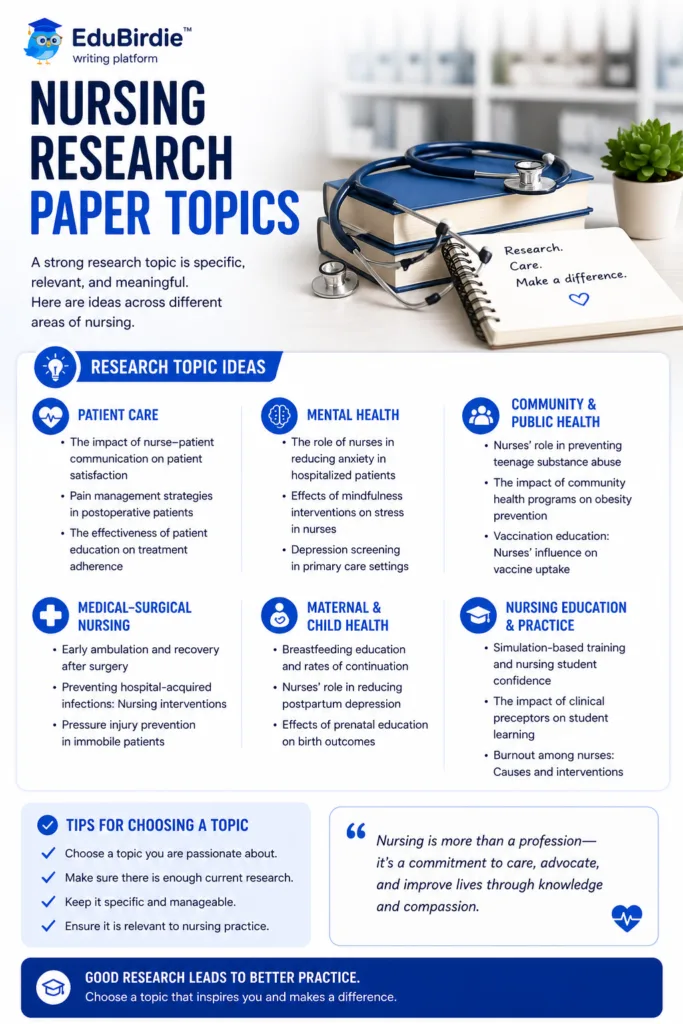
EduBirdie lists 420+ nursing research topics for 2026 across 21 specialties, from pediatric care to evidence-based practice.
A strong nursing research topic names a patient group, a nursing intervention, and an outcome you can measure. Each specialty below includes 20 topics, so you can start from your clinical interest and narrow from there.
Topics below cover trending areas like AI in clinical care, post-pandemic mental wellness, and telehealth, alongside long-standing specialties such as pediatric and palliative care.
What is a nursing research paper?
A nursing research paper is an academic paper that investigates a real-world healthcare problem, nursing technique, or way to improve patient care. Writing one means gathering evidence, analyzing what it means, and presenting your conclusions clearly.
Whether your focus is pediatric care, mental health, telemedicine, or advanced nursing practice, the goal is the same: evidence that can shape nursing policy and improve real patient outcomes.
How do you choose a nursing research topic?
Run your nursing research topic through these five checks before you commit:
- Stay relevant: Choose a topic aligned with current healthcare priorities or trends like telemedicine, mental wellness, or patient safety.
- Be specific: Avoid overly broad topics. Instead of something general, narrow it down — for example, from “Patient Care” to “Improving Patient Communication in Critical Care Units” within your research paper introduction.
- Ensure researchability: Search PubMed or CINAHL for your topic before you commit. If you find only a few recent studies, narrow the topic or pick another one.
- Be realistic: Pick topics that fit within your resources and time constraints.
- Follow your passion: Your interest in the topic fuels deeper insights and better research.
What makes a good nursing research topic?
A good nursing research topic is relevant, specific, backed by enough sources, and likely to improve patient care. The table shows each quality with a weak and a stronger example:
| Characteristic |
Explanation |
Example |
| Relevance to current issues |
Addresses real-world healthcare challenges, making your research practically useful and timely. |
Poor: General Nursing Practices. Better: Improving Pain Control in Postoperative Patients. |
| Specificity |
Clearly defined and focused enough to manage effectively within your research. |
Poor: Mental Wellness in Nursing. Better: The Role of Nurses in Managing Anxiety Disorders in Adolescents. |
| Availability of resources |
Supported by sufficient academic and clinical resources, so your claims can be well-backed. |
Poor: Nursing Care on Long-Duration Space Missions. Better: Nurse-Led Fall Prevention in Long-Term Care Facilities. |
| Potential impact |
Can genuinely improve clinical nursing, influence healthcare policies, or enhance patient results. |
Poor: The History of Nursing Uniforms. Better: Effect of Hourly Rounding on Patient Falls in Medical-Surgical Units. |
Top nursing research topics for 2026
The top 10 nursing research topics for 2026 focus on AI, telehealth, long COVID, burnout, and health equity:
- The role of AI in predicting clinical results in intensive care units
- How telemedicine is transforming community-based nursing
- Nursing approaches to managing long COVID symptoms
- The impact of TikTok and social media on patient education and health promotion
- Nursing leadership strategies to combat burnout post-pandemic
- Ethical challenges of using EHR in nursing
- Pediatric patient outcomes using telehealth services
- Nursing interventions using virtual reality for managing pain
- Cultural competence in clinical care for LGBTQ+ communities
- Trauma-informed nursing care in a post-COVID world
Nursing research topics by specialty
EduBirdie’s writers compiled this list of nursing research topics, organized into 21 specialty categories, to make your search easier.
Child nursing research topics
Child nursing research covers patients from infancy to adolescence, with topics on ADHD, seizures in infants, antibiotic resistance, and vaccine safety. Many of the 20 topics also involve parents, since family-centered care is standard in child nursing.
- ADHD causes and effective nursing interventions
- Vaccination safety: debunking autism myths
- Antibiotic resistance in preschool-aged children
- Impact of social media on eating disorders in teens
- Identifying and managing seizures in infants
- Best nursing practices in adolescent medicine
- Child obesity and effective dietary interventions
- Ethical challenges in pediatric nursing care
- Nursing strategies for speech disorders in children
- Psychological support techniques in infant nursing
- Evidence-based pediatric nursing: challenges and solutions
- Effective pain control in neonatal intensive care units
- Nursing strategies for managing pediatric asthma
- How screen time affects early childhood development
- Pediatric sleep disorders: effective nursing methods
- Childhood obesity: nursing strategies for prevention
- Managing type 1 diabetes in school-aged children
- Pediatric comfort care: nursing approaches
- Improving vaccination compliance in pediatric nursing
- Early detection of autism: nursing intervention strategies
Adult nursing research topics
Adult nursing research focuses on conditions common in adult patients, such as acute coronary syndrome, migraine, anxiety, and bipolar disorder. Most topics compare nursing strategies or test a non-drug intervention.
- Effective nursing strategies for acute coronary syndrome
- Understanding the root causes of anxiety disorders in adults
- Non-pharmacological nursing strategies for bipolar disorder
- Innovative nursing practices in clinical cardiology
- Advancements in cardiovascular imaging techniques
- Nursing approaches to migraine management in adults
- Psychiatric nursing strategies for adult psychiatric care
- Effective nursing interventions for obesity management in adults
- Exercise and sports medicine: implications for adult nursing
- Dental and oral healthcare challenges among U.S. adults
- Persistent pain treatment strategies in elderly adult patients
- Effective nursing strategies for stroke rehabilitation
- Mental wellness interventions in adult nursing methods
- Cardiac rehabilitation strategies in adult nursing assistance
- Nursing approaches to managing adult-onset diabetes mellitus
- Nursing care strategies for adult cancer patients
- Management approaches for adult asthma
- Advanced wound care techniques in adult nursing services
- Substance abuse treatment strategies in adult nursing
- Nursing interventions for managing adult obesity
Midwifery nursing research topics
Midwifery research follows mothers and newborns from the first antenatal visit to the postnatal period. Topics include rural maternal care, postnatal mental health, continuous midwifery care, and the effect of shift length on midwives.
- Improving maternal and neonatal care practices in rural communities
- Analyzing the effectiveness of the first antenatal visits for mothers
- Addressing mental illness during the postnatal period: nursing insights
- Exploring the impact of shift lengths on midwife performance
- Evaluating self-instruction kits for improved birth safety outcomes
- Benefits of continuous midwifery care throughout pregnancy
- Managing gestational weight gain: challenges and nursing solutions
- Analyzing factors influencing childbirth efficacy and safety
- Factors contributing to positive birth experiences: nursing perspectives
- Safety strategies for obese pregnant women in midwifery care
- Midwives’ role in promoting successful breastfeeding practices
- How prenatal yoga influences maternal and neonatal health outcomes
- Comparing outcomes and satisfaction: home births vs. hospital births
- Best practices in midwifery care for high-risk pregnancies
- Assessing water births as a pain relief method in midwifery
- Early detection and nursing strategies for postpartum depression
- Improving cultural competence among midwifery nursing staff
- Midwives’ impact on family planning education and contraception use
- Effective nursing approaches to managing gestational diabetes
- Reducing cesarean section rates through midwife-led care models
Elderly care nursing research topics
Elderly care nursing research looks at conditions that limit independence in older adults, including Alzheimer’s disease, atrial fibrillation, and joint disorders. Topics also cover cardiovascular risk reduction and critical care needs in seniors.
- Effective nursing interventions for older patients with joint disorders
- Early nursing strategies for managing Alzheimer’s disease progression
- Improving atrial fibrillation outcomes among elderly patients
- Innovative nursing approaches to bladder cancer therapy in the elderly
- Nursing methods for cardiovascular risk reduction in seniors
- Identifying critical care needs in elderly populations
- Ethical challenges faced by nurses in geriatric care settings
- Impact of evidence-based practice on geriatric nursing outcomes
- Nursing management strategies for stroke and cerebrovascular diseases
- Restless legs syndrome: effective nursing management in senior patients
- Nursing precautions and interventions for Parkinson’s disease patients
- Preventing falls in elderly patients: nursing strategies and solutions
- Dementia care best practices for nurses in long-term care facilities
- Addressing nutritional needs in geriatric patients: nursing approaches
- Hospice care nursing strategies for elderly patients
- Chronic arthritis pain reduction in elderly care: nursing methods
- Nursing roles in managing mental state issues among elderly patients
- Skin care and pressure ulcer prevention: nursing strategies for seniors
- Evaluating memory care program effectiveness in dementia nursing
- Medication management and education techniques for elderly persons
Women’s health nursing research topics
Women’s health nursing covers care across reproductive, hormonal, and cancer-related conditions, with a strong emphasis on prevention and patient education. Topics range from breast cancer support and infertility ethics to menopause and pregnancy prevention.
- Breast cancer treatment and patient support strategies
- Ethical considerations in infertility patient support
- Nursing techniques for managing menopause challenges
- Modern neonatal care practices: implications for nurses
- Effective nursing strategies for ovarian disorder management
- Nurse education and approaches for pregnancy prevention
- Reproductive endocrinology: nursing implications and practices
- Managing sleep disorders in women: nursing strategies
- Addressing sexual health disorders
- Causes and nursing management of vaginal atrophy
- Nursing approaches for effective menstrual disorder management
- Role of nurses in breast cancer screening and patient education
- Hormonal changes and women’s mental health
- Nursing care strategies for women with polycystic ovary syndrome
- Strategies and nursing support for managing menopausal symptoms
- Evaluating the effectiveness of HPV vaccination: nursing perspectives
- Prenatal patient support strategies for high-risk pregnancies
- Effective nursing interventions for postpartum depression
- Breastfeeding challenges: nursing support and interventions
- Women’s cardiovascular health: nursing strategies for prevention
Mental health nursing research topics
Mental health nursing research deals with psychiatric conditions such as depression, schizophrenia, bipolar disorder, PTSD, and addiction. Topics also cover medication compliance, suicide intervention, and trauma-sensitive care in psychiatric settings.
- Medication compliance among psychiatric patients
- Trauma-sensitive care practices in psychiatric settings
- Identifying primary causes of depression in psychiatric practice
- Effective nursing strategies for alcohol addiction disorders
- Diagnostic approaches to schizophrenia: mental health nursing practices
- Nursing services methods for managing bipolar disorder patients
- Managing PTSD in U.S. Army veterans
- Stress management among police officers: behavioral health nursing approaches
- Teenage aggression and video games: implications for nursing services
- Preventing the use of forbidden substances: role of psychiatric nurses
- Ethical considerations in psychiatric patient treatment
- Nursing services for physical trauma recovery in mental health patients
- Nursing interventions for managing severe depression
- Role of nurses in treating anxiety disorders among psychiatric patients
- Strategies for supporting patients with bipolar disorder
- Effective clinical care strategies for schizophrenia patients
- Mental health nursing interventions for PTSD in military veterans
- Early intervention strategies for adolescent mental health disorders
- Social media’s impact on teenage mental well-being disorders
- Nursing approaches for substance abuse recovery in psychiatric patients
Chronic disease management nursing topics
Chronic disease management research studies how nurses help patients control long-term conditions like diabetes and cardiovascular disease. Typical angles are patient education, medication compliance, and remote monitoring with e-health records.
- Nursing strategies for managing long-term pain in older patients
- Effectiveness of nurse education in chronic disease management
- E-health records used in long-term illness monitoring
- Improving medication compliance among chronic disease patients
- Nurse-led interventions to manage chronic cardiovascular diseases
- Managing diabetes complications: chronic nursing services strategies
- Clinical care approaches for chronic respiratory diseases
- Patient education’s impact on chronic disease management outcomes
- Telehealth effectiveness in long-term illness nursing services
- Nursing strategies to reduce hospital readmissions in chronic care
- Improving quality of life through chronic arthritis nursing care
- Evidence-based clinical care for chronic kidney disease management
- Nursing strategies to improve outcomes in long-term illness patients
- Cultural competence in nursing services for chronic illness management
- Community-based nursing programs for ongoing condition prevention
- Nursing care strategies for managing chronic neurological disorders
- Role of nurses in chronic disease management in primary care
- The effectiveness of nurse-led diabetes education programs
- Improving patient experience through chronic illness clinical care
- Integrative nursing approaches for managing chronic diseases
Community health nursing research topics
Community health nursing research moves care outside the hospital, into schools, neighborhoods, and local health programs. Topics include vaccination rates, nurse-led community programs, cultural competence, and closing healthcare gaps.
- Evaluating nurse-led community health programs and patient health improvements
- Community nursing strategies for improving vaccination rates
- Reducing healthcare gaps through community nursing initiatives
- Impact of cultural competence training on community health nurses
- Community nursing strategies to improve local health nursing outcomes
- Role of nurses in school-based community health promotion programs
- Managing mental health disorders through community nursing approaches
- Community healthcare nursing strategies for preventing long-term illness
- Effectiveness of community-based diabetes education by nurses
- Community nursing approaches to adolescent sexual health education
- Telemedicine’s impact on rural community health nursing care
- Community-based nursing strategies for substance abuse prevention
- Improving patient happiness through neighborhood nursing services
- Assessing health promotion initiatives: community nursing perspective
- Community nursing interventions for elderly health management
- Addressing mental health stigma through community nursing efforts
- Nurse-led asthma management programs in community settings
- Community nursing role in promoting healthy lifestyles among youth
- Community health nurses’ impact on healthcare financing disparities
- Integrative community nursing strategies for managing continuous pain
Pain management nursing research topics
Pain management research compares ways to assess and relieve pain, from opioid use to therapeutic injections and botulinum toxin. Several topics focus on specific groups, such as children with abdominal pain or patients with rheumatoid arthritis.
- Nursing approaches to abdominal pain management in children
- Evaluating headache treatment protocols in nursing practice
- Managing opioid use in patients with rheumatoid arthritis
- Innovative nursing applications of therapeutic injections
- Botulinum toxin use in pain management: nursing considerations
- Pros and cons of therapeutic injections: nursing perspective
- Nursing rehabilitation strategies for myofascial pain syndrome
- Role of opioids in bone healing: nursing implications
- Analyzing pain tolerance limits: implications for nursing methods
- Nursing management strategies for phantom limb pain
- Effectiveness of non-pharmacological pain relief in postoperative care
- Chronic neuropathic pain: nursing strategies and interventions
- Impact of patient teaching on pain management outcomes
- Evaluating opioid prescribing practices: nursing perspectives
- Pain assessment strategies for non-verbal patients in nursing
- Integrative nursing approaches to effective pain management
- Pediatric pain management: effective nursing interventions
- Nursing services strategies for pain management in terminal illness
- Virtual reality in pain relief: evaluating nursing effectiveness
- Arthritis pain management: effective nursing approaches
Palliative care nursing topics
Palliative care nursing research focuses on comfort and decision-making at the end of life. Topics cover pain control, ethical dilemmas, cultural competence, and integrative medicine in palliative settings.
- Nursing interventions to improve end-of-life care quality
- Effective pain care strategies in palliative nursing
- Role of medication compliance in palliative nursing services
- Cultural competence training for palliative care nurses
- Ethical considerations in end-of-life nursing decision-making
- Integrative medicine approaches in palliative care nursing
- Nursing strategies to manage anxiety in terminally ill patients
- Evaluating nurse-led palliative home-care programs
- Impact of patient training on palliative care outcomes
- Improving caregiver support through palliative nursing strategies
- Managing chronic pain in advanced cancer patients: nursing methods
- Addressing healthcare inequities in palliative nursing
- Trauma-informed nursing assistance practices in palliative settings
- Family-centered nursing care in hospice settings
- Nursing roles in advance care planning for palliative patients
- Assessing patient satisfaction in palliative nursing care
- Palliative nursing care strategies for elderly dementia patients
- Improving patient-nurse communication in end-of-life scenarios
- Nurse education programs focused on palliative care skills
- Evaluating telehealth effectiveness in palliative nursing assistance
Pediatric nursing research topics
Pediatric nursing research is set in hospitals and clinics, including the NICU, and covers conditions like asthma and treatments like play therapy. Nurse-led vaccination programs and cultural competence training for pediatric nurses are also included.
- Nursing interventions for pediatric patient outcomes improvement
- Play therapy effectiveness in pediatric nursing practice
- Nursing assistance strategies in the NICU
- Pediatric asthma management: nursing strategies
- Impact of nurse-led pediatric vaccination programs
- Cultural competence training for pediatric nurses
- Pediatric nursing approaches to manage chronic illnesses
- Evaluating telehealth in pediatric patient care outcomes
- Nursing management of pediatric pain in hospitalized children
- Reducing healthcare inequalities in pediatric nursing care
- Nursing strategies to improve pediatric medication consistency
- Improving pediatric nursing care through e-health records
- Pediatric nursing roles in childhood obesity prevention
- Trauma-informed nursing assistance in pediatric emergency settings
- Mental health nursing strategies for adolescent patients
- Nursing care for pediatric clients with developmental disorders
- Addressing sleep disorders through pediatric nursing techniques
- Pediatric nursing strategies for seizure management in children
- Effectiveness of patient learning in pediatric chronic illness care
- Family-centered nursing approaches in pediatric care units
Nursing education research topics
Nursing education research studies how nurses are trained, from simulation-based learning to curriculum design. Topics also look at teaching evidence-based practice and building cultural awareness into nursing programs.
- The effectiveness of simulation-based nursing education
- Cultural awareness integration in nursing education programs
- Innovative strategies to teach evidence-based nursing practices
- Impact of nursing curricula on care quality
- Improving medication consistency through targeted nursing education
- Nurse-led education programs in chronic illness care
- Addressing disparities in medical care in nursing curricula
- Role of online education platforms in nursing skill development
- Nursing education methods for mental health disorder management
- Teaching trauma-aware care principles in nursing education
- Assessment methods for evaluating nursing student competencies
- Strategies to enhance nursing student retention rates
- Nursing education curricula for pediatric patient care
- Technology integration in nursing education and training
- Patient protection training methods in undergraduate nursing education
- Nursing education approaches to improve patient satisfaction
- Leadership skills development in graduate nursing education
- Innovative nursing education programs in end-of-life care
- Teaching strategies for improving the quality of nursing interventions
- Impact of interdisciplinary education in nursing programs
Critical and intensive care nursing topics
Critical and intensive care nursing research deals with life-threatening conditions and the protocols used in the ICU. Topics include nurse-led protocols, electronic health records, and medication management for critically ill patients.
- Nursing methods in ICU: best practices
- Effectiveness of nurse-led protocols in critical care settings
- Role of electronic health records in intensive care nursing
- Managing medication conformity in critically ill patients
- Cultural sensitivity training in critical care nursing teams
- Critical care nursing strategies for improving treatment effectiveness
- Pain handling nursing approaches in critical care units
- Evaluating trauma-based care practices in ICU settings
- Telemedicine applications in critical care nursing practice
- Improving patient safety through nurse-to-patient ratio management
- Critical care clinical interventions for respiratory distress
- Managing chronic diseases in intensive care nursing environments
- Reducing healthcare disparities in critical care nursing
- Advanced cardiac life support training for ICU nurses
- Patient satisfaction improvement strategies in intensive care nursing
- Nursing strategies for managing delirium in critically ill patients
- Family involvement in critical care nursing interventions
- Impact of nutritional support on critical care nursing outcomes
- Patient teaching roles in intensive care nursing practice
- Evaluating sedation practices and nursing treatment in the ICU
Primary healthcare nursing topics
Primary healthcare nursing research covers the first point of contact between patients and the health system. Topics include evidence-based recommendations, vaccination in rural areas, economic evaluation, and data ethics.
- Implementing evidence-based recommendations in primary healthcare
- Ethical considerations for data collection in primary healthcare
- Economic evaluation methods in primary healthcare nursing
- Improving vaccination programs in rural and remote nursing care
- Role of private sector nursing in mental health service delivery
- Integrating childcare services into primary healthcare nursing
- Nursing interventions for medically unexplained symptoms in the ER
- Collaboration between local pharmacists and primary care nurses
- Assessing medical care quality: primary nursing strategies
- Identifying bias in healthcare financing: primary nursing perspective
- Role of nurses in chronic condition control in primary care
- Nurse-led clinics: impact on primary healthcare outcomes
- Improving vaccination compliance through primary nursing care
- Early detection of cardiovascular diseases: primary nursing strategies
- Evaluating telehealth effectiveness in primary healthcare nursing
- Mental health screening and referrals in primary nursing treatment
- Managing asthma effectively in primary healthcare settings
- Obesity prevention strategies: role of primary care nurses
- Enhancing patient education strategies in primary healthcare nursing
- Impact of cultural proficiency training in primary care nursing
Obstetrics nursing research topics
Obstetrics nursing research centers on pregnancy, labor, and delivery, including preterm labor, hypertensive disorders, and cesarean preparation. Some topics also address ethical questions in abortion care.
- Ethical considerations in abortion care: obstetric nursing perspective
- Effective nursing management practices for labor and delivery
- Importance of adolescent gynecology education: nursing approaches
- Identifying and managing the dangers of preterm labor in nursing treatment
- Nursing care approaches for hypertensive disorders in pregnancy
- Nursing strategies for effective cesarean section preparation
- Best nursing practices in newborn resuscitation procedures
- Challenges in obstetric nursing: ensuring maternal and child safety
- Nursing interventions to improve the delivery room behavior and safety
- Nursing recommendations for effective antenatal care practices
- Impact of prenatal nursing care on maternal and neonatal outcomes
- Nursing management strategies for high-risk pregnancy cases
- Role of nurses in promoting and supporting natural childbirth
- Reducing cesarean section rates: effective nursing strategies
- Postpartum nursing treatment strategies for maternal mental health
- Effectiveness of birth preparation classes: nursing perspectives
- Preterm labor prevention: effective care strategies
- Role of obstetric nurses in effective neonatal resuscitation
- Managing gestational diabetes effectively in obstetric nursing
- Maternal nutrition’s impact on fetal development: nursing insights
Nursing careers research topics
Nursing careers research examines roles, responsibilities, and professional growth in nursing. Topics include nurse practitioner roles, influential nursing theorists, and balancing career goals with patient care.
- Influential nursing theorists and their impact on practice
- Ethical considerations in nursing treatment for homeless populations
- Best practices in critical care nursing management
- Balancing career goals with professional nursing service
- Expanding the roles and responsibilities of nursing practitioners
- Defining clinical nurse roles in modern healthcare settings
- Promoting diversity and inclusion in nursing careers
- Effective stress management for nurses on night shifts
- The digital age: transforming nursing careers and education
- Challenges faced by nurses in remote care units
- Advanced nurse education: impact on career opportunities
- Challenges and opportunities for nurses in rural healthcare
- Cultural literacy and its importance in nursing careers
- Developing leadership skills in nursing management roles
- Impact of nurse staffing levels on patient outcomes
- Career satisfaction among various nursing specialties
- Technology’s role in nursing practice and career development
- Opportunities and challenges in international nursing careers
- Role of nurses in shaping healthcare policy development
- Future trends in nursing education and career paths
Health promotion nursing topics
Health promotion research looks at how nurses prevent illness before it starts, often through education in schools and communities. Topics include school nursing, healthy eating for youth, safe-sex education, and telemedicine.
- Assessing telemedicine: benefits and limitations in nursing
- Role of school nurses in promoting student health
- Healthy eating and sports: nursing strategies for youth
- Parental roles in promoting children’s healthy lifestyles
- Pharmacist-nurse collaboration for effective health promotion
- Nursing roles in adolescent safe-sex education
- Collaboration between social workers and nursing health promotion
- Ethical issues in medical sales and promotional practices
- Nursing strategies in disease control and prevention initiatives
- Risks of digital healthcare technologies: nursing perspectives
- Evaluating community-based health promotion program effectiveness
- Nursing interventions promoting healthy lifestyle choices
- Nurses’ roles in tobacco cessation programs
- Impact of nursing-led health education on chronic illness prevention
- School-based nursing measures for child health promotion
- Effectiveness of workplace wellness programs: nursing insights
- Digital media strategies for health promotion: nursing roles
- Enhancing cultural competency in health promotion nursing
- Evaluating public health campaigns: nursing approaches
- Nursing strategies for promoting health among aging populations
Healthcare management nursing topics
Healthcare management topics deal with the administrative and legal side of nursing, such as contracts, Medicare benefits, and staffing. Gender bias and the shortage of men in nursing are also covered.
- Identifying limitations in healthcare contracts: nursing implications
- Gender bias in nursing: management and solutions
- Nursing considerations for starting private medical practices
- Understanding Medicare benefits: implications for nursing management
- Legal risks for nursing treatment of non-English speaking patients
- Addressing the shortage of men in the nursing profession
- Managing medical marijuana use: nursing management policies
- Apology laws and medical decisions: nursing management perspectives
- Boosting patient outcomes with medical home nursing models
- Evaluating nursing uniform policies in healthcare management
- Nursing management strategies for enhancing patient safety
- Impact of health information technology on nursing management
- Cost-effectiveness analysis of healthcare models: nursing views
- Leadership styles in nursing management and staff morale
- Nursing management’s role in promoting ethical healthcare practices
- Quality improvement strategies in hospital nursing management
- Healthcare policy impacts on patient access: nursing management views
- Effective risk management strategies in nursing administration
- Interdisciplinary teams: nursing management effectiveness
- Current trends in global healthcare management: nursing perspectives
EBP nursing topics
Evidence-based practice (EBP) is an approach that combines clinical expertise, patient values, and the best research evidence to guide nursing care. Topics apply EBP to chronic pain, suicide prevention, cervical cancer screening, and trauma-informed care.
- EBP nursing strategies for managing chronic pain
- Increasing patient outcomes through evidence-based medication adherence
- Evidence-based nursing strategies for the prevention of suicide
- Integrating EBP in cervical cancer detection programs
- Role of evidence-based nursing in trauma-informed care
- Effective use of electronic health records in EBP nursing
- Evidence-based approaches to pediatric pain therapy
- Improving dental health through EBP nursing methods
- EBP nursing strategies to address health disparities
- Evidence-based end-of-life care practices in nursing
- Evaluating cultural empathy using evidence-based nursing
- EBP nursing interventions for primary care settings
- Evidence-based nursing ethics in patient decision-making
- EBP approaches to complementary health approaches
- Evaluating patient satisfaction through evidence-based clinical care
- Clinical leadership roles in promoting evidence-based practice
- Evidence-based nursing strategies for long-term disease care
- Implementing EBP nursing strategies in intensive care units
- Community health nursing programs guided by evidence-based practices
- Teaching EBP effectively in nurse education programs
Quantitative nursing research topics
Quantitative nursing research measures outcomes with numbers, using surveys, experiments, and statistical analysis. Examples include nurse-to-patient ratios and patient safety, medication adherence, and telehealth effectiveness.
- Effectiveness of nurse-led cervical cancer screening initiatives
- Impact of nurse-to-patient ratios on patient safety outcomes
- Quantitative assessment of medication adherence in chronic care
- Evaluating telehealth effectiveness in primary care settings
- Statistical analysis of oral health programs in aging patients
- Quantitative study on health disparities in rural clinical care
- Measuring the effectiveness of suicide prevention nursing programs
- Quantifying nursing leadership impact on hospital performance
- Research process evaluation in nursing education outcomes
- Nursing ethics training: measurable impacts on patient support quality
- Data-driven evaluation of trauma-informed care interventions
- Quantitative assessment of end-of-life care nursing strategies
- Statistical evaluation of complementary and alternative medicine use
- Analyzing the effectiveness of nurse-led chronic illness interventions
- Measuring patient contentment in intensive care nursing units
- Quantitative assessment of pediatric nursing pain control
- Statistical review of nursing interventions in mental health care
- Nursing inquiry covers the quantitative evaluation of vaccination rates
- Evaluating cultural adaptability training through quantitative analysis
- Measuring patient outcomes in nursing-led obesity prevention programs
Qualitative nursing research topics
Qualitative nursing research explores experiences and perceptions through interviews, observations, or focus groups. Typical topics look at patient views on end-of-life care, nurse attitudes to alternative medicine, and leadership styles.
- Patient perspectives on end-of-life care nursing practices
- Exploring nurse perceptions of complementary and alternative medicine
- Qualitative assessment of ethical challenges in nursing practice
- Patient experiences with suicide prevention programs in nursing care
- Cultural awareness in nursing: qualitative case studies
- Understanding nursing leadership styles through qualitative methods
- Qualitative evaluation of patient-nurse communication effectiveness
- Experiences of chronic illness patients in primary care settings
- Qualitative research process in nursing education strategies
- Patient experiences in nurse-led cervical cancer screening programs
- Analyzing qualitative data on healthcare disparities in nursing
- Nurses’ perspectives on medication adherence barriers
- Qualitative insights into oral health nursing education programs
- Patient experiences with trauma-informed nursing interventions
- Nurse experiences managing pediatric pain: qualitative insights
- Qualitative evaluation of patient contentment in mental health nursing
- Understanding nurses’ roles in managing chronic pain qualitatively
- Exploring patient perceptions of nurse-led telehealth initiatives
- Qualitative assessment of nursing approaches in community care
- Patient experiences with integrative medicine in nursing practice
Nursing research question examples
A strong nursing research question names the patient population, the nursing intervention, and the outcome you will measure, a structure often called PICO. Here are five examples:
- How do evidence-based nursing measures affect medication adherence in elderly patients with chronic illnesses?
- What is the impact of telemedicine on patient approval and outcomes in public health nursing?
- In what ways do trauma-informed care practices influence recovery rates of young patients following surgery?
- How effective are nurse-led cervical cancer screening programs in reducing healthcare disparities in rural communities?
- What role does cultural literacy training for nurses play in optimizing patient outcomes in intensive care units?
How to turn a nursing topic into a strong research paper
Once you pick a nursing research topic, narrow it to one patient group, find several recent peer-reviewed studies, and turn the topic into a PICO question. That question then shapes your methods, your sources, and your conclusion.
FAQs about nursing research topics
How can I narrow down my nursing research topic?
Start broadly, then identify a specific patient group, condition, or nursing practice. Narrow further by checking relevance, feasibility, and the available resources, so your final topic stays both focused and researchable.
Where can I find credible sources for my nursing research paper?
Credible sources include peer-reviewed journals, nursing databases like PubMed and CINAHL, official healthcare organization websites, and trusted nursing textbooks. Avoid general web results and outdated studies, since nursing practice guidelines change quickly.
How do I formulate a good nursing research question?
Define your patient population, nursing intervention, and expected outcome in one sentence. A strong question is specific, relevant, and researchable within the scope and timeline of your project.
What's the difference between a quantitative and a qualitative nursing research topic?
A quantitative topic measures data through surveys, experiments, or statistics, such as nurse-to-patient ratios and patient safety outcomes. A qualitative topic explores experiences and perceptions through interviews or focus groups, such as patient views on end-of-life care. If you’re unsure which approach your assignment expects, check the prompt.
Can EduBirdie help me write a nursing research paper?
Yes, EduBirdie’s nursing paper writers can help you choose a topic, structure your paper, and edit the final draft. You work directly with a writer matched to your nursing specialty and assignment requirements. You’re still responsible for submitting and defending the finished work as your own, consistent with your program’s academic integrity policy.