A persuasive essay is more than just a writing task — it’s a way to express your opinion, convince others, and support your ideas with logic. For students, learning how to write a persuasive essay is a vital skill, taught in subjects like English, political science, and social studies.
At the same time, persuasive writing helps students develop critical thinking and structured argumentation skills. Outside the classroom, it appears in everyday forms like advertising, political speeches, and opinion pieces. Whether you want to change someone’s mind or present a strong case, mastering persuasive writing can lead to success in both academic and real life.
What Is a Persuasive Essay?
A persuasive essay is a type of academic writing that convinces the reader to accept a particular point of view or take a specific action. The writer uses logic, evidence, and emotional appeal to reinforce their point and influence the audience.
Persuasive writing assignments are common in schools and universities, where they help students develop critical thinking and argumentation skills. The persuasive essay meaning is in its purpose — to present a strong opinion supported by logic and evidence to influence the reader. Outside the classroom, persuasive writing appears in editorials, business proposals, political speeches, and legal documents.
When the topic is complex or the argument hard to discuss clearly, some students turn to services that let them pay for assignments to learn from structured, professional writing.
How long should a persuasive essay be?
Most persuasive papers are 500-800 words at the high school level and 1,000-1,500 words for college assignments. Always check your instructor’s guidelines for exact word count.
Persuasive vs Argumentative Essay: What’s the Difference?
A persuasive essay stands out from other types of essays mainly because it aims to convince the reader of a particular point of view or argument. While persuasive and argumentative essays share similarities, they differ in many ways. Both convince the reader through well-structured arguments, but each has a different purpose, method, and tone.
| Aspect |
Persuasive Essay |
Argumentative Essay |
| Purpose |
Actively persuade readers to adopt the writer’s viewpoint |
Present balanced views; let readers decide independently |
| Tone |
Emotive, personal, and subjective |
Logical, neutral, and objective |
| Argument Structure |
Primarily supports one clear position |
Considers multiple viewpoints and counterarguments |
| Use of Evidence |
Emphasizes emotional appeals and ethical considerations, alongside logical reasoning |
Relies primarily on factual evidence and logical analysis |
| Audience Engagement |
Directly connect with the reader’s emotions, values, and beliefs |
Objective presentation, less emotional engagement |
Understanding these differences can improve your persuasive writing by helping you choose effective strategies to create a compelling argument and build a strong connection with readers.
Understanding Ethos, Pathos, and Logos in Persuasive Writing
Ethos, pathos and logos are three fundamental rhetorical appeals used to persuade an audience. These techniques, defined by Aristotle, are essential tools in writing persuasive essays, speeches and other forms of communication. Each appeal targets a different aspect of the audience’s perception, making arguments more compelling and convincing.
- Ethos refers to the credibility and ethical character of the speaker or writer. Establishing ethos means convincing the audience that the author is trustworthy, knowledgeable and has the right to speak on the subject. This can be done by demonstrating expertise, citing credible sources or presenting the argument fairly and rationally. For instance, mentioning relevant experience or academic credentials helps to reinforce ethos, making your persuasive argument stronger.
- Pathos appeals to human emotions. This technique aims to evoke empathy, fear, anger or excitement to persuade the audience to agree with the writer’s point of view. Using vivid language, personal anecdotes or emotional triggers such as images or stories can resonate with the audience’s emotions and encourage them to connect with the argument on a deeper level. Pathos is most powerful when you want to inspire action or change in attitudes.
- Logos is the appeal to logic and reason. It involves constructing a clear, rational argument supported by evidence such as facts, statistics, and logical reasoning. Logos helps to convince the audience by showing the soundness of the argument and its logical progression. A well-structured essay that presents and analyzes evidence while addressing counterarguments effectively uses logos to convince the reader through reason and intellect.
Combining ethos, pathos, and logos is key to creating an effective argument that resonates deeply with readers. By addressing the audience’s sense of credibility, emotion, and logic, you can influence their readers and achieve your persuasive goals.
How to Write a Persuasive Essay: Step-by-Step Guide
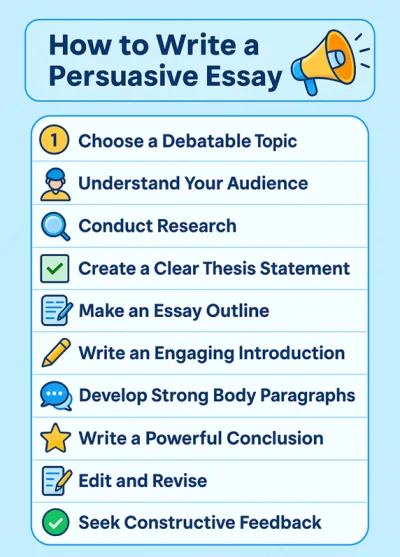
A successful persuasive essay requires careful planning, clear structure, and strategic use of evidence. Below is a step-by-step guide explaining how to write a persuasive essay, helping you create a strong and convincing paper.
1. Choose a Strong Topic. The first step is to pick a debatable topic with clear opposing views. Ensure you are interested in the topic and can support it with solid evidence. A good topic will allow you to make a convincing argument that resonates with your audience.
✅ Good: “Schools should replace textbooks with tablets.”
⚠️Weak: “Tablets are electronic devices.” (not debatable)
2. Understand Your Audience. Who are you writing for? Consider their views, biases, and potential objections. This will help you tailor your arguments to be more persuasive and relatable to your readers.
3. Conduct Thorough Research. Gather credible sources, articles, books and expert opinions to support your argument. Use multiple sources to make your argument well-rounded and evidence-based. Make sure to note relevant quotes and other information that you used in your essay.
✍️ Good sources:
- Academic journals (JSTOR, Google Scholar)
- Official statistics (e.g., government websites)
4. Write a Clear Thesis Statement. Your thesis should clearly state your main argument or position on the topic. It should be concise and specific at the end of your introduction paragraph. This will serve as the foundation for the rest of your essay. Example:
“Replacing textbooks with tablets in schools enhances student engagement, reduces costs, and prepares students better for digital workplaces”.
5. Outline Your Persuasive Essay. Create an outline to organize your key ideas and evidence. This will help you structure your essay logically and make sure each paragraph flows into the next. A standard persuasive essay structure includes introduction, body paragraphs, and conclusion.
6. Write a Compelling Introduction. Start your persuasive essay with a hook—such as an interesting fact, question, or relevant quotation—then add background information and end with your thesis.Hook sample:
“Did you know that students using tablets in class score 20% higher on standardized tests?”.
7. Write Body Paragraphs. The body of your paper contains the actual development of your paper’s argument. Each body paragraph should have one clear idea supporting your thesis. Start with a topic sentence, add evidence, explain its relevance, and address counterarguments. For instance:
Topic sentence: “Tablets improve student motivation.”
Evidence: “According to a 2023 Harvard study, interactive learning via tablets increased student engagement by 30%.”
Explanation: “Increased engagement leads directly to improved learning outcomes.”
Counterargument: “While some argue tablets are distracting, proper management can mitigate these concerns.”
8. Address Counterarguments. Providing answers to opposing views makes your argument more persuasive by showing fairness and credibility. Present counterarguments and explain why your position is stronger. For instance:
“Opponents argue tablets are too expensive. However, tablets offer long-term savings through reduced textbook costs.”
9. Write a Conclusion. Summarise your main points and restate your thesis in a new way. The conclusion paragraph should reinforce your argument and leave the reader with something to think about. You can also include a call to action or suggest further research or discussion on the topic.
10. Edit and Revise. Review your essay for clarity, coherence and consistency. Make sure to check for grammar, spelling, and formatting errors. Sometimes, using custom research paper writing assistance can be especially helpful. Ensure your arguments are logically structured and evidence-based.
11. Get Feedback. After you have completed your draft, share your essay with peers, teachers or mentors to get feedback. They can give you insights on areas that need improvement or further clarification. Use their feedback to refine your essay before submission.

Persuasive Essay Outline (Free Template)
Creating an outline is key to organizing your ideas clearly and logically. A good outline ensures your paper has a coherent persuasive essay structure and helps you identify the main parts of a persuasive essay. Use this simple template:
I. Introduction
- Hook (opening statement)
- Background information (briefly explain the context)
- Thesis statement (state your position)
II. Body Paragraphs (3-4)
- Topic sentence (introduce your argument)
- Evidence (facts, examples, or statistics)
- Explanation (why this supports your thesis)
- Address counterarguments (briefly refute opposing views)
III. Conclusion
- Restate thesis (paraphrase your main argument)
- Summarise key points (reinforce your strongest arguments)
- Call to action or closing statement (encourage further exploration of the topic)
This outline simplifies structuring your persuasive essay and ensures clarity and effectiveness throughout your writing.
Persuasive Essay Examples to Inspire You
Reading clear and well-written persuasive essay examples is one of the best ways to understand how persuasive writing works. Below are examples of persuasive papers to inspire you.
Sample 1: Introduction
Topic: “Schools Should Start Later“
Did you know that if schools started just one hour later students would perform better and be healthier? Many studies show that teenagers naturally fall asleep later and wake later yet many schools start early and harm students’ academic success and health. Starting school later nationwide would not only improve academic outcomes but also student health.
Sample 2: Body Paragraph
Topic: “Mandatory Recycling Programs Should Be Nationwide”
Mandatory recycling programs have already proven to work. For example, San Francisco implemented mandatory recycling in 2009 and within 5 years waste sent to landfills decreased by nearly 50%. According to a report from the Environmental Protection Agency, communities with required recycling save millions of dollars annually in waste management costs. Some argue mandatory programs infringe on individual choice but the environmental and economic benefits are overwhelming and justify nationwide adoption.
Persuasive Essay Topics
Choosing the right topic is key to writing engaging and convincing persuasive essays. Here are ten diverse and relevant ideas to get you started:
- Online learning should replace traditional classrooms permanently.
- Social media companies must take more responsibility for user privacy.
- A four-day workweek improves productivity and well-being.
- Animal testing for cosmetics should be banned globally.
- College should be free for everyone.
- Social media is bad for society’s mental health.
- Advertising to children should be more regulated.
- Voting age should be 16 in all elections.
- School cafeterias must provide healthier options.
- Governments should fund mental health services more.
These persuasive essay topics offer multiple viewpoints and encourage discussion on important social and educational issues.
Need more writing assistance?
Order your first paper and join EduBirdie to receive discounts and updates.
Try EduBirdie
Do’s and Don’ts of Writing a Persuasive Essay
Persuasion is not only about convincing others but also about communicating your thoughts with confidence. Follow these key tips to improve your essays and avoid common mistakes:
✅Do
- ✅ Do Research: Gather reliable sources and evidence to support your argument. Use facts, statistics, and expert opinions to back up your case.
- 🧠 Do Have a Clear Thesis: Your thesis should clearly state your position on the topic and guide the direction of your essay.
- 🎯 Do Address Counterarguments: Acknowledge opposing views and refute them with logic and evidence. This strengthens your argument and shows critical thinking.
- 🧩 Do Structure Your Essay: Use a clear structure with an introduction, body paragraphs, and a conclusion. Each paragraph should focus on one point that supports your thesis.
- 🗣️Do Use Persuasive Language: Use strong and convincing language to convince your audience. Use ethos, pathos, and logos to appeal to credibility, emotion, and logic. Repetition is a classic technique in persuasive writing to normalize ideas.
- 📝 Do Proofread: Check for grammar, spelling, and punctuation errors.
- 👥Do Tailor Your Argument: Consider your audience’s perspective and use arguments that resonate with them. Anticipate their concerns and address them.
❌ Don’t
- ❌ Don’t Rely on Emotion: While pathos is important, your argument should be supported by facts and evidence, not just emotional appeal.
- 🚫 Don’t Ignore Counterarguments: Failing to address opposing views can weaken your argument and make your essay seem one-sided.
- 📉 Don’t Use Weak Evidence: Ensure your evidence supports your argument. Avoid generalisations or unsupported claims.
- 🔍 Don’t Plagiarize: Always cite your sources.
- 🌀 Don’t Use Jargon: Avoid overly complex language that might confuse your audience. Aim for clarity and simplicity.
- 🔁 Don’t Repeat Yourself: Avoid repeating the same points. Instead, provide new evidence or different viewpoints to support your thesis.
- 🛑Don’t Go Off Topic: Stay focused on your main argument and avoid going off on tangents. Every paragraph should contribute to your thesis.
Follow these do’s and don’ts to ensure your persuasive essay is clear and effective.
Conclusion
Persuasive writing is a skill that goes beyond the classroom. Whether writing a paper for a class, preparing a speech, or advocating for change, mastering persuasive writing helps you express your ideas clearly and impact your audience. By choosing your topic wisely, researching thoroughly, structuring your essay logically, and applying rhetorical devices—ethos, pathos and logos—you can write a persuasive essay that resonates with your readers.
Don’t forget to address counterarguments, edit carefully, and seek feedback to improve your persuasive skills. With practice and attention to detail, you’ll be able to write essays that not only persuade but also spark meaningful conversation and change. And if you need some extra help, you can count on EduBirdie. Contact us today to get personalized help and achieve the academic success you deserve!