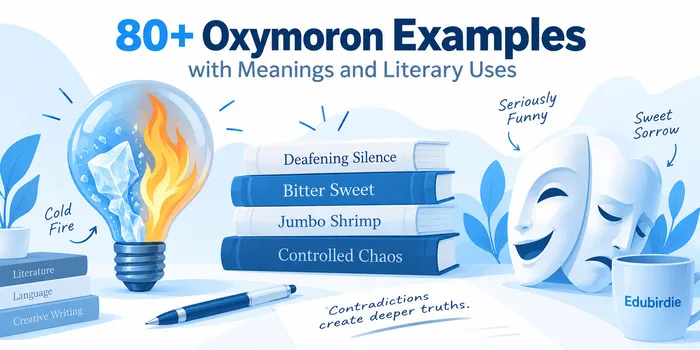
Oxymorons are everywhere — in everyday speech, literature, movies, and advertising. They mash up contrasting ideas to create phrases that are catchy, funny, emotional, or thought-provoking.
In this guide, you’ll learn what oxymorons are, see 80+ examples, learn what they mean, see how writers use them, and how they differ from paradoxes and simple contradictions.

What is an Oxymoron?
The basic oxymoron definition and examples are simple. This expression joins words that seem impossible together.
An oxymoron is a combination of two words with opposite meanings. These contradictory words make a surprising expression. For example, “deafening silence” combines sound and silence.
An oxymoron is a type of figure of speech. It appears in literature, conversations, advertising, and everyday language.
- Consider “sweet sorrow.” Sorrow usually feels painful. Sweetness usually suggests pleasure. Together, they describe mixed emotions.
- The phrase “cold fire” works similarly. Fire suggests heat. Cold suggests the opposite sensation.
Some oxymorons involve two words. Others can appear as longer expressions. Some even become common sayings in English.
For example:
- open secret
- true lies
- old news
- controlled chaos
- only choice
- same difference
These expressions appear contradictory at first. But listeners usually understand their intended meaning. Some oxymoron examples sentences have been heard time and again. Others sound more poetic and creative.
An oxymoron can also describe contradictory emotions. “Loving hate” suggests affection mixed with anger. “Cruel kindness” means help that hurts.
What Makes an Oxymoron Effective?
A good contradictory phrase creates tension between its parts. The contradictory terms make readers pause. They then look for the intended meaning.
Good oxymorons have three things in common:
- They create contrast. Opposite‐meaning words jump right out at you.
- They suggest something more profound. The phrase may refer to feelings that cannot be expressed in simple words.
- They sound memorable. Unusual combinations stay in the reader’s mind.
Consider “seriously funny”. The two words seem to disagree. Yet the phrase clearly describes something extremely amusing.
An effective oxymoron does not simply pair random opposites. The words must be logical.
For example, “controlled chaos” makes sense. It describes a seemingly disorganized situation. But someone is still managing its overall direction.
The most powerful expressions are often full of contradictions, as is real experience. People can feel happy and sad simultaneously. A workplace can have structure within apparent disorder. This tension gives an oxymoron its dramatic effect.
If you need help when using this rhetorical device in your writing, our do my essay service can provide additional support!
Oxymoron vs Paradox vs Contradiction
These three concepts can look similar. However, they work differently.
| Device |
Definition |
Example |
Key Difference |
| Oxymoron |
Combines opposing words |
Deafening silence |
Usually short and compact |
| Paradox |
Presents an apparently impossible idea |
Less is more |
Contains a broader thought |
| Contradiction |
States incompatible claims |
The door is open and closed |
The statements cannot both be true |
Thus, an oxymoron usually combines words. A paradox presents a thought that seems impossible. A contradiction simply presents incompatible claims.
For example, “jumbo shrimp” is an oxymoron. “Less is more” works as a paradox. Saying “The light is on and off” creates a contradiction.
A paradox may contain two opposing ideas. It often encourages deeper thought. An oxymoron usually creates a quick contrast.
Moreover, some expressions can overlap. Context determines how people classify them.
The distinction also appears in discussions about paradox vs oxymoron. A useful rule is simple: oxymorons are usually shorter. Instead, paradoxes usually express broader contradictory ideas.
Common Examples of Oxymorons
These rhetorical devices appear everywhere. Some sound poetic, others sound humorous or conversational. Let’s consider the most common types.
Everyday Oxymorons
These expressions occur in everyday speech.
| Expression |
Meaning |
| open secret |
Something widely known but officially hidden |
| old news |
Information that is no longer surprising |
| same difference |
Two choices that produce similar results |
| only choice |
A decision with no real alternative |
| pretty ugly |
Attractive and unattractive at once |
| deafening silence |
Extremely noticeable silence |
| small crowd |
A crowd containing few people |
| living dead |
Someone or something seems both alive and dead |
| true lies |
Lies containing some truth |
| clearly confused |
Confusion that is obvious |
| alone together |
Being together while feeling isolated |
| original copy |
A copy treated as an authentic version |
| minor crisis |
A problem described as relatively small |
| virtual reality |
A simulated experience that feels real |
| random order |
An arrangement that follows no obvious pattern |
| quiet roar |
A powerful sound described as quiet |
| working vacation |
A trip that still includes work |
| growing smaller |
Increasing while becoming reduced |
| act naturally |
Behave normally despite being instructed |
These expressions show how everyday life can inspire oxymorons. People often use them without thinking about their contradictions.
Funny Oxymoron Examples
Humor makes contrasting ideas even more noticeable. Here are some playful expressions:
- seriously funny
- military intelligence
- jumbo shrimp
- unbiased opinion
- even odds
- exact estimate
- bright smoke
- missing freezer
- business ethics
- organized mess
- controlled chaos
- friendly fire
- passive aggression
- virtual reality
- accidental plan
Some funny expressions depend on context. “Military intelligence,” for example, combines terms that can seem unexpected.
These phrases often appear in jokes and pop culture. Their humor comes from the contrast.
Romantic Oxymorons
Love creates many conflicting feelings. That makes romance especially suitable for figurative language.
Let’s see common examples:
- loving hate
- sweet sorrow
- painful pleasure
- cruel kindness
- bittersweet love
- cold affection
- beautiful sadness
- happy tears
- passionate restraint
- tender cruelty
- beautiful disaster
- honorable villain
- melancholy merriment
The phrase “sweet sorrow” describes the sadness of separation. And sadness can exist alongside affection.
Similarly, “loving hate” describes strong affection mixed with anger. Indeed, these conflicting emotions often appear in relationships.
Business & Work examples of Oxymorons
Business writing also contains interesting contradictions. For example:
- business ethics
- corporate freedom
- controlled chaos
- friendly competition
- mandatory choice
- planned accident
- working vacation
- temporary permanence
- virtual meeting
- creative accounting
- honest politician
- serious fun
- casual professionalism
- strategic retreat
- unbiased opinion
Some expressions are genuinely oxymoronic. Others depend on interpretation.
For example, “creative accounting” does not always involve opposing meanings. Therefore, context matters when identifying an oxymoronic expression.
Single-Word Oxymorons
Most expressions contain multiple words. However, some single words contain opposing elements. For example:
- bittersweet
- sweetheart
- spendthrift
- undead
- frenemy
- hellbent
“Bittersweet” is one of the most familiar examples. It describes something both pleasant and painful.
Some single-word examples are more debatable. Their meanings may have changed over time. That is why teachers usually prefer clearer expressions.
Adjective + Noun Oxymorons
The adjective-plus-noun pattern appears frequently. For example:
- deafening silence
- living dead
- cruel kindness
- sweet sorrow
- cold fire
- heavy lightness
- misshapen chaos
- wise fool
- honorable villain
- bright smoke
- silent scream
- beautiful disaster
- painful pleasure
- friendly fire
- open secret
- old news
This structure works because adjectives modify nouns. When their meanings conflict, the contrast becomes obvious.
Miscellaneous Oxymorons
Some expressions do not fit neatly into one category.
- still waking sleep
- faith unfaithful
- falsely true
- sick health
- brawling love
- honour rooted
- controlled chaos
- melancholy merriment
- heavy lightness
- o brawling love
- two opposing ideas
- conflicting ideas
- opposing ideas
Some come from literature. Others developed through everyday language. In fact, their meanings depend heavily on context. That context creates a new meaning.
Oxymoron Examples in Literature
For centuries, writers have used opposite phrases. They help authors express complicated feelings. Let’s take inspiration from Shakespeare, as he is especially famous for this technique.
Romeo and Juliet
William Shakespeare uses many oxymorons in Romeo and Juliet. One famous example is:
- “Parting is such sweet sorrow.”
The phrase combines pleasure and sadness. Romeo feels affection while facing separation.
Another example appears in:
- “O brawling love! O loving hate!”
These are expressions of love and conflict. They show Romeo’s confused feelings.
Shakespeare also writes about:
- heavy lightness
- serious vanity
- misshapen chaos
- feather of lead
- bright smoke
- cold fire
- sick health
- still-waking sleep
These famous examples show how William Shakespeare used contrast. He did not add contradictions randomly. Each phrase shows Romeo’s emotional turmoil.
Hamlet
Shakespeare uses contradiction in Hamlet to convey emotional uncertainty. Hamlet is always asking questions about truth, appearances, life, and death. His language contains contradictory ideas.
His famous question about existence concerns life and death together. Also, the play contrasts appearance with reality. Characters are often hiding what they really want. These tensions produce a strong rhetorical effect.
Paradise Lost
John Milton uses contrasting language throughout Paradise Lost. The poem explores good and evil, obedience and rebellion. These two opposing ideas create much of its dramatic tension.
Milton’s descriptions are beautiful and dark at the same time. His language gives familiar concepts greater emotional weight. This makes the poem a useful source for studying literary contrast.
Macbeth
Shakespeare also uses contradictions in Macbeth. The witches famously say:
- “Fair is foul, and foul is fair.”
The line combines opposing qualities. It suggests that appearances cannot be trusted.
The play repeatedly mixes good and evil. Characters also experience ambition, fear, guilt, and desire. These conflicting ideas set the play’s dark tone.
Oxymoron Examples for Students in Movies and Pop Culture
Contrasting phrases appear frequently in movies, music, television, and advertising.
Popular culture uses them because they are memorable. Short contradictions can also create humor.
For example:
- The Walking Dead
- True Lies
- Pretty Little Liars
- jumbo shrimp
- military intelligence
- friendly fire
- working vacation
- seriously funny
- living dead
- virtual reality
Movie titles often use contrasting concepts. “True Lies” combines truth with deception. “The Walking Dead” combines movement with death. The contradiction immediately evokes curiosity.
These phrases can also create mystery. Readers wonder how two incompatible concepts can coexist. That makes them effective in pop culture and advertising.
Why do Writers Use Oxymorons?
Writers use these expressions for several reasons. The technique can strengthen meaning and style. It also works well as figurative language in a sentence when writers want to make an idea more vivid.
To Create Contrast
Contrasting words immediately attract attention. Readers notice the tension between them. A phrase like “cold fire” creates a strong mental image.
To Express Complex Emotions
People often experience several emotions at once. Examples of oxymoron can express those feelings efficiently. “Sweet sorrow” captures sadness mixed with affection.
To Add Irony
These rhetorical devices can highlight ironic situations. The contradiction may expose an unexpected truth.
For example, “honorable villain” suggests a character with mixed qualities.
To Improve Memorability
Unusual expressions are easier to remember. Contradiction makes a phrase stand out. That explains why advertisers and speakers often use them.
To Create Humor
Humor often comes from unexpected combinations. “Jumbo shrimp” sounds funny because its parts conflict. The same applies to “seriously funny.” The contrast itself creates amusement.
How to Create your Own Examples of Oxymorons
Creating an oxymoron is easier than it seems. Start with one strong concept.
First, pick a word that has a clear meaning. Then, think the other way around.
For example:
Word: silence
Opposite: noise
Now, put them together: deafening silence.
And then ask yourself if it would make sense together. A random pairing usually sounds weak.
Try these mixes:
- warm + cold
- love + hate
- light + darkness
- freedom + control
- truth + lies
- beauty + ugliness
- order + chaos
- happiness + sadness
Then, make a short phrase.
For example:
- controlled freedom
- beautiful ugliness
- peaceful conflict
- honest deception
- silent noise
However, not all combinations are equally successful. The best ones show something beyond the contradiction. For this purpose, an effective oxymoron should provoke thought. It should also sound natural enough for your audience.
You can practice to find opposite words. Then, scramble them differently and use an oxymoron in a sentence.
For example:
- The room fell into deafening silence.
This gives you an oxymoron example sentence with precise context.
Common Mistakes When Using Oxymorons
Oxymorons are simple to recognize. However, writers can still misuse them.
Mistake 1: Confusing Them With Paradoxes
A paradox presents a broader thought. An oxymoron usually combines words.
For example, less is more expresses a complete idea. It works better as a paradox. Deafening silence is a compact oxymoron.
Knowing paradox figurative language concepts can help you distinguish them.
Mistake 2: Using Unrelated Opposites
Not all opposite pairs of words make a good oxymoron. The words should flow naturally. And they should say something helpful. In fact, random combinations can confuse the reader.
Mistake 3: Overusing Them
Too many oxymorons can weaken your writing. The effect becomes less powerful with repetition. So, use them when they add meaning, humor, or emphasis. One strong phrase can work better than five weak ones.
Mistake 4: Ignoring Context
Some of the phrases may be used differently. Always take the surrounding sentence into account. Context determines whether an expression sounds clever or confusing.
Mistake 5: Treating Every Contradiction as an Oxymoron
A contradiction is not automatically an oxymoron. The expression should combine contradictory elements in a meaningful way. A simple factual error does not count.
For example, “The door is open and closed” may be contradictory. It does not automatically create an effective oxymoron.
Concluding on Oxymorons
Oxymorons show how opposites can be surprisingly effective together. Words like deafening silence, sweet sorrow, and controlled chaos can add contrast, humor, emotion, and emphasis to your writing.
Once you know how they work, it’s easier to spot and use them. Just make sure the contradiction is meaningful and not just a juxtaposition of opposites that don’t belong together.
FAQ
What is the best example of oxymoron?
Deafening silence is one of the clearest examples. Silence is the absence of sound. Deafening means really loud. Together, they describe silence that feels overwhelming or noticeable.
Is “bittersweet” an oxymoron?
Yes, bittersweet is widely treated as an oxymoron. It combines opposing sensations. Bittersweet means both pleasant and painful at the same time. The word works especially well for memories, relationships, and emotional experiences.
What is the difference between an oxymoron and a paradox?
An oxymoron is an expression of opposites. A paradox is a statement or thought that seems self-contradictory. For example, deafening silence is an oxymoron. Less is more is a paradox.
Can an oxymoron be one word?
Yes. Bittersweet is an example of a one-word oxymoron. But many oxymorons have separate words. Single-word examples may have dictionary definitions and word history to draw on.
Why do authors use oxymorons?
Writers use oxymorons to emphasize differences and express complex emotions. They can also provide irony, humor, and dramatic tension. These devices can make descriptions stick in the head and can show a character’s mixed-up emotions.