A good essay title gives the reader an idea of what your topic is about and also makes a good first impression. However, finding the right words, length, and format can be tricky.
This guide will show you how to write an essay title step by step. You’ll learn the most important rules, formatting requirements, common mistakes to avoid, and practical tips to make your title clear and engaging. We have also provided examples of different essay types to help you get a title that matches your topic, tone, and assignment.

What is an Essay Title?
An essay title tells readers what your paper covers. It gives them a quick idea of your subject. A good title also sets the right expectations.
Think of your heading as your essay’s first impression. It appears before your introduction. Readers see it before anything else.
That’s why this element should connect directly to your main idea. It should also match your essay’s tone and writing style.
Look at the example:
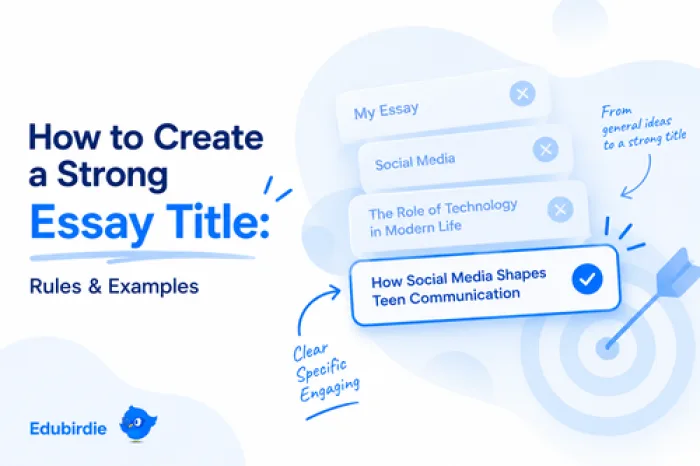
- Social Media.
- How Social Media Shapes Teen Communication.
The first version is too general and simply boring. Instead, the second option provides readers with more information by showing the subject and the essay’s focus.
Here are three points to remember if you are learning how to title an essay:
- Begin with your essay. Don’t try to come up with a random phrase. Look at your main idea, argument, and repeated themes.
- Identify the type of essay. While an academic paper usually needs a clear, descriptive title, a narrative essay can have a more creative one.
- Stay on topic. Your title doesn’t need to tell everything. It simply has to guide readers and show them what to expect.
Put simply, the best essay title gives your readers enough information about your focus without giving away the entire paper.
Why a Good Essay Title is Important
The name of your work helps readers quickly understand your paper. It also creates interest before they start reading.
Think about articles online. A clear headline helps readers decide what matters. Essays work similarly, especially when teachers read many papers.
A good essay title can:
- Introduce the subject.
- Show the central idea.
- Grab the reader’s attention.
- Set the right tone.
- Make the essay easier to identify.
- Give readers useful context.
A headline can also show your writing skills and prove that you understand your essay’s point.
Look at the example:
- The Effects of Sleep Loss on Student Performance works well. It presents the subject and focus.
- Compare it with Sleep. It feels too broad.
Your headline should help readers predict the essay’s content. It should never promise something your paper does not discuss.
👉 If you need extra writing support, you can use our “do my essay” service and understand the intricacies of creating powerful headings.
What Makes a Good Essay Title?
There are several qualities that turn an ordinary heading into a powerful one. These are the 6 key qualities you should know when learning how to make a title for an essay.
Clear
Your subject must be instantly recognizable to readers. Avoid confusing phrases and unclear references.
For example: The Influence of Online Learning on Student Motivation
The example makes clear what the subject and focus are.
Specific
Specific headings give useful information to the readers. Avoid selecting topics that are too broad.
Instead of Technology in Education, try: How Artificial Intelligence is Transforming College Education.
The second option gives the reader a more definite course.
Relevant
The heading should match your essay’s content. Don’t choose something that sounds interesting but doesn’t fit.
Check your title after finishing your work. Make sure it represents your central idea.
Concise
Shorter headlines tend to do better. Eliminate duplicated ideas and superfluous words.
For example, “Social Media and Teen Mental Health” works better than “An Essay About the Many Different Ways Social Media Can Affect Mental Health.”
The shorter version conveys the point more quickly.
Interesting
A strong title should create some interest. However, it should still sound appropriate.
You can use a question, a contrast, or a surprising idea. Do not make statements that your text will not support.
Keyword-focused
Make headings more informative by including relevant keywords. This is especially important for articles, online writing, and research papers.
Use keywords organically. Never force them into awkward phrases.
Need help with your essay?
EduBirdie’s experts are ready to assist whenever you need a hand.
Place an order
How to Write a Title in an Essay Step by Step
Creating a heading becomes easier with a simple process. Follow these steps after you understand your paper.
Step 1: Finish the Essay First.
Your final headline should reflect the finished essay. However, writing a title too early can limit your ideas.
So, start with a working title if necessary. Then, change it after completing your text. This approach gives you more freedom during the writing process.
Your essay may develop in an unexpected direction. And your final title should reflect that direction.
Step 2: Identify the Main Idea.
Ask yourself one simple question: “What is my essay really about?”
Look beyond the general subject and find the specific point you want readers to remember.
For example, your subject might be social media. Your main idea might concern its effects on mental health. That gives you a much stronger starting point.
You can also summarize your essay in one sentence. Then, remove unnecessary details.
For example:
Main idea: Social media can increase anxiety among teenagers through constant comparison.
Possible title: Social Media and Anxiety Among Teenagers
Step 3: Choose Important Keywords.
Look through your essay for repeated concepts. Find the words that describe your central idea. How to essay topics can also help you identify useful terms. These words help with formatting titles and keeping your heading on point.
These keywords might include:
- Technology.
- Education.
- Climate change.
- Social media platforms.
- Mental wellness.
- History.
- Inequality.
- Machine learning.
Use the words that appear in your own work.
For example, a paper about the US government might use:
The Role of the U.S. Government in Climate Policy
Step 4: Decide on the Title Format.
Different essays can use different heading structures.
For example:
You could use a straightforward format:
The Effects of Sleep Deprivation on College Students
You could ask a question:
Does Social Media Improve or Harm Communication?
Or you can be creative and use a phrase with a subtitle:
Behind the Screen: Social Media and Adolescent Mental Health
You may also use a contrast:
Free or Controlled? Technology in Schools Today
Remember, your essay title format should be appropriate for your topic and audience.
Step 5: Check for Clarity and Length.
Read your title aloud. Does it make sense immediately?
Remove any unnecessary words and make sure that the heading accurately reflects your essay. Look for fuzzy language, words that are repeated, and words that are vague.
Additionally, check your teacher’s rules for formatting. Some assignments might have special requirements.
5 Essay Title Rules
Essay headings usually follow simple academic conventions. However, requirements can differ by school or instructor.
Capitalization
Many academic headings use title case. Capitalize important words in the title.
For example: The Effects of Social Media on Student Mental Health
Usually, you capitalize nouns, verbs, adjectives, and adverbs. Short articles and prepositions often stay lowercase. The first word and last word are normally capitalized as well.
Length
There is no universal title length for every essay. Most headings should stay concise. Aim for enough words to explain your subject. Avoid turning the name of your paper into a complete paragraph.
A short heading can work well: Climate Change and Coastal Cities
A longer headline may also work: How Climate Change Is Reshaping Coastal Cities
The right length depends on your essay’s focus.
Punctuation
Most essay titles need little punctuation.
A question mark works for a direct question. A colon can separate a main title from a subtitle. Unnecessary commas, exclamation marks, and quotation marks should be avoided.
Should titles be questions?
They are good to use with.
Questions are particularly useful for argumentative essays and opinion pieces. They can awaken interest and introduce the essay’s main problem.
For example: Can Online Learning Replace Traditional Classrooms?
So make sure your work actually gives the answer.
Can you Use a Colon?
Yes. Colons are great for two-part titles.
For example: The Digital Classroom: How Technology Changes Education
The first part is to generate interest. The second part explains the subject.
A colon also works well for academic essays and research papers.
Essay Title Format by Style Guide
Different style guides have different requirements. Always check your assignment first.
| Style |
Title case |
Bold |
Centered |
Notes |
| APA |
Yes |
Yes |
Yes |
Running head is not required for most student papers |
| MLA |
Yes |
No |
Yes |
Double-spaced |
| Chicago |
Yes |
It depends |
Yes |
Follow the instructor’s requirements |
APA
APA student papers usually center the title. The heading uses bold formatting and title case. Place this element near the top of the title page. Remember that APA rules can differ for student and professional papers.
MLA
MLA usually centers the headline. Do not bold, italicize, underline, or put quotation marks around it. Use title case for the main heading. Keep the paper double-spaced.
Chicago
Chicago style usually uses title case. Placement and formatting can depend on your assignment. Some instructors may request bold formatting. Others may prefer plain text. Always follow the specific instructions provided.
5 Tips for Creating a Catchy Essay Title
A catchy title does not need to sound dramatic. It simply needs to create interest.
1️⃣ Use Numbers
Numbers can make these elements more specific. This approach works well for informative writing.
For example: 5 Ways Social Media Changes Student Communication
2️⃣ Ask a Question
Questions can encourage readers to think and can also introduce your central issue. They should connect directly to your arguments.
For example: Can Technology Improve Student Learning?
3️⃣ Use a Subtitle
Subtitles add detail without making the main heading too long. The first phrase attracts attention. The subtitle provides context.
For example: Behind the Screen: Social Media and Teen Mental Health
4️⃣ Use Keywords Naturally
Include important terms when they fit naturally. This helps readers understand your subject and also helps online articles appear in search engines. Still, don’t sacrifice clarity for keywords.
5️⃣ Avoid Clickbait
Your title should accurately represent your essay. Avoid claims that sound exaggerated or misleading. Clickbait may grab attention. However, it can damage your credibility.
A compelling heading should make a promise. Your text should then deliver on it.
Essay Title Examples by Essay Type
The best heading depends on your assignment. Different essay types often need different approaches.
Argumentative
Argumentative essays present claims and supporting evidence. Their titles should usually identify the main issue.
Examples:
- Should College Education Be Free?
- Why Schools Should Limit Student Screen Time
- The Case for Stricter Plastic Waste Regulations
- Social Media: A Threat to Teen Mental Health?
These examples show different approaches. You can use questions, claims, or contrasts.
Persuasive
Persuasive essays aim to convince readers. Their headings can highlight a clear position.
Title examples :
- Why Every Student Should Learn Financial Literacy
- The Benefits of Later School Start Times
- Why Public Transportation Deserves More Funding
- Protecting Local Parks for Future Generations
Choose a heading that reflects your position. Avoid making claims your writing cannot support.
Analytical
Analytical essays examine ideas, texts, or evidence. Their titles should show the subject of analysis. An analytical title should sound focused and informative.
Examples:
- Symbolism in The Great Gatsby
- Power and Ambition in Shakespeare’s Macbeth
- The Role of Fear in Modern Political Advertising
- Identity and Isolation in Contemporary Fiction
Compare and Contrast
These essays examine similarities and differences. Your heading can name both subjects. You can also use a subtitle to clarify your comparison.
Examples:
- Online Learning vs. Traditional Classrooms
- City Life and Rural Life: Two Different Experiences
- Comparing Public and Private Education
- Social Media and Television: Changing Forms of Entertainment
Narrative
A narrative essay tells a story, so its heading can be more creative. Narrative titles can reflect the story’s mood. They should still connect with your writing.
Examples:
- The Day Everything Changed
- A Lesson I Did Not Expect
- Looking Through the Looking Glass
- One Train, Two Destinations
Expository
Expository writing explains a subject, so headings should usually be direct and descriptive. To choose title ideas for essays, start with your text’s central point. Classification essay ideas can help you find focused subjects. Then, turn that focus into a clear phrase.
Examples:
- How Recycling Reduces Household Waste
- The Causes of Sleep Deprivation Among Students
- How Wildfires Affect Local Communities
- The History of Renewable Energy
College Application
College application essays can use more personal headings. However, you don’t always need one. If you include one, keep it meaningful. Your title should support your story. It should not overshadow the personal content.
Examples:
- Learning to Listen
- More Than a Competition
- Finding My Place in a New School
- The Recipe That Changed My Perspective
5 Common Essay Title Mistakes
A weak heading can make a strong essay seem less focused. Watch for these common problems.
Titles like My Essay tell readers nothing. The same applies to titles like Education or Life. Be more specific about the subject.
A heading should not summarize your entire document. Remove details that do not help readers understand the focus.
Your title must represent the actual content. Do not choose a heading based only on your introduction. Check it again after completing the paper.
Adding too many keywords makes headings awkward. Readers notice unnatural language quickly. So, use only relevant keywords. Let the heading sound like something a person would actually write.
Creative essay title ideas can work well for some assignments. However, academic papers often need a clearer approach. Avoid clichés and vague metaphors. Creativity should support your point.
Essay Title Checklist
Before submitting your essay, review the title.
- Does the heading match the essay’s subject?
- Does it show the central idea?
- Is it specific enough?
- Is it concise?
- Does it use the right tone?
- Are important keywords included naturally?
- Does it follow your instructor’s rules?
- Is the capitalization correct?
- Is punctuation necessary?
- Does the title fit the essay type?
- Does it create reader interest?
- Does it avoid clichés?
- Does it accurately represent the essay’s content?
If you still cannot decide, create several options. Then, compare them side by side. A title generator can also provide starting points. However, you still need to judge the generated headings.
You can also search for ideas based on your subject. Then, adapt the ideas to your own paper. The goal is not to find the most creative phrase. It is to find the right words.
Summing up
A good essay title is clear, specific, relevant, and concise. It should state your main idea, not summarize the whole paper.
Write your essay first and find the central point to get the best result. Brainstorm several options for the title. Next, check wording, capitalization, punctuation, and required formatting style.
Whether you opt for a direct statement, a question, or a creative subtitle, ensure that the final title accurately represents your essay and helps readers understand what to expect.
FAQ
How long should an essay title be?
Most titles should be concise and informative. There is no universal word limit. Aim for a heading that clearly shows your subject. Remove unnecessary words and repeated ideas.
Should essay titles be in quotation marks?
Usually, no. These elements generally do not need quotation marks. However, headings of shorter works may use quotation marks. Follow the required style guide for your assignment.
Can an essay title be a question?
Yes, it can be a question. Questions work especially well for argumentative and persuasive essays. Make sure your text directly addresses the question.
Should you write the title before or after the essay?
Writing a temporary heading first can help. However, create the final name of the work after finishing. Your essay may change during writing. The final title should reflect its finished focus.