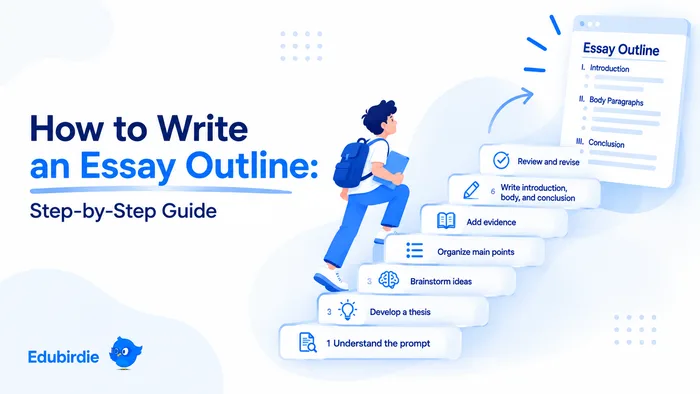
An essay outline is a structured plan that organizes your thesis, main points, evidence, and conclusion before you start drafting.
- First, understand the prompt, develop a clear thesis, brainstorm ideas, choose your strongest points, and arrange them in a logical order. Then add supporting evidence under each body section and review the structure for gaps or repetition.
In this guide, you’ll learn how to write an essay outline step by step, use a simple template, and adapt it to different types of essays.
What is an essay outline?
Writing an essay starts with an essay outline. An outline is a mini plan that indicates the main points of a paper (introduction, body paragraphs, conclusion). An outline should also include the evidence you’ll use to support each idea.
Think of your outline as a map — it helps you stay focused, organize your ideas, and keep every paragraph on track.
Most instructors expect some form of outline before a draft is submitted, and for good reason. A clear plan saves time during the writing process, reduces the number of rewrites, and makes sure every paragraph connects back to your central thesis.

Essay outline template
Every solid essay outline example follows the same basic skeleton, no matter the subject. Below is a template you can copy and adapt for any assignment.
Introduction
- Hook: an interesting fact, question, or statement that grabs the reader’s attention.
- Background/context: a sentence or two that explains the subject at hand.
- Thesis statement: one sentence that states your main idea and previews your key points.
Body paragraphs
- Topic sentence: states the main point of the paragraph.
- Evidence or example: a fact, quote, or statistic from your research.
- Analysis/explanation: why this evidence matters and how it proves your point.
- Connection to thesis: ties the paragraph back to your overall argument.
- Transition: a phrase that leads smoothly into the next section.
Conclusion
- Restated thesis: your thesis statement, rephrased in new words.
- Synthesis of main points: a brief summary of the strongest ideas from the body.
- Final insight/closing statement: a takeaway that shows the broader implications of your argument.
A tip: if you proofread essay online — a clean outline makes that process much faster, since the structure is already logical.
Need help with your essay?
EduBirdie’s experts are ready to assist whenever you need a hand.
Place an order
Step-by-step plan on how to write an outline for an essay
Knowing how to write an essay outline is mostly about breaking a big task into small, manageable stages instead of trying to plan the whole paper at once. We created a perfect seven-step plan that works for almost any assignment, from a short response paper to a longer research project.
1. Understand the essay prompt
Before you can write an essay outline, read the prompt more than once and underline the actual task words: “compare,” “argue,” “explain,” or “analyze.” Note the required essay type, the expected length, and any required length for sources. Misreading the prompt is one of the most common reasons students have to restart their outline from scratch.
It also helps to jot down what the grading rubric rewards. This is because instructors often weigh structure and evidence differently from one class to the next. A few extra minutes spent decoding the prompt at this stage almost always saves a full rewrite later in the writing process.
2. Develop a thesis statement
Once you understand the assignment, draft a statement that describes your main idea in one clear sentence. This becomes the anchor for every other part of your plan, so keep it specific rather than vague.
I always tell students to treat the thesis statement as a working idea, not a locked-in rule. As you brainstorm and organize evidence, come back and adjust the wording so every main point still supports the same central claim. An outline built around a thesis that never gets revisited usually falls apart by the third body paragraph.
3. Brainstorming part
List every idea, example, or piece of evidence that could support your thesis. This is also the stage for preliminary research: skimming articles, textbooks, or class notes to see what support already exists for your argument. Don’t worry about order yet — just get every possible key point onto the page.
A messy list at this point is normal. Some students prefer a simple bullet dump; others sketch a quick mind map. Either way works as long as every idea from your notes and early research ends up somewhere on the page before you start narrowing it down.
4. Select best ideas and organize them
Review your brainstorm and remove all but your strongest supporting points. There are usually three points for a five-paragraph essay, and more for longer academic writing. Group related ideas together. The best way is to put them in an order. You might, for example, organize by importance, by chronology, or by cause and effect.
5. The core part: write introduction, body, and conclusion
Place your ideas using the three-part structure. You can use the template above. Each body section should get its own topic sentences, while the introduction and conclusion frame the essay as a whole. At this stage, resist the urge to write in full sentences. It is better to work with short phrases. They are enough to hold your place. Also, rewriting them later during the actual draft tends to produce fresher wording anyway.
6. Provide evidence in each body paragraph
Under each topic sentence, write down the specific evidence you will use. Add a short note on why this point can be important for your essay.
7. Review and revise your outline
Read the draft plan and make sure each paragraph relates to your thesis. Cut anything that repeats. Rearrange anything that feels out of place. Make sure your conclusion doesn’t introduce a whole new argument. A quick read-aloud pass at this stage often reveals gaps that are easy to miss on screen.
Essay outline formats for academic writing
Not every outline looks the same. The right format depends on the assignment, the subject, and how detailed your instructor wants the plan to be. Some rubrics even specify a format directly on the assignment sheet.
| Outline Format |
Structure |
Best For |
Short Example |
| Alphanumeric |
Roman numerals, then letters, then numbers |
Standard essays, quick planning |
I. Intro → A. Hook → 1. Statistic |
| Decimal |
Numbered sections (1, 1.1, 1.2) show how ideas relate |
Research papers, complex arguments |
1.0 Body Paragraph → 1.1 Evidence |
| Full-sentence |
Every line is a complete sentence |
Long papers, group projects |
1.1 Social media shortens attention spans. |
Alphanumeric outlines use Roman numerals for major sections and letters or numbers for supporting details, making them the most common choice for a typical five-paragraph essay.
Decimal outlines number every level (1.0, 1.1, 1.2) to show exactly how minor points relate to major ones, which suits longer research projects.
Full-sentence outlines spell out complete sentences at every level, which takes more time to prepare but leaves almost nothing to figure out once you start writing the draft.
How to outline an essay: different types
Different types of essays call for slightly different outlines. Here’s how the same basic planning tool adapts across common assignments, from a single argumentative claim to a full literary analysis paper.
Example of argumentative essay outline
An argumentative essay outline states the claim and supports it with evidence. It also considers the other perspective on the topic.
- Thesis: School should start at a time that aligns with teens’ sleep cycles.
- Body 1: Sleep research says that a later start time leads to better academic performance.
- Body 2: It can also reduce car accidents among teen drivers, as they do not drive while sleepy.
- Counterargument: Critics argue that later schedules disrupt after-school jobs and sports.
- Rebuttal: Many districts have changed activity schedules with no major problems.
- Conclusion: Restate the argumentative essay claim and note the health benefits at stake.
A persuasive essay outline follows nearly the same shape, though it often leans more on emotional appeals alongside the evidence.
Outline for expository essay
An expository essay explains a topic rather than arguing a side. You can also hear the name of an explanatory essay outline, since the goal is to explain a process or idea clearly rather than persuade the reader. Nevertheless, the structure below works for either label.
- Thesis: Composting reduces household waste in three simple steps.
- Body 1: Collection of organic waste.
- Body 2: Managing decomposition conditions.
- Body 3: Using the finished compost in a garden.
- Conclusion: Summarize the process and its environmental benefit.
Narrative essay outline example
A narrative outline follows a story arc instead of a list of claims.
- Hook: Missing a flight in a foreign country.
- Rising action: Searching for another way with a limited amount of cash.
- Climax: Unexpected help from a stranger.
- Resolution: What the experience taught the writer about trust.
Compare-and-contrast essay outline example
A contrast essay outline can be organized point-by-point or subject-by-subject.
- Thesis: Online classes are more flexible than in-person classes; however, they are less engaging.
- Point 1: Flexibility of schedule (online vs. in-person).
- Point 2: Engagement and student interaction
- Point 3: Access to instructor feedback.
- Conclusion: Which format for which learner?
Literary analysis essay outline example
- Thesis: The protagonist’s inner conflict is mirrored by the repetition of storm imagery.
- Body 1: Storm imagery in the opening chapters.
- Body 2: How the imagery shifts as the character changes.
- Body 3: The last storm scene and its symbolic resolution.
- Conclusion: What the pattern reveals about the novel’s larger theme.
Common essay outline mistakes to avoid
Even students who write an essay outline every time can fall into a few recurring traps. Spotting these patterns early usually takes less time during editing than catching them after the full draft is written.
- Starting without a clear thesis: every other decision becomes harder without one.
- Including points that do not support the thesis: cut anything that drifts off focus.
- Putting multiple main ideas in one paragraph: split them into separate sections instead.
- Listing evidence without explaining its purpose; always add a line of analysis.
- Using an illogical paragraph order: check that each section builds on the last.
- Making the outline too detailed or too vague: aim for a middle ground that still makes sense at a glance.
- Treating the outline as something that cannot change: revise it as your understanding of the topic develops.
Quick checklist for a strong essay outline
Lastly, here is a quick checklist from EduBirdie; check it out to make sure your example of an outline for an essay is ready.
- Does the outline answer the prompt?
- Is the thesis clear?
- Does every body paragraph support it?
- Is evidence assigned to specific claims?
- Do the ideas follow a logical order?
- Are counterarguments included when needed?
- Does the conclusion synthesize rather than introduce a new argument?
Running through these questions takes only a minute, but it catches structural gaps that are much harder to fix once the full draft is written.
Final thoughts
A strong essay outline makes the writing process easier because you already know what each section needs to accomplish. Start with a clear thesis, organize your main ideas in a logical order, and assign evidence to each body paragraph.
Your outline does not need to be perfect or overly detailed. It should simply give your essay a clear direction.
Review it before you draft, remove points that do not support your thesis, and adjust the structure whenever your argument develops.
FAQ
How do you write an outline for an essay?
Read the prompt, draft a thesis, brainstorm supporting points, then arrange them into an introduction, body paragraphs, and a conclusion. Add evidence under each point before you start writing the full draft.
What does an essay outline look like?
The three parts are the introduction, the body paragraphs, and the conclusion. The introduction sets up the topic, the body develops the argument with evidence, and the conclusion ties everything together.
What is the basic format of an essay outline?
Most outlines use Roman numerals for major sections, letters for subpoints, and numbers for specific details. This alphanumeric format is the most common starting point for students.
How long should an essay outline be?
Length varies by assignment, but most outlines are one page in length. Some parts of a short paper might only need a few bullet points, while a longer research paper might need more detail.
Does an essay outline have to be in full sentences?
Not really. Brief phrases work well for your own planning purposes, but some instructors expect full-sentence outlines. It works particularly well for longer papers or when papers are submitted as a group.
[/faq]