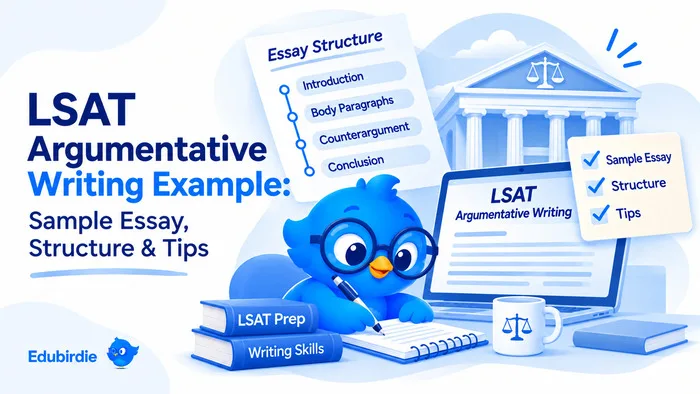
The LSAT Argumentative Writing is a 50-minute, unscored essay in which you analyze a debatable Key Question, consider multiple perspectives, and write a persuasive argument in support of your own position.
It offers law school admissions committees a direct sample of your critical reasoning and analytical writing skills, both online and with remote proctoring.
Here is a detailed analysis of the current format, along with a sample prompt for practice, a high-scoring sample essay, writing templates, and useful writing tips.

What is LSAT Argumentative Writing?
LSAT argumentative writing is a timed essay task that law schools can read along with your LSAT results. Here, you study a short prompt about a debatable issue, review several perspectives, and write your own argument.
The task helps law schools to measure a test taker’s ability to reason and write. It is part of the admissions process but is unscored. Many people call it the LSAT writing sample or the writing section. Test takers who want extra practice can also use a professional essay writing service to access model essays.
The format changed in 2024:
- The previous LSAT administration asked you to choose between two options using set criteria.
- The current version gives you a Key Question and perspectives, and you build your own position.
Now, schools see the completed writing sample next to your LSAT score. You take it online, on your own computer, with remote proctoring. Physical scratch paper is not allowed, so you take notes in a built-in digital tool. Always verify details on the official LSAC website!
LSAT Argumentative Writing at a Glance
| Feature |
Details |
| Total duration |
50 minutes |
| Prewriting analysis |
15 minutes |
| Essay writing |
35 minutes |
| Scoring |
Unscored |
| Prompt format |
Key question and 3–4 perspectives |
| Word limit |
No official word limit |
LSAT Argumentative Writing Example: Prompt and Sample Essay
This new LSAT argumentative writing example follows the current LSAC format. It includes an original practice prompt and a full sample essay.
A finished response shows you what to aim for. Set a timer, read the prompt, and treat it as a practice writing prompt before you read the sample.
LSAT Argumentative Writing Sample Prompt
This is a practice example, not an official LSAC prompt. Treat it as one of your sample prompts. If you need help in assignment writing for law school applications, you can use this layout as a model.
🔹 Key Question: Should universities prioritize career preparation over a broad liberal arts education?
This LSAT argumentative writing example question has no single correct answer. Every defensible position can earn a strong essay, as long as you support it.
🔹 Introduction: Rising tuition and a changing job market have led many families to ask what a university degree is for. Some people want programs built around jobs, while others defend broad study. Read the perspectives below, then write an essay that states and defends your own position.
🔹 Perspective 1: Students get a university degree by borrowing large amounts. A university’s promotional brochure promises jobs, and a modern university should deliver on that promise, with a focus on career preparation and practical career skills. It does students more good to have specialized training and internships than theoretical courses.
🔹 Perspective 2: Jobs change faster than the course catalog. A wide undergraduate liberal arts education teaches students to write, reason, and learn new subjects. These are skills that employers value in any field and that improve student learning over time.
🔹 Perspective 3: Universities are more than jobs. They teach cultural values and prepare citizens for civic and political life, something a career-oriented society might easily forget.
🔹 Perspective 4: A degree is more a badge than an education. The debate about the curriculum misses the point because degrees are badges of membership in the upper-middle class, which help families stay where they are.
Need help with your essay?
EduBirdie’s experts are ready to assist whenever you need a hand.
Place an order
Full LSAT Argumentative Writing Sample Essay
Universities should not prioritize career preparation over a broad liberal arts education. Instead, they should treat a liberal arts foundation as the base and add practical career skills on top of it. This approach prepares graduates for jobs that exist today and for jobs that do not yet exist.
The strongest reason is that jobs change faster than degree programs. A program built around one set of tools trains students for the economy as it is now. Software that was standard ten years ago is outdated today. Students who learn to write clearly, weigh evidence, and learn new subjects can adapt when the tools change. A broad study also engages students’ intrinsic motivation, since they follow questions that interest them. Curious students learn more and stay in school longer.
A second reason is that education has a purpose beyond a paycheck. Graduates vote, serve on juries, and join community boards. A university that offers only specialized training skips the thinking that civic and political life demands. A balanced curriculum helps students make meaningful contributions as workers and citizens.
Critics raise a fair objection. Students borrow large sums, and families expect a return. If a degree does not lead to a job, they argue, the university has failed.
This concern is real, but it does not require putting career preparation first. Internships, project courses, and career advising can sit inside a broad curriculum. A history major who completes a research internship leaves with both analytical skills and workplace experience.
Another view claims that degrees mostly signal social status, so the curriculum hardly matters. That claim ignores what students actually do in school. A graduate who can build a cogent argument gains a skill that no badge can supply.
In conclusion, universities should keep a broad liberal arts education at the center and weave career readiness through it. This path provides students with flexible skills, informed citizenship, and real job experience. A school that sacrifices the first two to guarantee the third may win short-term placement rates, but it loses the education that makes a degree last.
LSAT Argumentative Writing Example Breakdown
A good LSAT argumentative writing example answers the key Question and shows independent reasoning. Here is why the sample essay works, with a few sentences quoted for reference.
Thesis statement and introduction
The first sentence states the position: universities “should not put career preparation ahead of a broad liberal arts education.” The second sentence explains the alternative. The reader knows the plan before the first body paragraph.
Supporting arguments and evidence
Each body paragraph makes one point. The software example in paragraph two shows why narrow training goes stale. The essay uses simple rhetorical techniques: a concrete example, a contrast, and a clear transition. Paragraph three links the argument to voting and jury service, thereby extending it beyond the job market.
Counterargument and rebuttal
The sample admits that “students borrow large sums” and then responds. It proves that internships can fit within a broad curriculum while keeping the thesis intact.
Conclusion and logical flow
The conclusion restates the thesis in new words and ties together the three main ideas: flexible skills, informed citizens, and job experience. Every paragraph supports the same claim, so the reader never loses the thread.
How to Write an LSAT Argumentative Essay in 5 Steps
Step 1: Read the prompt and analyze the perspectives
Start with the Key Question. Then read each perspective and note what it assumes. Good LSAT argumentative writing starting habits begin with a calm, careful read.
Use the guided prewriting analysis questions to see where the views agree and where they clash. This is how test takers analyze a prompt before they pick a side, and it helps you generate productive ideas.
Step 2: Choose your position and plan your argument
Pick a position you can defend in 35 minutes, such as the one in the LSAT argumentative writing example prompt above. Write a one-sentence thesis in the digital notepad. Then build a quick LSAT argumentative writing outline with two reasons, one counterargument, and one example each.
Step 3: Write an introduction and strong body paragraphs
Open with the issue and your thesis. Give each body paragraph one main point and one example. Link each point back to the Key Question. Later, compare your draft with an argumentative writing LSAT example to check your balance.
Step 4: Address an opposing argument
Pick the strongest view against your position. State it fairly, then explain why it fails or matters less. This shows you can reason with more than one idea in mind.
Step 5: Review your essay
Save the last few minutes for a check. Look for a clear thesis, consistent logic, tidy grammar, and smooth transitions. Fix any sentence that blurs your point. Compare your essay with the LSAT argumentative writing example response above to see what you can tighten.
LSAT Argumentative Writing Essay Structure
You can adapt this simple LSAT argumentative writing essay structure during practice. It is a suggested structure, not a mandatory LSAC template. The LSAT argumentative writing example essay above follows it closely. Most strong essays run four to five paragraphs, with a few sentences in each.
-
- Introduction: present the issue and thesis.
“Although many people argue…, I believe…”
- First body paragraph: develop your strongest argument.
“The most important reason is…”
- Second body paragraph: add reasoning or evidence.
“A second reason is…”
- Counterargument and rebuttal: address another view.
“Some will object that…, but…”
- Conclusion: reinforce the overall argument.
“In short, the evidence shows…”
Swap the starters for your own words once you feel comfortable. The order matters more than the exact phrases.
Common LSAT Argumentative Writing Mistakes to Avoid
Every example of LSAT argumentative writing that loses points shares a few problems. Most are easy to fix in essay writing practice. Here is how:
-
-
- Writing a vague or unclear thesis. State your position in one direct sentence.
- Summarizing perspectives instead of developing an original argument. Use them as material, not as your essay.
- Making unsupported claims. Add a reason or example to every claim.
- Ignoring counterarguments. Answer at least one opposing view.
- Using weak transitions between paragraphs. Open each paragraph with a link to the last one.
- Spending too much time planning or editing. Stop planning in time to write a full essay.
LSAT Argumentative Writing Tips for a Stronger Essay
These tips go beyond the steps above:
- Use the 15-minute prewriting analysis period strategically. You can move on after five minutes, but extra time gives you a stronger plan.
- Choose a position you can defend with logical arguments.
- Prioritize reasoning over complicated vocabulary.
- Use specific examples where appropriate, including your own educational experience.
- Keep one consistent argument from start to finish.
- Practice with official LSAC and LawHub resources.
Apply these strategies to manage your time efficiently and deliver a clear, compelling argument that leaves a strong impression on admissions committees.
How Long Should LSAT Argumentative Writing Be?
LSAC sets no official word limit, so aim for a complete, focused essay. Read several LSAT argumentative writing sample examples, then write your own.
Many students search for an LSAT argumentative writing example PDF. For this reason, LSAC offers an official practice prompt through a free LawHub account instead.
Also, know the LSAT argumentative writing deadline for your application cycle. Your score release depends on a completed writing sample on file.
Some Final Thoughts
On test day, the most important rule is to stay calm! Even if the LSAT writing prompt feels unfamiliar — no worries. A steady practice essay routine builds confidence, and your LSAT score does not depend on this section. Good writing also helps in higher education beyond law school.
You don’t have to do fancy writing to do well on the argumentative writing section of the LSAT. The key is disciplined reasoning and structured planning. Your essay is not scored, but it gives the admissions officers a raw view of how you think, how you structure your claims, how you respond to counterarguments, and how you perform under timed pressure.
Use the 15-minute planning time to develop a defensible position, support it with specific examples, and address opposing points of view directly. As you practice steadily with realistic prompts, you will be able to write a polished, persuasive sample on test day!
FAQ
How long is LSAT argumentative writing?
It lasts 50 minutes: 15 minutes for prewriting analysis and 35 minutes for essay writing. Approved accommodations can adjust these times.
Is LSAT argumentative writing graded?
No, it is unscored. Law schools can still read your writing sample, and you need a completed sample on file before your score is released.
How many words should an LSAT argumentative essay be?
LSAC sets no official word limit. Quality matters more than length, so aim for a complete essay with a clear thesis and support.
What makes a good LSAT argumentative writing example?
There is actually no single LSAT argumentative writing example answer. But a successful essay has a clear thesis, logical reasoning, specific examples, a counterargument with a rebuttal, and a concise conclusion.
Can you use personal examples in LSAT argumentative writing?
Yes, if they support your argument. They are short and to the point, each linking back to your thesis.