A good idea does not make a good grant proposal. You have to explain why your project is important. What are you trying to do? Why should a funder trust you to do it?
Find out how to write a grant proposal in this guide — from research to review. You’ll learn how to structure each section, set clear objectives, draw up a realistic budget, and avoid common mistakes. We also provide a checklist and a short example to help you.
If you need extra help with an academic task, you can also contact EduBirdie with a “do my essay” request.

What is a Grant Proposal?
A grant proposal is a written request for funding sent to a foundation, government body, or other funding agency. In short, it explains what you want to do, why it matters, and how much money you need to do it.
Grant proposal writing is common ground for nonprofits, universities, and independent researchers.
Basically, what is grant proposal writing? Think of it as a pitch: you’re persuading a granting organization that your project deserves their money over someone else’s.
What is the Purpose of Grant Writing?
The purpose of the grant proposal? Convince a funder that your proposed project solves a real problem, that you have a workable plan, and that you can be trusted with their money!
A strong proposal answers three questions reviewers always ask:
- What’s the problem?
- What’s your plan?
- Why should we fund you specifically?
Once we talked about how to write a paper proposal, that understanding can also help you with the grant writing process. In fact, they both aim to promote something in common: your ideas or yourself!
Need help with your essay?
EduBirdie’s experts are ready to assist whenever you need a hand.
Place an order
Who Writes Grant Proposals?
Writing a grant proposal is not the job of one person or one type of professional. Grant writers usually are:
- Non-profit organizations applying for funding for programs or operations.
- Researchers and graduate students who propose a research project.
- Schools seeking funding for equipment, staff, or new programs.
- Companies applying for innovation or development funding.
- Individuals, including artists and independent researchers, who seek project-specific funding.
This range of applicants shows that grant proposals serve many purposes, but all require a clear case for why the project deserves support.
The Preliminary Research Before Writing a Grant Proposal
Before you even open a blank document, we recommend you do preliminary research. If you think it is unnecessary, it actually saves you time later and shapes the entire grant-writing process.
Step 1️⃣: Find the Funding Opportunity
First things first: identify grant opportunities that align with your project’s mission.
For this purpose, check:
- Government agencies.
- Private foundations.
- Corporate giving programs.
They all publish grant resources listing what they fund and when. Go through all of them! This way, you will also know who to reach out to. After all, a mismatched proposal is just a waste of your time and the organization’s, so be careful with this step!
To summarize this step: look for a good fit rather than applying to every option available.
Step 2️⃣: Review the Grant Requirements
Every funder has its own proposal guidelines. Carefully read the eligibility rules, page limits, formatting rules, and deadline before you begin writing. Missing a small detail here is one of the most common reasons proposals get rejected.
Step 3️⃣: Research the Funding Agency
Learn about the funding organization’s mission and its previous projects. Understanding a granting agency’s priorities helps you frame your project in language that echoes their own goals. Reviewers will definitely notice this effort!
Step 4️⃣: Gather Supporting Documents
Collect supporting documents:
- Budgets.
- Letters of support.
- Your organization’s history.
- Staff resumes.
- Any prior progress reports.
Indeed, having these ready prevents a last-minute scramble before submission.
Grant Proposal Process: 7 Key Components
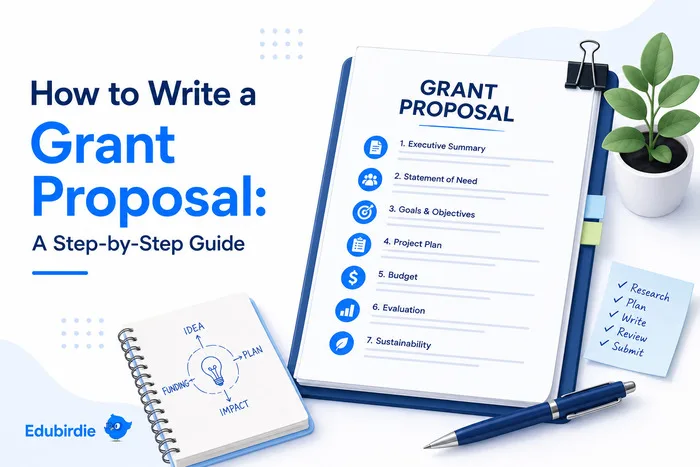
A good thing about the format of a grant proposal is that all of them, regardless, are built from the same core sections. Usually, your grant proposal will consist of:
- Executive summary.
- Statement of need.
- Goals and objectives.
- Project plan.
- Budget.
- Evaluation.
- Sustainability.
The table below explains each part in detail:
| Section |
Why It Matters |
What to Include |
Tips |
| Executive Summary |
Gives reviewers a quick, complete picture of the entire proposal. After that, they can dive into details. |
Project overview, funding amount requested, brief mission statement, and expected impact. |
Write this last, even though it appears first. It’s easier to summarize once the rest is done. |
| Statement of Need |
Proves the problem is real, urgent, and worth solving right now. |
Evidence, data, statistics, community testimonials, and findings from the literature review. |
Use recent, credible sources. |
| Goals and Objectives |
Shows reviewers exactly what success looks like and how you’ll know you’ve achieved it. |
SMART goals (specific, measurable, achievable, relevant, time-bound). |
Avoid vague language like “improve” or “help” without numbers attached. |
| Project Plan |
Demonstrates you have a clear, realistic path from idea to execution. |
Activities and timeline, staff responsibilities, key milestones. |
Break the timeline into phases or quarters for easier tracking. |
| Budget |
Shows funders exactly where their money goes and that your numbers are trustworthy. |
Budget justification, direct costs, indirect costs, and cost-per-outcome breakdown. |
Every number here should match figures mentioned elsewhere in the proposal. |
| Evaluation |
Proves you’ll actually measure whether the project worked. |
KPIs, data collection methods, and reporting schedule. |
Include both short-term and long-term measures of success. |
| Sustainability |
Reassures that the project won’t collapse once their grant ends. |
Future funding plans, partnerships, revenue strategies. |
Mention specific next steps, not just general optimism about “future funding”. |
Grant Writing Process: Step-by-Step
When you know what you are about to deal with, you may dive into learning the grant writing steps. The process can be broken into ten manageable steps for a successful case!
1. Write a Compelling Cover Letter
Your cover letter introduces your organization and briefly states what you’re requesting. Keep it short, specific, and aligned with the granting organization’s priorities.
2. Create an Executive Summary
Summarize the entire proposal in a few paragraphs: the problem, your solution, and the funding amount requested. For many reviewers, this section determines whether they continue with the rest of the proposal.
3. Explain the Problem: Statement of Need
This is where you provide evidence:
- Statistics.
- Community data.
- Literature review.
Basically, you must prove with numbers that the problem is real and urgent.
4. Define Project Goals and SMART Objectives
The project objectives should be specific, measurable, attainable, relevant, and time-bound. SMART is a framework that lets you take a broad ambition and turn it into something you can actually review.
What is the big picture change you’d like to see? Start with your overall goal. Then break it down to smaller objectives using this SMART framework:
- Specific: who gets what and what will change.
- Measurable: put a number or metric you can measure.
- Achievable: choose a goal that is feasible within your budget and time constraints.
- Relevant: tie the objective directly to the need you just identified.
- Time-based: Have a clear deadline or reporting period.
Instead of “improve community literacy,” a SMART objective would read: “Increase reading proficiency for 100 third-graders by one grade level within one academic year.”
The second version tells reviewers what success looks like and how you will prove it happened.
5. Describe your Project Methodology
Explain your actionable plan step by step: what you’ll do, who’s involved, and what resources you’ll use. This section is often called the project narrative. In the example below, you can see how it is written.
6. Develop an Evaluation Plan
Define how you’ll measure success. Include clear KPIs and how you’ll report progress, such as through periodic progress reports.
7. Prepare a Realistic Budget
List direct costs (staff, materials) and indirect costs (overhead) to justify each line item. An inconsistent budget is a fast way to lose credibility with funders.
8. Demonstrate Organizational Capacity
Show your organization’s track record with previous projects. Include key staff bios and relevant experience.
9. Explain Sustainability After Funding Ends
Funders want to know your project won’t collapse once their money runs out. Mention plans for additional funding or other funding sources going forward.
10. Review, Edit, and Submit
An easy but really necessary step: proofread for clarity, cut anything unnecessary, and confirm you’ve followed every formatting rule before submission.
Grant Proposal Tips to Improve your Chances
Knowing the steps is good, but if you want a genuinely winning grant proposal, here are the tips to make your application stand out:
- Follow every application instruction: Never ignore the guidelines! For instance, how long is a grant proposal? If the funder asks for a two-page limit or a specific font, treat that as a hard rule; do not exceed it because you think it is better. Actually, funders can simply ignore a long proposal.
- Use evidence and data: Instead of saying your program “helps a lot of students,” cite the actual figures. Answer the questions: how many students, what improvement, over what time period.
- Write for reviewers, not yourself: Assume they know nothing about your organization. Avoid internal shorthand, acronyms, or assumptions about shared context. Be more specific than you think you should be.
- Keep language concise: Long, technical sentences slow reviewers down and bury your point.
- Proofread multiple times: Typos and inconsistent numbers signal carelessness to reviewers. Read your draft a few times! Moreover, read it out loud at least once; it’s an easy way to catch awkward phrasing your eyes glide past on a silent read.
- Ask someone else to review: A second pair of eyes catches gaps you can’t see anymore after staring at the same document for days. Ideally, ask someone unfamiliar with the proposed project to check it and hear their opinion.
Taken together, these details help reviewers understand your proposal quickly and give them fewer reasons to question its feasibility or credibility.
Grant Application Mistakes to Avoid
We usually notice the same faults even in the proposals from experienced people. That’s why we share these common mistakes with you:
- Ignoring eligibility requirements.
- Weak problem statement.
- Unrealistic goals.
- Inconsistent budget.
- Missing evaluation metrics.
- Generic proposal reused for multiple funders.
You can check if you have them in your proposal, correct them, and send a perfect grant proposal!
Checklist Before you Submit your Grant Proposal
Congrats, now you know how to write a grant proposal! Before you hit send, though, check if your proposal includes:
- Cover letter
- Executive summary
- Need statement
- Objectives
- Methodology
- Timeline
- Budget
- Evaluation
- Sustainability
- Supporting documents
All good? Then you are ready to submit the winning grant proposal!
How to Write a Grant Proposal: Example
Here’s a mini-version to help you understand how to format a grant proposal faster:
Project title: Bright Futures Community Literacy Program
Need: In Jefferson County, 42% of third-graders read below grade level, compared to a state average of 27%. Local schools report insufficient after-school reading support, and two of the three public libraries in low-income neighborhoods have reduced hours due to budget cuts, leaving families with limited access to literacy resources.
Objectives: To increase the reading achievement of 120 students by one full grade level in one academic year as measured by standardized reading assessments administered at the beginning and end of the program.
Activities: One-on-one tutoring with trained volunteers once a week, monthly distribution of books to participating families, and quarterly parent workshops on how to support reading at home.
Budget: $52,000 total, $30,000 for tutor stipends and training, $12,000 for books and learning materials, $6,000 for venue and transportation, $4,000 for program evaluation.
Expected Outcomes: 80% of participants will show measurable gains in reading by the end of the program, and 90% of families will report increased reading engagement at home, as measured by post-program surveys and library card sign-up data.
Review this grant proposal example as a reference while you prepare your own!
Get that Grant Proposal!
A successful grant proposal should make your project easy for a reviewer to understand and evaluate.
Your goals, evidence, project plan, budget, and expected results must support the same clear argument: the project addresses a real need and offers a realistic solution.
Do not try to impress reviewers with complicated language or ambitious claims that you cannot support. Focus on clear evidence, specific objectives, realistic costs, and a defensible plan.
Before you submit the proposal, use the checklist above and compare your draft with the example to make sure no essential section is missing!
FAQ
How long should a grant proposal be?
Length depends entirely on the funder’s guidelines. Some cap proposals at two pages; others allow twenty. Always check the specific funder’s proposal guidelines first.
What makes a grant proposal successful?
A clear problem statement, realistic goals, a detailed budget, and strong alignment with the funding organization’s mission all contribute to successful grant writing.
What is the most important section of a grant proposal writing?
Most reviewers point to the statement of need and executive summary as the sections that make or break early impressions.
Can an individual write a grant proposal?
Yes. Individuals, including artists, researchers, and graduate students, can apply for grants meant for individual applicants rather than organizations.
How long does it take to write a grant proposal?
Simple proposals might take a few days; a large research project proposal with extensive supporting documents can take several weeks of preliminary research and drafting.