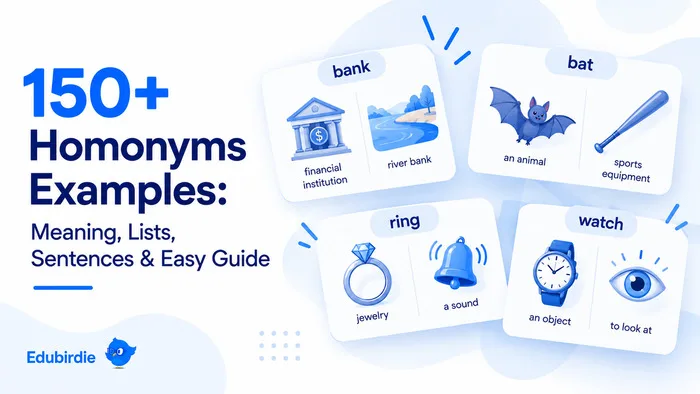
Homonyms are words that share the same spelling, pronunciation, or both but have different meanings. Common homonyms examples include bank, which can mean a financial institution or the side of a river, and bat, which can refer to an animal or sports equipment. Their meaning becomes clear from the context in which they appear.
Understanding homonyms can make English vocabulary, spelling, reading, and writing much easier. This guide explains what homonyms are, how they differ from homophones and homographs, and how to recognize their meaning in sentences.
You’ll also find 150+ examples of homonyms organized into practical lists, sentence examples, common mistakes, and simple tips for learning them.

What are Homonyms?
Homonyms are words with the same form or sound. They have different meanings. Some have the same spelling. Others may sound alike but look different.
The homonyms definition can vary between dictionaries. Some sources use the term broadly. They include homophones and homographs. Other sources use it more narrowly. They mean words with identical spelling and pronunciation.
The key idea is simple — the word form stays the same, but the word’s meaning changes based on context.
For example, consider the word “bank”. It can mean a financial institution. It can also mean land beside a river. These are words with unrelated meanings.
Another example is “bat”. A bat can be a flying mammal. It can also be a piece of sports equipment.
Consider these two sentences:
- The bat flew across the dark room.
- She picked up the bat before practice.
The spelling stays the same, whereas the meanings are completely different!
Need more writing assistance?
Order your first paper and join EduBirdie to receive discounts and updates.
Try EduBirdie
How Homonyms Get Different Meanings
Homonyms can have two or more meanings. Context tells readers which of them fits. The prefix homo means “same.” The second part relates to names or words.
The term describes forms that share a common characteristic. A useful example is “ring”:
- A ring can mean jewelry.
- It can also describe a sound from a phone.
Some homonyms involve a noun and a verb. For example, “watch”:
- It can name an object.
- It can also describe an action.
Learning these words improves spelling and reading. It also helps you understand English more naturally. If you need extra support, you can use our “do my essay” service and get qualified assistance from our writers!
Homonyms vs. Homophones vs. Homographs
English has three closely related terms that often confuse learners.
The homonyms vs homographs difference becomes clearer here. Focus on spelling and pronunciation first.
| Feature |
Homonyms |
Homophones |
Homographs |
| Same spelling |
✓ |
Sometimes |
✓ |
| Same pronunciation |
✓ |
✓ |
Sometimes |
| Different meanings |
✓ |
✓ |
✓ |
| Example |
bat |
write/right |
lead |
Homonyms
Homonyms share the same spelling, pronunciation, or both. Their meanings remain different.
For example, “can” can mean ability. It can also mean a metal container.
- I can swim.
- She opened a can of soup.
This gives you an example of homonym in everyday English.
Definitions can differ across textbooks. Some teachers use the term “homonym” broadly. Others use it only for exact matches.
Homophones
Homophones sound the same, but their spelling can differ.
For example:
- write and right;
- sea and see;
- flower and flour;
- pair and pear.
These words have the same sound. However, they have different spellings and meanings. These are useful homophone examples for spelling practice.
Homophones can create mistakes in writing. A reader may understand the sentence. However, the spelling still matters.
Homographs
Homographs have the same spelling, but their meanings differ. Some also share the same pronunciation. Others do not.
The word “lead” gives a useful example:
- lead means to guide someone;
- lead means a heavy metal.
These words have identical spelling. Still, their pronunciation is different.
The word “tear” works the same way:
- She wiped a tear from her eye.
- Be careful not to tear the paper.
The pronunciation changes. The spelling stays the same.
100+ Examples of Common Homonyms
English contains many words with different meanings. Some appear in daily conversations. Others appear in school, work, and nature.
In the following sections, you’ll see examples in useful groups.
Everyday Homonyms
| Word |
Meaning 1 |
Meaning 2 |
| bank |
financial institution |
river bank |
| bill |
money owed |
bird’s beak |
| bowl |
round container |
roll a ball |
| can |
ability |
metal container |
| date |
calendar day |
fruit or social meeting |
| fair |
reasonable |
public event |
| jam |
fruit spread |
traffic blockage |
| kind |
caring |
type |
| left |
departed |
opposite of right |
| light |
illumination |
not heavy |
| match |
contest |
small stick for fire |
| nail |
finger covering |
metal fastener |
| park |
public area |
leave a vehicle |
| point |
sharp end |
idea or detail |
| ring |
jewelry |
circular sound |
| rock |
stone |
move gently |
| ruler |
measuring tool |
person who governs |
| seal |
animal |
close something tightly |
| spring |
season |
jump or coil |
| watch |
timepiece |
observe |
| wave |
moving water |
hand gesture |
These same word different meaning examples appear frequently in everyday speech.
Notice how the surrounding words change the meaning. “Wear a watch” refers to an object. “Watch the road” uses the verb.
Homonyms Used in School and Writing
Students encounter many homonyms during lessons. They also appear in essays and exams.
| Word |
Meaning 1 |
Meaning 2 |
| address |
location |
speak to |
| board |
classroom writing surface |
group of directors |
| book |
written work |
reserve a place |
| chapter |
section of a book |
local branch of an organization |
| class |
group of students |
category |
| course |
series of lessons |
direction or route |
| draft |
early version |
current of air |
| file |
collection of documents |
smooth with a tool |
| grade |
school mark |
level or rank |
| journal |
written record |
academic publication |
| letter |
alphabet symbol |
written message |
| line |
row or mark |
queue |
| major |
main or important |
university field of study |
| mean |
signify |
unkind |
| note |
short message |
musical sound |
| paper |
writing material |
academic assignment |
| plot |
story events |
piece of land |
| point |
idea or detail |
sharp end |
| review |
study material again |
evaluation or critique |
| right |
correct |
direction |
| scale |
measuring system |
climb |
| sentence |
group of words |
legal punishment |
| subject |
school topic |
person under discussion |
| term |
school period |
expression or word |
| volume |
amount of space |
book in a series |
| word |
unit of language |
promise |
The word “sentence” shows how context matters. A grammar lesson uses one sense. A court report uses another.
The word “letter” also has various meanings. It can describe an alphabet symbol. It can also mean a written message.
Homonyms in Business and the Workplace
Workplace English contains many examples of homonyms. These words have the same spelling or pronunciation but can have very different meanings depending on the context.
Here are some common examples used in business and professional communication:
- Account – a financial record or a description of an event.
- Balance – an amount of money remaining or a state of stability.
- Board – a group of people who manage a company or a flat piece of material.
- Capital – money used for business or the main city of a country.
- Check – to examine something or a document used for payment.
- Client – a customer or a person receiving professional services.
- Company – a business organization or the presence of other people.
- Contract – a legal agreement or to become smaller.
- Current – something happening now or a flow of water.
- Deal – a business agreement or to distribute or handle something.
- Firm – a business organization or something solid and strong.
- Hire – to employ someone or to pay to use something temporarily.
- Interest – attention or curiosity about something, or a financial charge on borrowed money.
- Market – a place where goods are bought and sold or the action of promoting and selling products.
- Order – a request for goods or services or the arrangement of things.
- Partner – a business associate or someone who shares an activity.
- Pitch – a sales presentation or the action of throwing something.
- Project – a planned piece of work or to estimate future results.
- Report – a written document or the action of informing someone.
- Seal – to close something securely or an official mark.
- Stock – goods available for sale, a supply of something, or shares in a company.
- Strike – to hit or remove something, or a protest by workers.
- Suit – a legal case or a matching set of formal clothes
- Tender – a formal offer or something gentle.
- Train – to teach someone a skill or a railway vehicle.
- Turnover – the total value of a company’s sales or the rate at which employees leave and are replaced.
- Value – the worth or price of something or the action of considering something important.
- Yield – to produce a result or to give way.
Example in the Workplace
The word interest provides a good example of how meaning changes depending on context.
- Financial meaning: A bank charges interest on a business loan.
- General meaning: A manager may show interest in a new project idea.
Understanding these different meanings helps employees communicate more clearly, interpret business documents accurately, and avoid misunderstandings in professional situations.
Nature and Animal Homonyms
English contains many homonyms related to nature and animals. These words have the same spelling or pronunciation but different meanings depending on the context. Some refer to animals, plants, or natural objects, while others describe actions, everyday objects, or concepts.
Here are some common examples of nature and animal homonyms:
- Bark – the outer covering of a tree or the sound a dog makes.
- Bat – a flying mammal or a piece of sports equipment used to hit a ball.
- Bear – a large wild animal or the action of carrying or supporting something.
- Boar – a wild pig; bore, which sounds the same, can mean to make a hole.
- Branch – a part of a tree or a division of a company or organization.
- Bug – a small insect or an error in a computer program.
- Calf – a young cow or another young animal, or the muscle at the back of the lower leg.
- Crane – a large bird with long legs and a long neck or a machine used to lift heavy objects.
- Doe – a female deer or another female animal, such as a rabbit.
- Duck – a water bird or the action of lowering your head or body quickly.
- Eagle – a large bird of prey or a golf score of two strokes under par on a hole.
- Fish – an animal that lives in water or the action of searching for something.
- Fly – a small flying insect or the action of traveling through the air.
- Ground – the surface of the earth or the past tense of the verb grind.
- Herd – a group of animals or the action of gathering and moving animals together.
- Kind – a type or category of something or a quality of being caring and helpful.
- Mole – a small animal that lives underground or a dark mark on the skin.
- Mouse – a small rodent or a computer device used to control a pointer.
- Palm – a type of tropical tree or the inner surface of the hand.
- Pupil – the dark central part of the eye or a student at school.
- Ram – a male sheep or the action of hitting something with great force.
- Seal – a marine mammal or the action of closing something tightly.
- Shell – the hard protective covering of certain animals or the outer covering of an object.
- Sole – the bottom of the foot or a type of flatfish.
- Swallow – a small bird or the action of moving food or liquid down the throat.
- Trunk – the main stem of a tree or the long, flexible nose of an elephant.
Example in Everyday English
The word crane is especially interesting because it has two completely different meanings.
- Nature meaning: A crane is a tall bird with long legs and a long neck that often lives near wetlands.
- Everyday meaning: A crane is a large machine used to lift and move heavy materials at construction sites.
Examples of Homonyms in Sentences
Sentences make word meanings easier to understand. Here are popular words in context.
Bear
- The bear walked through the forest.
- I cannot bear this noise.
Bark
- The dog will bark at strangers.
Bank
- She deposited money at the bank.
- We sat beside the riverbank.
Bat
- A bat flew over the garden.
- He bought a new baseball bat.
Can
- I can finish the project today.
- She recycled an empty can.
Date
- The meeting starts on Friday’s date.
- They planned a dinner date.
Fair
- The teacher gave everyone a fair chance.
- We visited the summer fair.
Fly
- A fly landed on the table.
- Birds fly across the sky.
Jam
- She spread strawberry jam on toast.
- Heavy jam delayed our trip.
Left
- He left the office early.
- Turn left after the bridge.
Match
- The teams played a close match.
- She struck a match carefully.
Nail
- She painted her nails blue.
- He hammered a nail into the wall.
Park
- Children played in the park.
- Please park near the entrance.
Ring
Rock
- He picked up a small rock.
- The baby began to rock gently.
Seal
- We saw a seal near the coast.
Spring
- Flowers bloom during spring.
- The cat can spring onto the chair.
Watch
- My watch stopped working.
- Watch the road carefully.
Wave
- A large wave hit the shore.
- She gave me a friendly wave.
These sentences show how context changes the meaning of words. The same word can have a completely different sense.
Alphabetical List of Homonyms
This list of homonyms words gives you a quick reference. Some words appear more than once in English dictionaries.
- address
- arm
- band
- bark
- bat
- bear
- bill
- board
- bolt
- branch
- bright
- can
- capital
- case
- check
- class
- club
- crane
- date
- deck
- duck
- eagle
- fair
- file
- fine
- fly
- foot
- ground
- hail
- hand
- head
- kind
- jam
- journal
- key
- kind
- lap
- left
- letter
- light
- line
- match
- mean
- nail
- note
- order
- park
- pen
- point
- pound
- press
- race
- right
- ring
- rock
- ruler
- scale
- seal
- sentence
- shot
- sink
- sole
- spring
- stalk
- stock
- subject
- suit
- table
- tie
- train
- trunk
- type
- watch
- wave
- well
- yard
For a fuller homonym example, look at “pen”. It can mean a writing instrument. It can also mean an enclosure for animals.
The word “light” provides another useful case. It can describe illumination. It can also mean not heavy.
How to Determine the Meaning of a Homonym
Consider the Context
When a word has multiple meanings, use context. Look at the whole sentence first. Ask what topic the sentence discusses.
- The bank approved my loan.
- The bank was covered with grass.
Pay Attention to Grammar Clues.
Check whether the word works as a noun or verb. Its tense and position can also help.
- I watch television every evening.
A past tense form can also provide clues. Ground means earth. It can also be the past tense of grind.
Look at Nearby Words
Surrounding elements often reveal the intended sense. For two words spelled the same with different meanings, nearby words can make the difference clear.
Consider Pronunciation if Applicable
Some words have the same spelling but different pronunciation. “Lead” is a good example. The verb sounds like “leed.” The metal sounds like “led.”
Commonly Confused Homonyms and Word Pairs
Homonyms can create spelling and meaning problems. The following examples deserve special attention.
Bear and Bare
“Bear” can mean an animal. It can also mean carry or tolerate.
“Bare” means uncovered or empty.
- The bear lives in the forest.
- His feet were bare.
Principal and Principle
“Principal” can mean the head of a school. It can also mean the main person or amount. These homonym examples can help you remember the difference.
“Principle” means a rule, belief, or basic idea.
- The principal spoke to the students.
- Honesty is an important principle.
Stationary and Stationery
“Stationary” means staying still.
“Stationery” means writing materials.
- The car remained stationary.
- She bought new stationery.
This pair shows why spelling matters in writing.
Affect and Effect
“Affect” usually works as a verb. It means to influence something.
“Effect” usually works as a noun. It means a result.
- Stress can affect your sleep.
- The medicine had a strong effect.
4 Tips for Learning Homonyms Faster
You don’t need to memorize every word at once. When asking what are homonyms examples, start with familiar words. Use simple practice methods.
Tip 1️⃣: Flashcards
Put one word on the front. Write its different meanings behind it. Add a short sentence for each meaning. Review your cards regularly.
Tip 2️⃣: Reading
Read books, articles, and short stories. Notice words with different meanings. Ask yourself what each word means. Then, check the surrounding sentence.
Tip 3️⃣: Sentence practice
Write two sentences for each word. Give the word a different meaning each time.
For example:
This method connects spelling with meaning.
Tip 4️⃣: Quizzes
Short quizzes make review more active. Cover one meaning and recall it. You can also ask yourself questions such as “What is an example of a homonym?” Then, answer with words like bat, bank, or ring.
4 Tips for Learning Homonyms Faster
You don’t need to memorize every word at once. When asking what are homonyms examples, start with familiar words. Use simple practice methods.
Tip 1️⃣: Flashcards
Put one word on the front. Write its different meanings behind it. Add a short sentence for each meaning. Review your cards regularly.
Tip 2️⃣: Reading
Read books, articles, and short stories. Notice words with different meanings. Ask yourself what each word means. Then, check the surrounding sentence.
Tip 3️⃣: Sentence practice
Write two sentences for each word. Give the word a different meaning each time.
For example:
- The ring is beautiful.
- I heard the phone ring.
This method connects spelling with meaning.
Tip 4️⃣: Quizzes
Short quizzes make review more active. Cover one meaning and recall it. You can also ask yourself questions such as “What is an example of a homonym?” Then, answer with words like bat, bank, or ring.
Why Homonyms Matter in English
Homonyms matter because English depends heavily on context. The same form can communicate different ideas.
Writing
The right word makes your writing clearer. It also catches spelling mistakes. Specificity improves readability and prevents redundancy in writing and other issues.
Communication
Context helps people understand what you’re referring to. The tone and pronunciation can also provide useful clues.
Learning ESL
At first, homonyms can confuse English learners. Still, learning them develops vocabulary and correct pronunciation. It also makes it easier to read and to speak.
Exams
Tests frequently have puzzling pairs of words. Knowing what they mean helps you choose wisely. It can also help with your grammar and spelling.
So, homonyms in general make English more flexible and interesting. Knowing them makes regular communication much easier.
Summarizing
Homonyms show how a single word form can convey completely different meanings depending on context. Words such as bank, ring, watch, and bat may look or sound the same, but the surrounding sentence tells you which meaning applies.
Learning common homonyms also makes it easier to distinguish them from homophones and homographs, avoid frequent spelling mistakes, and understand English more accurately.
💡 The best way to remember them is to study each word, its different meanings, and how to use it in several sentences.
With regular reading and practice, recognizing homonyms becomes much more natural, and choosing the correct meaning becomes easier in both writing and everyday communication.
FAQ
What are 20 examples of homonyms?
Common words include bank, bat, bear, bark, can, date, fair, fly, jam, left, match, nail, park, ring, rock, seal, spring, watch, wave, bill, and point. Their meanings depend on the context of a sentence.
Are homonyms always spelled the same?
No. Definitions vary from source to source. Some use homonyms for words with the same spelling. Others include words with the same sound. Homophones are spelled differently. Homographs are words that are spelled the same but may be pronounced differently.
Why are homonyms important in English?
Homonyms help learners learn context. They allow you to develop your vocabulary, spelling, and reading skills. They also help prevent common errors. Recognizing different meanings makes communication clearer and helps students understand how words work in real sentences.