Sentences in a paragraph: how many should you write
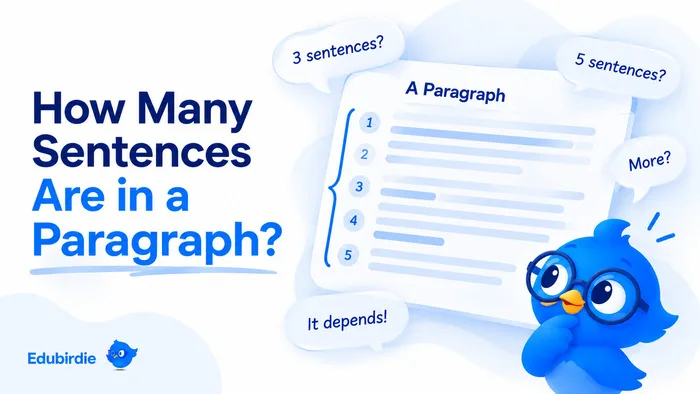
Most paragraphs should contain three to five sentences, totaling around 50 to 150 words.
However, there is no single rule that applies to every text. The ideal sentence count depends heavily on your writing format: online content works best with brief two-to-four sentence blocks, while academic papers often stretch to eight sentences. As long as your paragraph introduces, supports, and wraps up a single clear idea without drifting, your sentence count is right on track.

How many sentences should be in a paragraph?
There’s no single rule that fits every situation or any text. But most paragraphs work best with three to five sentences. That span gives a writer enough room to explain an idea, support it with claims, and finish it without so much drag that the reader gets lost in the thread. The exact number of sentences still depends on the type of writing, the subject, and the complexity of the idea.
A quick way to check yourself: if a paragraph only makes one point and moves on cleanly, the sentence count matters less than whether the text actually does its job.
What is the ideal paragraph length?
The correct length can be measured two ways:
- By counting sentences.
- By counting words.
Both matter, since a paragraph can technically hit the “right” sentence count and still feel too dense if every sentence runs long.
Correct length by number of sentences
For most general writing, three to five sentences is a safe target. Academic work sometimes stretches to six or more sentences per paragraph, since each idea usually needs a topic sentence, supporting sentences, and evidence before the writer can move to the next point. Online content tends to be shorter, often just two or three sentences, because readers scan web pages rather than reading every line.
Need more writing assistance?
Order your first paper and join EduBirdie to receive discounts and updates.
Try EduBirdie
Correct length by number of words
In terms of words, a typical paragraph falls somewhere between 50 and 150 words. A part under 50 words can still work if it makes a sharp, single point, but anything over 200 words usually signals that it covers more than one idea and should be split.
| Writing Type |
Typical Sentences |
Typical Words |
| Academic essay |
4–6 |
100–150 |
| Research paper |
5–8 |
150–200 |
| Blog / web content |
2–4 |
40–80 |
| Business writing |
3–5 |
60–100 |
| Journalism |
1–3 |
20–60 |
| Fiction |
Varies |
Varies |
Overall, the ideal length is not 5 sentences or a 500 words paragraph. The ideal text is the one that explains the idea clearly without being cut off too soon or overexplaining something for too long.
How many sentences are in a paragraph for different types of writing?
The right paragraph length shifts a lot depending on the format. The structure that reads naturally in a novel would feel out of place in a research paper, and the reverse is just as true. Here’s how sentence counts tend to vary across common writing types, along with a few reasons why each format settled on its own norms.
Academic writing and essays
Academic writing usually calls for fuller paragraphs, often four to six sentences, since each point needs a topic sentence, evidence, and some analysis before it is complete. Professors generally expect a clear statement of the main idea up front, followed by enough support to prove it. A teacher grading an essay is usually looking for that structure as much as the content itself.
Research papers
A research paper often runs even longer per paragraph, sometimes five to eight sentences. It is because writers need room to summarize sources, explain findings, and connect the evidence back to their argument.
If you’re stuck mid-draft, you can always hit EduBirdie with a message like “write my philosophy paper for me” and get academic help when your text needs deep source analysis.
Blog posts and online content
Online readers skim, so blog paragraphs are usually short. Two to four sentences, with plenty of white space between them. Short, frequent subheadings keep a post easy to scan on a phone screen.
Business and professional writing
Business writing favors clarity over length. Three to five sentences per paragraph is typical, with the main idea stated immediately so busy readers don’t have to dig for the point. Emails and reports both benefit from this approach. In this case, most readers skim the first sentence of a text before deciding whether to read the rest.
Journalism
News writing uses some of the shortest formats, often just one to three sentences. Reporters lead with the most important fact and let each paragraph stand almost on its own, partly so editors can cut from the bottom without losing meaning. This inverted structure means the first few sentences of a news post carry more weight than the ones that follow.
Fiction and creative writing
Fiction and creative writing don’t follow strict rules at all. A tense scene might use single-sentence paragraphs to speed up the pace, while a descriptive passage can run for a full page. Dialogue often gets its own new space every time a different character speaks, which is a convention rather than a sentence-count rule.
How many sentences are in different parts of an essay?
Sentence count can also shift depending on where the paragraph sits inside an essay.
How many sentences should an introduction have?
An introduction usually runs three to five sentences: a hook, some background, and a thesis statement that previews the argument. Keep the first sentence sharp, since it sets the tone for the whole paper.
How many sentences should a body have?
The body part of the text is the most flexible. It can actually contain four to eight sentences. The body length depends on how much evidence the point needs. Each one should focus on a single main idea, supported by examples, and include a transition sentence that links it smoothly to the following paragraph.
How many sentences should a conclusion have?
A conclusion can be shorter. It is typically three to five sentences. It should consist of a restated thesis, a quick summary of key points, and a final sentence that proves a thesis statement or leaves a reader with something to think about.
Paragraph structure
Regardless of sentence count, strong paragraphs share the same basic parts.
Topic sentence
The topic sentence states the paragraph’s main idea. The first sentence should give the reader an explanation of what this essay is about.
Supporting sentences
Supporting sentences explain or expand on the topic sentence with reasons, context, or description that helps prove the point.
Evidence and examples
Evidence and examples give the text weight and support. Here, you include a statistic, a quote, or a specific detail that supports the claim.
Transition sentence
A transition sentence bridges to the next part, so the writing flows rather than feeling like a list of disconnected ideas.
Concluding
A concluding sentence wraps up the point and states a thesis one last time.
Can a paragraph be one sentence?
Yes, one sentence paragraphs are completely acceptable — especially in journalism, blog posts, or fiction, where a short, punchy line carries more weight standing alone. In academic writing, though, a single-sentence paragraph usually looks underdeveloped. However, you can sometimes see experienced writers using one sentence deliberately for emphasis.
Can a paragraph have two sentences?
A two-sentence paragraph works fine in most writing, particularly online content or narrative writing, as long as the two sentences together introduce and support one clear idea. In formal academic writing, two sentences may feel thin unless the point is genuinely simple.
When is a paragraph too short or too long?
Length problems usually come down to how well the paragraph matches its one main idea. Also, the writer should consider how smoothly it connects to the previous paragraph.
Signs a paragraph is too short
It is too short when it states a claim but never explains or supports it, leaving the reader with a vague point and no real analysis. If a paragraph only contains one or two sentences and doesn’t fit one of the shorter formats above, it’s worth asking whether it is too short and can be connected to a previous one.
Can it be too long?
A long paragraph often signals that it’s covering more than one idea. If you notice the subject shifting halfway through, or the narrative running past 200 words, that’s usually the moment to break it apart. Readers also tend to skip dense blocks of text entirely, so a long paragraph can lose its point even when the writing itself is solid.
When to split a paragraph
Split a paragraph whenever the focus changes, when a new example needs its own space, or when the block of text simply looks too dense on the page. More white space between shorter paragraphs makes any piece of writing easier to read.
Examples of paragraphs with different sentence counts
Seeing the differences side by side makes the guidance easier to apply than reading about sentence counts in the abstract. Each example below focuses on a single idea, no matter how many sentences it takes to explain it.
One-sentence example
The fire spread faster than anyone expected.
Three-sentence example
Remote work changed how teams communicate. Meetings moved online, and quick hallway conversations turned into scheduled calls. Many employees say they miss the casual exchanges that used to happen in person.
Five-sentence example
Recycling programs only work when participation is high. Cities that offer curbside pickup see far better results than those that rely on drop-off centers. Convenience, it turns out, matters more than awareness campaigns. Studies show that residents recycle more when the process takes little extra effort. That’s why several cities have invested in expanding curbside collection rather than relying on public education alone.
Longer example
A paragraph can run past five sentences when it needs to build a more detailed argument, especially in a research paper or analysis. In these cases, every sentence should still connect back to the paragraph’s main idea rather than introducing a second, unrelated point, since a paragraph that drifts loses its structure and becomes harder for the reader to follow, even if each individual sentence is well written.
Choose the right number of sentences for a paragraph: some tips
There is no formula that works for every paper, subject, or writing style, but a few quick checks can help determine the right length for any given paragraph:
- Find the main idea of the paragraph. Everything in the paragraph has a bearing upon it.
- Consider the type of writing. Academic writing, business writing, and fiction all follow different norms.
- Add enough evidence or explanation. Don’t leave a claim standing without support.
- Remove sentences that don’t support the main idea. Cut anything that belongs in a different part.
- Split the paragraph when the focus changes. A new idea deserves a new paragraph.
How many sentences are in one paragraph: final thoughts
At the end of the day, there is no universal sentence count for every paragraph. While three to five sentences is a solid standard for general writing, your ideal length always depends on your format, audience, and main idea.
Focus less on hitting a strict formula and more on clarity: state your point, support it with strong evidence, and move to a new paragraph as soon as your focus shifts.
FAQ
How many sentences are in a paragraph?
Most should have three to five sentences. Still, the number can vary depending on the type of writing. Academic paragraphs are usually longer than blog posts and journalism.
Is 3 sentences enough for a paragraph?
Yes, three sentences are often enough, as long as they introduce, identify, support, and close out one clear idea. It’s a common length in business writing and general essays.
Can a paragraph be 10 sentences?
It can, especially in research papers, because they are more detailed than any other type of writing. But a paragraph that long should be checked to see if it’s still on point and makes sense.
How many words are in a paragraph?
Word count usually falls between 50 and 150 words, depending on the writing type. Academic and research paragraphs tend to run toward the higher end of that range.
Does every paragraph need a topic sentence?
Most do, since a topic sentence helps readers follow the argument. Fiction and some forms of narrative writing are exceptions because the main idea can come through description or dialogue.