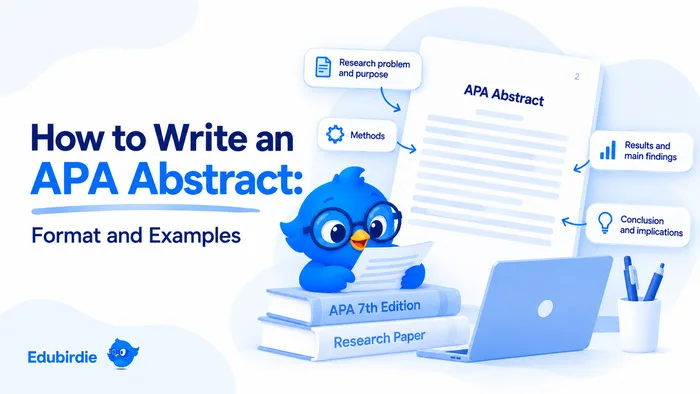
An APA abstract is a 150–250-word summary of a research paper’s purpose, methods, results, and conclusions, placed on its own page right after the title page.
Whether you are prepping a thesis or submitting to a journal, this guide breaks down the formatting rules, step-by-step writing process, and real examples to help you write yours effortlessly.

What is an abstract in APA format?
An APA abstract is a brief summary of a paper’s purpose, methods, results, and conclusions. It sits on its own page right after the title page and gives readers a quick way to decide whether the full document is relevant to their research.
Most instructors and journals expect this summary to run under 250 words. A good APA abstract allows a reader to understand the entire study without reading the rest of the paper. That’s why databases and search engines often display it before anything else.
Do you need an abstract for an APA paper?
Actually, not every APA paper requires one. It depends on the assignment type and the audience reading it. Let’s discuss two situations.
Student papers
Many student papers skip the abstract unless a professor specifically asks for it. Usually, such important works as a final thesis can require one. Check your assignment sheet or ask your instructor directly, because APA style leaves this decision to the individual course or institution. Also confirm whether you are writing in APA a citation vs MLA format, as this can change based on the subject.
Professional papers and journal articles
On the other hand, professional papers and journal articles almost always include one. A comprehensive summary helps other researchers scan a database of publications. An abstract also influences their decision on whether the articles are relevant enough to read in full. Journals also use them to index the paper, so a clear summary can affect how easily other researchers find the work at all.
Order top-quality papers at EduBirdie
Rely on human experts to improve your work and support your academic goals.
Choose writer
APA abstract format: APA 7th edition requirements
The APA abstract format follows a strict set of rules. More to that, the APA 7 abstract, in particular, changed a few small details from earlier editions, including the approved font list. Here’s what the 7th edition requires:
| Element |
APA 7 Guideline |
| Length |
Typically up to 250 words; follow instructor or journal requirements |
| Placement |
Separate page after the title page |
| Heading |
Abstract, centered and bold |
| Paragraph |
Start on the next line |
| First-line indent |
No indentation |
| Line spacing |
Double-spaced |
| Margins |
1 inch on all sides |
| Font |
Use an APA-approved font |
| Keywords |
Include when required; place below the abstract |
| Citations |
Generally avoid unless essential |
Formatting tip: the word “Abstract” goes at the top of the page, centered and bold, with no punctuation after it. The text itself starts on the next line, and every line remains double-spaced in a 12-point font, such as Times New Roman.
EduBirdie knows that formatting rules like this can feel like a lot to track on your own. Thus, our APA paper writing service can always help you with changing the page number placement, spacing, and margins before you submit. Just hit EduBirdie with the message and our best writers will lend you a hand!
What should an APA abstract include?
A strong abstract covers four things, in a specific order.
Research problem and purpose
Start by stating the research problem and why it matters. One or two sentences are usually enough to identify what the study set out to answer, without repeating the full background from the introduction.
Methods
Briefly describe the method you used to collect and analyze data — a survey, an experiment, or a review of existing sources. Keep this part precise and short.
Results and main findings
In plain language, the main results are as follows. Don’t drown this section with figures. Instead, talk about the overall trend or summarize what the data showed. Also save exact statistics for the results section of the full paper.
Conclusion and implications
Close with the possible implications of the findings and any suggestions for future work. This tells readers why the study matters beyond its own pages.
How to write an abstract APA: step-by-step guide
Writing an abstract is easier once you break it into stages. Here’s how to write an abstract APA reviewers and instructors will recognize it as properly formatted, from the first draft to the final proofread.
1. Write the summary after finishing your paper
Draft the abstract last, once the full paper is finished. It’s much easier to summarize a document you’ve already written than to predict what it will say.
2. Identify the research problem and objective
Reread your introduction and pull out the core question your paper answers. State it in one clear sentence.
3. Summarize your methodology
Look at your methods section and condense it to a sentence or two describing your approach, sample, or data source. Name the method directly — survey, experiment, case study, or literature review — so a reader can judge the study’s design at a glance.
4. State the main results
Go to your results section and note the single most important finding. Skip minor details that don’t change the overall conclusion, and resist the urge to list every result just because the full paper covers them.
5. Interpret the conclusion and implications
Restate the results within a larger context. You should also point out any possible implications for other researchers or for future work in the field. This is also the place to briefly mention limitations, if the assignment or journal expects them, without turning the summary into a second discussion section.
6. Include relevant keywords
APA suggests that three to five keywords be listed below the abstract in italics. The word “Keywords” should be indented and followed by a colon. APA abstract keywords typically denote the subject, method, and population of the study. For instance: sleep, memory, college students.
7. Check the word count and APA formatting
Reread the draft against the APA manual’s formatting rules: word count, spacing, margins, and page number. It also helps to read it out loud once, since sentences that feel dense on the page often become clear the moment you hear them spoken.
I always tell students that a strong abstract should prioritize clarity over sounding academic. To sum up the best recommendations: write it after the paper is done, focus only on the purpose, methods, findings, and implications, and cut any phrase that doesn’t help a reader understand the study fast.
APA abstract example
Seeing a full APA abstract example makes the format easier to picture. I added a short version below, but you are free to write longer summaries for your works if required.
Research paper
APA abstract keywords example: sleep duration, memory retention, college students, recall performance. Swap in terms that match your own study’s subject and method.
This study examined how sleep duration affects memory retention in college students. Forty participants completed a memory task after either six or eight hours of sleep. Students in the eight-hour group scored significantly higher on recall tasks. These results suggest that sleep duration plays a measurable role in short-term memory performance, with possible implications for study habits and course scheduling. Future work should test whether these effects extend to long-term retention.
Literature review
This review summarizes research on remote work productivity published between 2015 and 2024. Findings across the reviewed studies point to mixed effects, with productivity gains tied closely to job type and home environment. Researchers find that structured schedules and dedicated workspaces consistently predict better outcomes. The review identifies gaps in current research and outlines directions for future work on hybrid work models.
Template to use
Use this outline to build your own draft. You can actually copy the structure below into a blank page and fill in each line with your own study’s details before trimming it to fit the word count:
- Sentence 1: State the research problem or purpose.
- Sentence 2–3: Summarize the method used.
- Sentence 4–5: Report the key findings.
- Sentence 6–7: Note the conclusion and possible implications.
- APA abstract keywords line: List three to five keywords, italicized, on the next line.
Structured vs. unstructured APA abstracts
APA papers can use one of two abstract styles, depending on the field and publication. Check your journal’s author guidelines or your instructor’s rubric before choosing. The wrong format can mean a quick revision request later.
Unstructured version
An unstructured abstract reads as one flowing paragraph, without separate labeled sections. Most student papers and many journal articles in the social sciences use this format, since it reads more naturally for shorter studies.
Structured version
A structured abstract breaks the summary into labeled sections, such as:
- Background.
- Method.
- Results.
- Conclusions.
This is a common format for medical and scientific journals, to allow readers to quickly scan each section. It is especially useful when comparing several studies at the same time.
Abstract vs. introduction: what’s the difference?
An abstract and an introduction serve different purposes, even though both appear near the beginning of a document. The summary stands alone on its own page and briefly summarizes the entire paper, from method to conclusion. The introduction, by contrast, appears in the body of the paper and sets up the background and thesis without revealing the results.
A reader can understand a study’s outcome from the abstract alone, but the introduction assumes the reader will keep reading the rest of the paper. In short, the abstract answers “what did this study find,” while the introduction answers “why does this study exist.”
Common mistakes to avoid
A few small errors show up often in student abstract drafts. However, most of them are easy to fix once you know what to look for. While proofreading your draft, check this:
- Writing the abstract before the paper is finished, which leads to mismatched details.
- Adding citations or quotation marks, which APA style generally avoids in this section.
- Going over the word limit.
- Forgetting the page number in the upper half of the header.
- Skipping keywords when the assignment specifically requires them.
- Indenting the first line, when APA 7 calls for no indentation.
APA abstract checklist
EduBirdie created a quick checklist you can run through before you submit your abstract. And if you checked out all of them — congrats, your APA abstract is ready for submission!
- Does the abstract sit on its own page after the title page?
- Is the heading “Abstract” centered and bold?
- Is the text double-spaced with no first-line indent?
- Does the abstract stay under the word limit?
- Are three to five keywords listed below the summary?
- Are all major sections — purpose, method, results, conclusion — covered?
- Is the page number in place, and citations avoided unless essential?
One last tip: formatting mistakes are easy to miss on a screen, so it helps to print the page or view it at actual size before you check off each item below.
Final thoughts
At the end of the day, there is no universal sentence count for every paragraph. While three to five sentences is a solid standard for general writing, your ideal length always depends on your format, audience, and main idea.
Focus less on hitting a strict formula and more on clarity: state your point, support it with strong evidence, and move to a new paragraph as soon as your focus shifts.
FAQ
How long should an APA abstract be?
Most APA abstracts stay under 250 words, though instructors and journals can set a different limit. Always check the specific assignment or publication guidelines first.
Does an APA paper need an abstract?
Not always. Professional papers and journal articles almost always include one, while student papers often skip it unless the instructor requires it.
Does an APA abstract go on a separate page?
Yes. The abstract appears on its own page right after the title. The word “Abstract” is centered and bold at the top.
Do you indent an APA abstract?
No. APA 7 abstract does not use a first-line indent for the abstract paragraph, unlike most other paragraphs in the paper.
How many keywords should an APA abstract have?
Recommended APA abstract keywords are usually three to five, listed on the next line below the abstract, in italics, introduced by an indented “Keywords” label.