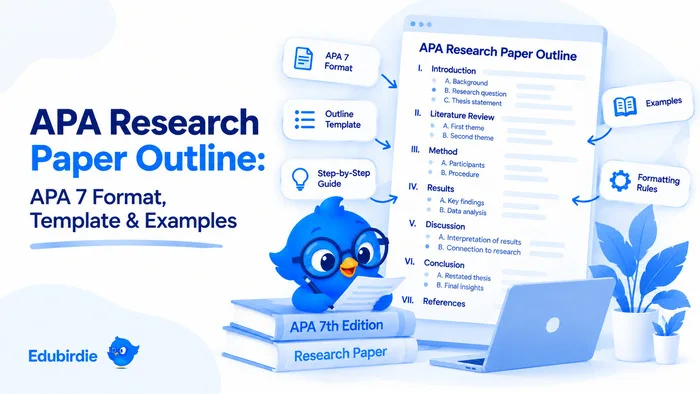
An APA research paper outline is a structured blueprint that organizes your topic’s main sections, subpoints, and evidence according to APA 7 formatting rules. Usually arranged in an alphanumeric, full-sentence, or decimal format, it maps out your paper’s flow before writing.
Here is a look at the essential requirements, step-by-step drafting steps, and copy-ready templates to help you build yours.

APA Paper Outline Template
Every APA research paper outline follows the same skeleton:
- A title page.
- Main sections.
- Supporting points under each section.
- A reference list.
Use the templates below as a starting point, then fill them with your own ideas.
Basic APA Research Paper Outline
This APA outline template works for most student papers. Copy it into a blank page and replace each line with your own topic. Keep each line short, since you will expand it later.
- Title page: Paper title, your name, institutional affiliation, course, instructor, date.
- Abstract: A short summary of research, if your instructor asks for one.
- Introduction: Hook, background, and research question or thesis.
- Body: Three or more main headings, each with supporting points.
- Conclusion: Restated thesis and key insights.
- References: Every source you cite.
Order top-quality papers at EduBirdie
Rely on human experts to improve your work and support your academic goals.
Choose writer
APA 7 Outline Template You Can Copy
The template below uses the alphanumeric levels most instructors expect: Roman numerals, capital letters, Arabic numerals, and lowercase letters. You can simply copy/paste this outline and just adjust the general naming to your paper’s ideas.
- I. Introduction
- A. Background on the research topic
- B. Research question
- C. Thesis statement
- II. Literature review
- A. First theme
- Key source and finding
- Key source and finding
- B. Second theme
- III. Method
- A. Participants
- B. Procedure
- IV. Results
- V. Discussion
- VI. Conclusion
- VII. References
What is an APA Research Paper Outline?
EduBirdie gave you a perfect APA outline template above, but let’s go back to the basics for a second. What is actually an APA research paper outline?
Shortly, it’s a structured plan that lists your main ideas and supporting points in the order they will appear in your paper. It follows the APA style rules for headings and formatting. That’s why the outline can actually become your draft structure with very little rework.
By the way, the APA 7 outline does not require you to submit an outline. Still, most professors ask for it, since a clear outline shows your logic before you write a single full page. Later, it helps readers navigate around the research.
A good APA paper outline also helps you spot weak points early. You can fix a thin section in minutes, while fixing it in a finished draft can take hours.
APA Outline Format
There are three popular outline formats that your research can take the shape of.
- The alphanumeric outline is the safest choice for a college research paper outline. It saves time later because each line can become a topic sentence.
- A decimal outline suits science and engineering topics. The numbers show at a glance how each idea connects to the one above it.
- When you use a full sentence format, write every entry as a complete thought. Keep the sentences in each level parallel, so the structure stays easy to scan.
Pick the APA outline format that matches your assignment and your instructor’s preferences. Check a short table below for a quick comparison of the formats.
| Outline Format |
Structure |
Best For |
Example |
| Alphanumeric |
Roman numerals, letters, numbers |
Most student papers |
I. Introduction → A. Background |
| Full-sentence |
Complete sentences at each level |
Detailed planning |
I. Social media use has increased… |
| Decimal |
Numbers showing hierarchy |
Complex, highly structured topics |
1.0 → 1.1 → 1.1.1 |
Main Parts of an APA Research Paper Outline
An APA research paper structure includes several standard sections. Your APA format research paper outline should list the ones your assignment requires, and nothing more. Not every paper needs all of them, so check your assignment first.
Title page
List your paper title, name, institutional affiliation, course, instructor, and date. Student papers skip the running head, while professional papers include one.
Abstract
The abstract sits on its own page after the title page. It summarizes your research question, method, results, and conclusions in about 250 words.
Introduction
Introduce your topic, explain why it matters, and state your research question or thesis. Your first paragraph should grab attention and set up your main argument.
Literature review
Group sources by theme, not by author. Show what other researchers found and where a gap still exists, since your paper fills that gap.
Method
Explain how you collected and studied your evidence. List your research methods, samples, and tools in short, clear points.
Results
Report what you found, with no opinion attached. Note the tables or figures you plan to include, and add a short line about your data analysis, so you remember which numbers matter most.
Discussion
Explain what your results mean and how they connect to earlier studies. This is where your key insights live.
Conclusion
In conclusion for a research paper, you must restate your main point and note the wider impact of your work.
References
Plan your reference list early. APA uses a hanging indent, so each entry’s first line is flush left, and subsequent lines are indented.
Tables, figures, and appendices
List every table, figure, or appendix you need. Each one goes on a new page after the reference list.
How to Write an APA Research Paper Outline Step-by-Step
The rules are good to know, but how to write an outline for a research paper by yourself? Follow these nine steps to build an outline that will make your research structure clear and ready to be the foundation of your paper.
1. Review the assignment requirements
Read the prompt twice. Note the required length, the paper type, the number of sources, and any formatting rules from your instructor. If anything looks unclear, ask your professor now, before you write it all around a wrong guess.
2. Choose and narrow your research topic
Start broad, then cut your topic down until you can cover it within the page limit. “Social media” is too wide, while “Instagram use and sleep in college freshmen” is workable.
3. Formulate a research question or thesis
Turn your narrowed topic into one clear research question. Your answer becomes your main argument.
4. Conduct preliminary research
Skim a few strong sources to test your idea. A quick scan of your topic can show you which points deserve a full section.
5. Group your sources and evidence
Sort your notes by theme. Each group of related notes can become a main heading in your outline. Drop any note that does not fit a group, since it probably does not support your main argument.
6. Identify the main sections
Pick three to five major sections that support your thesis. Name each one with a short, clear phrase.
7. Add supporting points
Add supporting evidence under every main heading. It can be a statistic, a quote, or a study result.
8. Check the logical flow
Read the draft from top to bottom. Ask whether the ideas connect and whether each section leads naturally to the next one.
9. Apply APA formatting requirements
Lastly, set 1-inch margins, double-space every line, and add a page number in the upper right corner. Then check your outline against the APA 7th edition outline format in the APA manual. Fix spacing and indents now, so you do not repeat the work later.
APA Research Paper Outline Example
Here is an APA paper outline example for the topic “Sleep and academic performance in college students.” Each sample shows a different format that we discussed above.
APA outline example for a student research paper
- I. Introduction
- A. Sleep loss is common among college students
- B. Research question: Does sleep affect grades?
- II. Literature review
- A. Sleep and memory
- B. Sleep and attention
- III. Method
- A. Survey of 200 students
- IV. Results and discussion
- V. Conclusion
Full-sentence APA outline example
- I. Most college students sleep less than the recommended seven hours.
- A. Late classes and part-time jobs shorten sleep.
- B. Short sleep may lower academic performance.
- II. Earlier studies link sleep to memory.
- A. Students who sleep well recall more material.
Alphanumeric APA paper outline example
- Introduction
- A. Background
- Sleep habits of students
- Prior research
- a. Memory studies
- b. Attention studies
Decimal outline example
- 1.0 Introduction
- 1.1 Background on student sleep
- 1.2 Research question
- 2.0 Literature review
- 2.1 Sleep and memory
- 2.2 Sleep and attention
We provide these research paper outline examples so you can compare them and choose the best one for your project. Also, consult your professor about any formatting requirements!
APA 7 Outline Format Guidelines
If it all seems too much — no worries, EduBirdie has a tip for you. The APA 7 outline format is simple once you know the formatting rules. Follow these APA guidelines to keep your outline clean and consistent:
- Use a readable font, such as Times New Roman, 12 pt, or another sans-serif font approved by APA.
- Double-space the whole document unless your instructor asks for different line spacing.
- Set 1-inch margins on all sides.
- Put the page number in the page header, top right.
- Start each level with the correct marker: capital Roman numerals, then capital letters, then Arabic numerals, then lowercase letters.
- Indent each new level to show hierarchy.
- List at least two items at any level. A single “A.” with no “B.” breaks the rule.
- Capitalize the first word of each entry, and use parallel structure inside each level.
One last tip: you can build the outline in Microsoft Word or Google Docs. Both tools let you set spacing and indents fast.
Save a blank copy with your settings applied. You can reuse it for every paper this semester, saving setup time for each new assignment.
Avoid these Mistakes in an APA Research Paper Outline
Small errors can weaken an otherwise strong plan. Most of them take seconds to fix once you spot them. While proofreading your outline, watch for these:
- Skipping the research question. Without it, the outline drifts.
- Using a single subpoint. Every level needs at least two entries.
- Mixing formats. Pick alphanumeric, decimal, or full sentence, and stay with it.
- Writing vague headings. “Other stuff” tells you nothing.
- Ignoring parallel structure. Start entries in a level with the same kind of word.
- Forgetting the reference list. Add it to your outline from day one.
- Leaving structural gaps. Every claim needs evidence under it.
Need extra support checking your plan? Students turn to EduBirdie’s research paper writing help to get a flawless outline for their project with professional help.
APA Research Paper Outline Checklist
EduBirdie recommends that you go through our checklist for an APA paper outline before you start writing. It takes two minutes and can save you a full rewrite:
- Does the outline match the assignment requirements?
- Is your research question or thesis clear?
- Do all major sections support the main argument?
- Does every main heading have at least two supporting points?
- Do the ideas follow a logical order?
- Are all levels formatted with the right markers?
- Did you apply APA formatting, including spacing, margins, and page numbers?
- Did you list your reference list, tables, and appendices?
All checked? Then your outline is perfect to build a research paper around it.
APA Style Outline: Final Thoughts
Building a clear APA research paper outline is the easiest way to organize your ideas, prevent writer’s block, and ensure your paper flows logically.
By following APA 7 formatting guidelines — such as setting 1-inch margins, maintaining a parallel structure, and choosing the right hierarchy — you lay a strong foundation for your final draft.
Use these templates and step-by-step tips to create an outline that keeps your research focused and assignment-ready.
FAQ
What is the correct outline format for an APA research paper?
Most students use an alphanumeric format with Roman numerals, capital letters, Arabic numerals, and lowercase letters. Your instructor may prefer a full-sentence or decimal format, so check the assignment first.
Does APA 7 require an outline?
No. The APA manual does not require an outline. Instructors often ask for a personal check of your project plan. Always follow your course rules.
What are the main parts of an APA research paper?
A typical paper has a title page, abstract, introduction, literature review, method, results, discussion, conclusion, and references. Some papers also add tables, figures, and appendices.
Should an APA paper outline use Roman numerals?
Yes, most of the time. However, it’s not the only format you can use. You can use Roman numerals with capital letters, or Arabic numerals with lowercase letters. Another alternative is a decimal outline format.