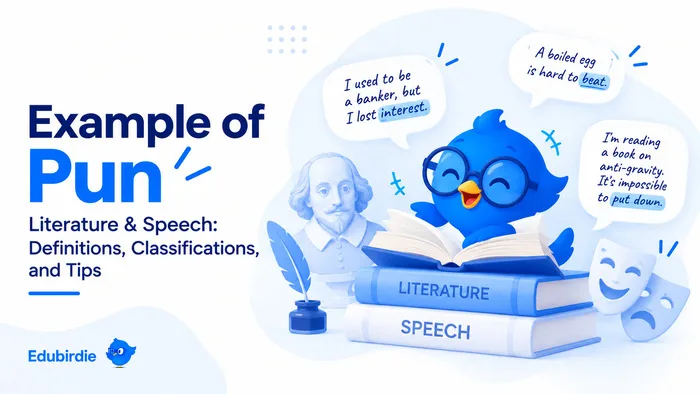
A pun is a clever form of wordplay that creates humor by using words with multiple meanings or terms that sound alike.
By understanding the core pun meaning and examples, such as “I used to be a banker, but I lost interest”, you can easily spot how language creates double meanings.
In this guide, we will explore the main types of puns, see how famous authors use them, and show you how to write your own.

What is a pun?
📍 A pun is a form of wordplay that creates humor or a double meaning by using language in a tricky way.
It takes advantage of:
- multiple meanings of the same word;
- words that sound alike;
- words with similar spellings;
- unexpected interpretations of a phrase.
The literary term for punning is paronomasia. You don’t need to remember it, since most people just say “pun.”
The basic pun definition is short: one expression, two meanings. A pun can hinge on a single word or on a whole phrase.
Writers and speakers use puns for a few simple reasons:
- to create humor;
- to make language memorable;
- to attract attention;
- to create double meanings;
- to add creativity to writing.
By the way, if you need to analyze puns in a class text, EduBirdie’s English assignment help can walk you through the wordplay line by line.
Need help with your essay?
EduBirdie’s experts are ready to assist whenever you need a hand.
Place an order
What is an example of pun?
An example of pun is a sentence or joke that uses a word’s double meaning or similar-sounding words to create humor. The simplest example of pun wordplay is a sentence where one word fits two meanings at once.
Here are a few examples of a pun you may already know:
- “I used to be a banker, but I lost interest.”
- “The bicycle was two-tired.”
- “A boiled egg is hard to beat.”
- “I’m reading a book on anti-gravity. It’s impossible to put down.”
See how each one makes you pause, then smile when the second meaning clicks.
Another example of pun for beginners can be a banker joke, because it uses one word with two clear meanings.
Types of puns with examples
Puns come in several kinds, depending on how the wordplay works.
Most puns rely on sound, spelling, or both. Some rely even on pictures.
Actually, studying these types can also help you pick words with more than one meaning when you struggle to find another word for things in an essay.
So, let’s see some more pun examples to expand your vocabulary!
🔹 Homophonic puns
These puns use words with different spellings that sound alike. “You can tune a piano, but you can’t tuna fish” works because “tune a” and “tuna” sound nearly the same. The piano is a musical instrument, and the fish is dinner.
The English language has thousands of homophones, so these puns are easy to find. Try swapping two words that sound the same: “The bicycle fell over because it was two tired.”
🔹 Homographic puns
This type uses words with identical spellings but different meanings. These words may sound different, so the joke lives in the written form. These homographic pun examples depend on the page, not the ear.
For example, a fish called a bass and an instrument called a bass look the same on the page. “He joined the band to play bass, but he was better at fishing.”
🔹 Homonymic puns
This type uses words that look and sound the same but mean different things. “A bank teller who sings can’t hold a note” works because “note” can mean money or a musical tone.
🔹 Compound puns
These pack more than one pun in a sentence. “The bakery says we knead dough, so we loaf around and rise to the occasion” has three. Writers use multiple puns to build a joke that keeps going.
A recursive pun is a rare cousin. You must understand an earlier pun to get the joke, like “To understand recursion, you must first understand recursion.”
🔹 Visual puns
Visual puns use images instead of, or along with, words. A logo might feature a smiling pencil and the slogan “Draw a conclusion.” The picture and the phrase work together.
Pun examples in everyday life
Fun fact: you hear and read puns daily, often without noticing. They show up in conversation, signs, and ads.
Funny pun examples
Here are some funny pun examples that rely on sound and double meaning. Each one aims for a humorous effect:
- “I’m on a seafood diet. I see food, and I eat it.”
- “I have a photographic memory, but I never developed it.”
- “A pessimist’s blood type is always B negative.”
- “The baker quit because he didn’t make enough dough.”
- “A short psychic broke out of jail. Small, medium, and large.”
To remember it easily or to come up with your own idea of a funny pun, dad jokes often follow this pattern. The groan is part of the fun.
Examples of puns also show up in math, like jokes about negative numbers that treat “negative” as an attitude.
Puns in conversation
People drop puns into speech to lighten the mood. Many puns twist a common phrase. If a friend says “Denial isn’t just a river in Egypt,” they play on the sound of “the Nile.”
A quick “no pun intended” can follow when someone says a pun by accident. The phrase serves as a wink, since the speaker acknowledges the double meaning without saying it was intentional.
Puns in advertising and headlines
Advertisers love puns because a clever line sticks in memory. A hair salon named “Curl Up and Dye” is a classic example of pun, and a news site might run “Short psychic broke free” as a headline. A church calling itself a non-profit institution plays on the sound of “nonprofit.”
Puns can also help in school writing. A strong essay title example can use a light pun to hook the reader’s attention.
Pun examples in literature
What’s interesting, famous authors have used puns for centuries.
The question is: What is a pun in literature? Shortly, it is wordplay that adds humor, character, or a hidden second point to a scene. Check the examples below to see this pattern in Shakespeare and Carroll’s works.
Shakespeare pun examples
William Shakespeare filled his plays with puns, from silly to deadly. In Romeo and Juliet, the dying Mercutio jokes that tomorrow you will find him a “grave man.” One word means serious, and the other means buried.
Richard III opens with a pun on “sun” and “son,” turning a gloomy winter into a glorious summer. Shakespeare’s plays also use double entendres, which are phrases with two meanings.
Puns in Alice’s Adventures in Wonderland
Lewis Carroll loved wordplay. When the Mouse calls his story a long and sad tale, Alice stares at the mouse’s tail instead. The pun plays on “tale” and “tail,” and the book even prints the story in a winding shape, like a long tail.
Carroll also joked that a tortoise teaches the class, so students called him “Tortoise” because he taught us. Many puns in the book reward a reader who sounds out the words.
Why do writers use puns?
Writers use pun examples in literature for a humorous or rhetorical effect. A pun can reveal a theme, show a character’s wit, or make a serious scene memorable.
Teachers group the pun with other literary devices, such as irony and metaphor. As a pun figure of speech, it also counts as pun figurative language, because the words carry more than their plain meaning. Some authors treat it as an art form.
For example, Oscar Wilde built The Importance of Being Earnest on a pun, since “Ernest” sounds like “earnest.” Charles Dickens, in books like Great Expectations, also leaned on comic wordplay. Comedians like George Carlin did the same in stand-up. Even Mark Twain wrote with a sharp ear for double meanings.
Pun examples for students
We are sure you got inspired by all these puns. It is time for you to use them in your writing or even speech. These simple pun examples are easy to study. Use this pun meaning and examples table to practice: read each line, find the wordplay, and name the type.
| Pun Example |
Wordplay |
Type of Pun |
Why It Works |
| I used to be a banker, but I lost interest. |
interest |
Homographic |
“Interest” can mean curiosity or money earned on financial assets. |
| The bicycle was two-tired. |
two-tired / too tired |
Homophonic |
The phrases sound alike but have different meanings. |
| The dog’s bark was worse than the tree’s bark. |
bark |
Homographic |
“Bark” can refer to a dog’s sound or the outer layer of a tree. |
| The calendar’s days are numbered. |
numbered |
Double meaning |
Calendar days literally have numbers, while “days are numbered” means that something will end soon. |
| The math teacher has too many problems. |
problems |
Double meaning |
“Problems” can mean math exercises or difficulties. |
| A boiled egg is hard to beat. |
beat |
Double meaning |
“Beat” can mean defeat or mix an egg by stirring it. |
How to recognize a pun in 5 steps?
You can spot wordplay with a simple method. A short pun definition and examples help here, because you compare the second meaning with the first. Follow these five steps:
- Look for a word with more than one meaning. Check whether the sentence makes sense in two different ways.
- Look for similar-sounding words. Many puns depend on homophones.
- Identify the unexpected interpretation. A pun usually shifts the reader from one meaning to another.
- Consider the context. Ask why the particular word was chosen.
- Read the sentence aloud. Some puns become obvious only when spoken.
Try it on this line: “Time flies like an arrow; fruit flies like a banana.”
The word “flies” has two meanings (step 1). The sentence shifts from a verb to a noun in the second half (step 3). Read aloud; the pattern makes the trick clear (step 5).
How to make your own pun?
You can write puns by starting with vocabulary instead of a joke. Build the wordplay first, then shape the sentence.
- Choose a simple topic.
- Write down words associated with that topic.
- Look for words with multiple meanings.
- Find homophones or similar-sounding words.
- Place the two meanings in the same context.
- Keep the sentence or punchline short.
- Read it aloud to check whether the wordplay is clear.
Here is a mini example.
- Topic: school.
- Word: class.
- Possible meanings: a lesson / a group or category.
Put both meanings in one setting, and you get: “In biology class, every animal belongs to a class.”
A pun in a sentence works best when it stays short, and adding it to your own writing works best in small doses. Try these play-on-words examples as models, then write a few of your own.
Pun vs. joke: what is the difference?
The pun meaning is tied to language: it relies on wordplay. A joke is a broader category of humor and may use:
- situations;
- observations;
- exaggeration;
- surprise;
- storytelling;
- wordplay.
A pun can be a joke, but not every joke is a pun.
Students also ask about pun vs play on words. A pun is one kind of wordplay, and wordplay also includes riddles, spoonerisms, and rhymes.
Compare two lines:
- “The baker quit because he couldn’t make enough dough” is a pun, since “dough” means both bread mix and money.
- “My neighbor’s dog is so lazy that he needs a nap after his nap” is a joke built on exaggeration, with no double meaning.
Final thoughts
Mastering puns is a fantastic way to sharpen your language skills, enhance your creative writing, and add humor to everyday conversations. From clever homophones to memorable literature, wordplay shows just how flexible and engaging English can be.
Whether you are analyzing classic texts in English class, crafting a catchy essay title, or simply trying to make your friends smile with a classic dad joke, understanding how double meanings work gives you a fresh perspective on vocabulary.
Now that you know the different types of puns and how to spot them, try using the steps above to build a few original play-on-words examples of your own today!
FAQ
What is a simple example of a pun?
“I used to be a banker, but I lost interest” is a simple example of pun. The word “interest” can mean both curiosity and money earned, creating a double meaning.
What are the main types of puns?
The main types are homophonic, homographic, homonymic, compound, and visual puns. Each one uses sound, spelling, or images in a different way to create wordplay.
What is a pun example in a sentence?
It is a line where one word or phrase has two meanings at once. “The bicycle was two-tired” works because it sounds like “too tired.”
Writers use puns or play on words examples to add humor, make lines memorable, reveal character, and create double meanings. A pun can also support a theme while keeping the tone light.
What does “no pun intended” mean?
It is an example of a pun that the speaker used accidentally, or wants to make it seem accidental. People often say it after a phrase that carries a secondary meaning.