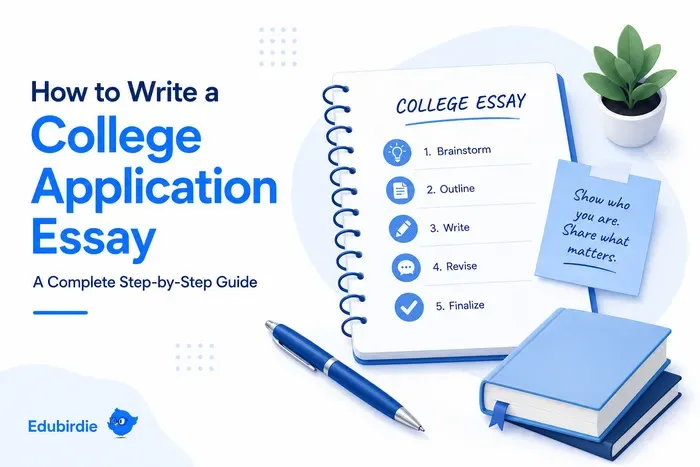
Every college application you submit is a chapter of your story, but the essay is where admissions officers learn about the person behind the grades. Trying to grasp how to write an essay for a college application means learning how to choose a meaningful topic, develop it into a focused story, and demonstrate real self-growth.
This manual will walk you through each step while helping you keep your authentic voice at the heart of the application!
What is a College Application Essay?
A college application essay is a short personal statement that gives the admissions officers a glimpse of who you are, beyond your grades and test scores. It’s your opportunity to share a story, a value, or a challenge that defined you, in your own voice.
If the writing process feels overwhelming, EduBirdie’s writers can help you do my essay the right way, from brainstorming to a polished final draft.

Why a Strong Personal Statement for College Application Matters
Admissions officers review thousands of applications each cycle. Grades alone rarely give them a real sense of a student’s personality.
A strong personal statement gives admissions officers a reason to remember you.
Every associate dean of admissions will agree: essays are where a name on a transcript turns into an actual person. Your essay can shape how admissions officers interpret the rest of your application by adding context that grades and activities alone cannot provide.
7 College Application Essay Prompts
Before you figure out how to write a college application essay, you need to understand what you’re actually being asked. The Common App offers seven prompts, and most schools also allow a fully open topic.
The Common App Essay Prompts
- A background, identity, or talent that’s central to who you are.
- A time you faced a challenge, setback, or failure.
- A belief or idea ever challenged by you.
- A meaningful act of kindness you received.
- An accomplishment that sparked personal growth.
- A topic or idea you find so engaging that you lose track of time.
- Any topic of your own choice.
How to Choose the Best Prompt
| Prompt Type |
What Admissions Officers Want |
Best Approach |
| Background or Identity |
Understand who you are |
Tell a meaningful personal story |
| Challenge or Setback |
See your resilience |
Focus on growth and reflection |
| Belief or Value |
Learn what shapes your perspective |
Show how your thinking evolved |
| Achievement or Interest |
Discover your motivation |
Explain why it matters to you |
| Open Topic |
Learn something memorable about yourself |
Choose your strongest story |
Can you Write about any Topic?
Yes. If you’re applying through the Common App, you can choose the open-topic prompt. Some colleges using their own application systems may have different essay requirements.
Just make sure the story reveals something real about your personality rather than reading like a résumé in paragraph form.
That said, an open topic isn’t an excuse to skip focus. Pick one clear thread, be it a hobby, a relationship, or a habit of mind, and follow it all the way through instead of touching on five different ideas at once.
Need more writing assistance?
Order your first paper and join EduBirdie to receive discounts and updates.
Try EduBirdie
How to Write a Winning College Application Essay?
Step 0: Choose the Right Topic During College Essay Brainstorming
To resolve how to write a strong college application essay, you must first choose a winning topic. It is not as hard as it seems. It is important that you stop searching for an “impressive” idea and start looking for a meaningful one.
Admission committees read plenty of essays about winning the big game; far fewer about the quiet moment that actually changed how a student sees the world.
Try these 5 things to get unstuck:
- List five moments from high school that still feel important to you.
- Ask a friend or family member what story they’d tell about you.
- Write for ten minutes without editing, just to see what surfaces.
- Think about a challenge, however small, and what you learned from it.
- Notice which topics keep coming up in your daily life and conversations.
👉 If it all still seems confusing, EduBirdie provides college admissions essay help for talented students ready to pursue their academic path at their dream college!
Step 1: Structure your College Admissions Essay Correctly
Additionally, you must know about college application essay structure. Actually, there are two distinct structures that you can use. The choice depends on your goals and the university’s essay requirements.
| Structure |
What It Looks Like |
Best For |
| 1. Narrative structure |
One continuous scene or event, told start to finish, building tension toward a resolution |
A single defining moment, challenge, or turning point that can carry the whole essay on its own |
| 2. Montage structure |
Several smaller moments or scenes linked around one central theme or idea |
A personality trait, value, or interest that shows up in multiple places rather than one big event |
| 3. Which is right for you? |
Ask yourself: Does my story have one clear arc, or several smaller ones that share a thread? |
If one arc — go narrative. If several related moments — go montage. Either works if it lets your real voice come through. |
Step 2: Create an Outline
Once you’ve settled on a topic and chose a structure, the process of how to write a good essay for college application becomes much easier. Next, you need to create an outline of your essay.
A typical college application essay format looks like this:
- Opening scene.
- Context.
- The problem or tension.
- What did you try first?
- The turning point.
- Small evidence of progress.
- The realization.
- Reflection.
- Closing thought.
💡 Tip from EduBirdie: Write down the scenes or ideas you want to include and make a rough outline. You don’t need a hard structure yet, just a sense of where your story starts and where it ends.
Step 3: Write an Attention-Grabbing Introduction
How to write a great college application essay starts with a memorable opening. Your first sentence should drop the reader into a specific moment. Skip generic openings like “Ever since I was young” and start mid-scene instead.
Begin with a specific moment: “The envelope shook slightly in my hands as I read the first line for the third time.
If you want to know how to write a great college application essay, the secret is to begin it with a memorable opening. Your first sentence should place the reader in a specific moment. Skip the backstory and get right into the action. Avoid weak ones like “ever since I was a child”.
Begin with a specific moment: “The envelope quivered a little in my hands as I read the first line for the third time.
Step 4: Build a Strong Narrative
In your first and second paragraphs, use concrete sensory details to hold the reader. Don’t spell out every feeling, but let the story develop naturally.
Instead of: I was afraid to give my speech.
Write: I stepped out onto the stage. My palms were sweating, my note cards shaking in my hands. The room was much quieter than it was before.
Step 5: Show Reflection and Personal Growth
The best essays spend as much time discussing what a student learned as what happened. State the lesson learned clearly near the end, without repeating it word for word from earlier paragraphs.
Instead of: Winning the debate competition helped me to become confident.
Write: The trophy was less important than the fact that I no longer measured success by being right. I learned that good listening often had more impact on my point of view than proving I was right.
Step 6: Write a Memorable Ending
Your final comments should feel earned, not rushed. Read your first draft through, tighten up anything vague, and make sure the ending ties back to your opening idea.
If you began your essay with: The envelope shook slightly in my hands as I read the first line for the third time.
End with: Months later, I still have that acceptance letter in my desk drawer. It reminds me that the biggest step ahead wasn’t getting into college. It was learning to trust myself before I trusted others.
Step 7: Don’t Forget about Editing and Proofreading
A strong first draft is never the final draft. Revise it wisely:
- Read your essay aloud.
- Cut unnecessary adverbs and filler words.
- Ask a teacher or friend for honest feedback.
- Double-check the word count.
- Compare your draft against the prompt.
Also, it is better to leave a few days between drafts if you can. Coming back with fresh eyes after time is one of the simplest ways to catch what you missed the first time.
After this final step, your personal statement for college application is almost ready!
Your College Application will Stand Out
Many applicants have strong grades and impressive extracurricular activities. What sticks is a unique voice on the page.
That’s the real difference between forgettable essays and successful essays in a crowded application process: less proving, more showing. If you want more targeted advice, that’s usually the gap worth closing first.
- Find your authentic voice. Write like yourself, not like the version of you that sounds “accepted”-worthy. Committees can tell when creative writing is forced.
- Show, don’t tell. Don’t just say you’re resilient — give a moment that proves it.
- Use vivid details. Specific, sensory details make a story stick.
- Be specific instead of impressive. The importance of a good college essay topic is how true and precise it is.
- Focus on reflection, not achievements. Your education and accomplishments already live in the rest of your application. This is the one place to express who you are, your qualities, your thinking, your growth, not just what you’ve done.
If you’ve written academic assignments before, remember that a college application essay follows a different approach than papers built around research paper topics for college students. Accordingly, focus on telling a personal story rather than presenting evidence or defending a thesis.
College Application Essay Examples
Below are a few examples of application essays you can read before writing your own. Before you lean into that, we also suggest you check this college application essay template, which helps millions of students every year to structure their essays:
| [Opening scene — 1 sentence] Drop the reader into a single specific moment. No summaries, no “ever since I was young.”
[Context — 2–3 sentences] Briefly explain what’s happening and why this moment matters, without over-explaining.
[Complication or challenge — 3–5 sentences] Describe the obstacle, tension, or turning point at the center of the story.
[Reflection — 3–5 sentences] Explain what you learned or how your thinking changed. This is the section admissions officers weigh most heavily.
[Closing thought — 1–2 sentences] Connect back to your opening scene and leave the reader with one clear, forward-looking idea. |
Our examples are built around this exact same template. See how one template can create completely different essays once you plug in your own story and voice.
Personal Growth Essay Example #1
“The bike had been sitting in the garage for two years, its chain rusted and its back wheel bent from a fall I never bothered to fix. The summer before senior year, I finally pulled it out, spread the parts across the driveway, and spent three weeks learning what patience actually feels like. Every stripped bolt and skinned knuckle taught me the same lesson: the things worth fixing rarely go right the first time.”
Passion Essay Example #2
“Every Sunday, my grandmother rolls dough on the same wooden table her mother used, and every Sunday, I stand beside her, failing to get the edges even. It took me years to realize the dumplings were never really the point. What she was actually teaching me, one uneven fold at a time, was how to belong to something older than myself.”
Passion Essay Example #3
“I have taken apart four broken radios, one microwave, and, against my mother’s wishes, the living room clock. I’m not sure what I was hoping to find inside them, only that once I opened one, I couldn’t stop wanting to see how the next one worked. That curiosity is the closest thing I have to a personality trait.”
How to Write a Good College Application Essay Without Mistakes
Even a strong writer can undercut a good story with a few avoidable mistakes. We advise you to avoid:
- Choosing a topic just because it sounds impressive to college admissions.
- Turning the essay into a list of extracurricular activities and awards.
- Writing what you think the school wants to hear instead of what’s true.
- Picking a different topic than the one that actually matters to you.
- Overusing quotes instead of your own words.
- Packing paragraphs with unnecessary adverbs and vague language.
- Ignoring the word count limit set by the application.
- Leaning too heavily on AI tools instead of your own honest voice.
And remember: if readers finish your essay knowing more about your character than your accomplishments, you’ve done your job well!
Personal Statement for College Application Checklist
Before deadlines close in, run through this checklist:
- Answered the prompt.
- Clear personal story.
- Strong introduction.
- Personal reflection.
- Authentic voice.
- Correct grammar.
- Within the word limit.
💡 The very last tip: Start early. A personal statement written the night before a deadline rarely reflects your best writing, and admissions officers can usually tell the difference.
Final Thoughts
A memorable college application essay doesn’t depend on an extraordinary experience. It depends on honest reflection, clear storytelling, and careful revision. Start early, refine your draft, and don’t be afraid to ask for guidance when you need it.
With the right approach, your personal statement can become one of the strongest parts of your college application!
FAQ
How long should a college application essay be?
Most college application essays run 500–650 words, matching the Common App’s official limit. Always check each university’s specific word count before you submit, since some schools set their own limits.
How to write a good application essay for college: what should I write about?
Choose a topic that reveals something true about your personality, values, or growth. A small, honest story usually beats a big, impressive-sounding one.
Can I use the same college application essay for multiple colleges?
Often yes. Just double-check each school’s supplemental prompts, since those usually require a different topic or angle. Many colleges also require supplemental essays that must be written specifically for that institution.
What makes a college application essay stand out?
An authentic voice, specific details, and real reflection make an essay memorable.
When should I start writing my college application essay?
Start the summer before senior year if possible. Starting early leaves room for multiple drafts, honest feedback, and real editing, rather than a rushed final draft.