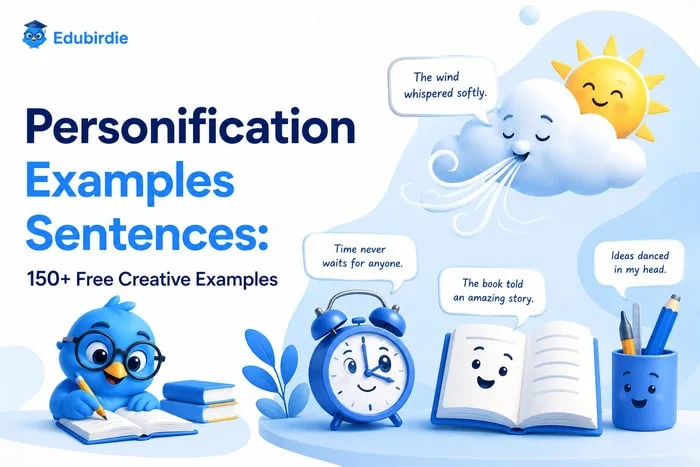
Sometimes you can give human qualities to non-human things: the sky is crying, the time is running, the wind is talking.
If you use personifications in your daily life, it is time to embed them in your academic writing as well to enrich your texts.
In this guide, EduBirdie will tell you everything you need to know about good personification examples and share some tips on how to use them in your essays!

What is Personification?
It is a literary device in which a writer assigns human characteristics, emotions, intentions, or behaviors to animals, inanimate objects, or abstract concepts.
A typical example of personification is when a writer treats a non-human thing as if it were a living, breathing person.
So, as a student, you may include an example of personification sentence in your text to share deep feelings without writing long, boring explanations.
For instance, you are saying, “The sun is smiling.” Obviously, the sun does not have a face, and it cannot experience happiness. Still, this personification example is giving it a human action, which makes the setting feel warm and safe.
Why do Writers Use Personification Examples in Literature?
If we talk about how to get better at writing essays, we cannot help but talk about figurative language personification examples. Master authors use good examples of personification to explain complex ideas and feelings to readers. With figurative devices, you give your audience a familiar bridge to cross into your story.
Other reasons why writers (and you) should use examples of personification in the texts are:
🔸It builds instant empathy.
🔸It explains abstract concepts.
🔸It enhances environmental moods.
🔸It increases text scannability.
Personification vs Anthropomorphism
Before EduBirdie gives you personification examples, we should talk about something that confuses a lot of students: the difference between personification and anthropomorphism.
| Feature |
Personification |
Anthropomorphism |
| Core definition |
Using human verbs/adjectives as descriptive tools. |
Turning an object or animal into a literal character. |
| Physical actions |
The object stays in its natural place (e.g., a tree waving). |
The object breaks natural laws (e.g., a tree walking and talking). |
| Duration |
Usually lasts for just one sentence or paragraph. |
Lasts throughout the entire duration of the story. |
| Primary goal |
To build vivid imagery and deep emotional connections. |
To create a main character for fables or children’s books. |
We also recommend checking what a double entendre is, because it is often confused with personification!
What are some Personification Examples: 150+ Ideas
The best way to master this technique is to look at a wide variety of personification ideas. We have put together a massive collection of sentences, broken down into clear, thematic categories.
Find inspiration for your next homework assignment below!
Personification Literary Examples: Nature
Authors love giving full human characteristics to landscapes to make environments feel alive:
- The ancient forest guarded its deepest secrets from tourists.
- Brave sunflowers nodded their heads as the breeze passed.
- Dry desert sand drank the rainfall in thirsty gulps.
- The ocean swallowed the tiny canoe in a giant wave.
- Mountain peaks pierced the clouds, standing tall against the cold.
- The wide river raced down the canyon to the sea.
- The giving tree offered its branches to shelter travelers.
- Prickly cactus saluted the cowboys across empty plains.
- The valley held its breath as morning mist settled.
- Wildflowers danced joyfully, celebrating the arrival of spring.
Personifications: Weather
Weather has its own natural, chaotic energy, which makes it perfect as an example of personification.
- The winter wind howled through cracks in the cabin.
- The afternoon sun smiles warmly upon the city.
- Angry storm clouds marched aggressively across the horizon.
- Raindrops pattered gently against my bedroom window.
- Thick fog crept silently into the harbor.
- A cruel blizzard mocked the stranded drivers.
- Morning mist lazily dragged its body across the lake.
- Lightning bolts danced across the dark sky.
- Thunder grumbled angrily, warning us to head indoors.
- A summer breeze caressed my face, chasing the heat.
Animal Personifications
Using an example of a personification with animals helps humanize their natural behaviors, making their instincts relatable to readers:
- The wise owl lectured the entire forest from above.
- Our lazy cat judged my outfit with a slow blink.
- Busy ants organized a rescue mission for the bread.
- A proud rooster announced that a new day had arrived.
- The loyal dog’s eyes smiled as its owner entered.
- Crafty foxes played hide-and-seek with the farmer.
- Tired fireflies blinked their lanterns through the dark.
- The caged bird sang a tragic song about freedom.
- A curious squirrel investigated our patio furniture.
- The mother bear fiercely protected her young cubs.
Easy Examples of Personification on Objects
Look at how these sentences use a personification example to liven up boring objects:
- My computer threw a tantrum and refused to save.
- The heavy door groaned loudly on its rusty hinges.
- The chocolate cake was practically screaming my name.
- The smoke detector shrieked a frantic warning.
- A worn-out mattress wrapped its comfortable arms around me.
- The car headlights winked as the remote unlocked it.
- Stubborn grass stains refused to leave my pants.
- The antique mirror revealed the harsh truth.
- A rusty key complained loudly in the jammed lock.
- The office printer coughed up a stack of wrinkled paper.
Time Personification Examples
Using the best personification examples for time helps capture that mental illusion perfectly:
- Time flies when you are having fun.
- The clock hands raced forward, stealing our vacation.
- Opportunities knocked loudly, but he was too afraid.
- The years stole his youth while he worked.
- A fresh dawn stepped forward to banish night.
- History watches closely to see our modern choices.
- Passing seconds marched onward like disciplined soldiers.
- The weekend waved a sad goodbye on Sunday.
- The past refuses to let go of his conscience.
- Future promises waited patiently around the corner.
Personification Example: Emotions
Turning feelings into a 3 examples of personification exercise helps students express deep emotional pain or joy:
- Sudden fear gripped my throat during the presentation.
- Ugly jealousy reared its head at the sight of the phone.
- True happiness visited our home during the holidays.
- Deep sorrow weighed heavily on her fragile shoulders.
- Love heals old emotional wounds that medicine cannot touch.
- Blinding anger boiled inside his chest until he snapped.
- A wave of panic chased away my logical thoughts.
- Loneliness sat quietly beside him in the dark room.
- Sweet Hope refused to die during the family crisis.
- Guilt followed him around like a heavy shadow.
Personifications about School and the Classroom
For students searching for a cute personification examples list to use in their school essays, the classroom is full of great options:
- The school bell happily rescued us from geometry.
- My backpack groaned under the weight of textbooks.
- Library books slept peacefully on their dusty shelves.
- The chalkboard screamed as the teacher wrote.
- My stubborn pencil refused to stay sharp.
- The classroom clock mocked my deep boredom.
- An empty desk waited patiently for the student.
- The crowded hallway swallowed hundreds of teenagers.
- My final essay begged for descriptive adjectives.
- The cafeteria line crawled along like a snake.
City and Urban Life Personifications
You can craft two examples of personification using urban structures to show the contrast between concrete and nature:
- The city watched us through thousands of neon eyes.
- Streetlights blinked awake as the sun went down.
- Heavy traffic crawled through the narrow avenues.
- The skyscraper stood proud against the howling wind.
- A dark alleyway hid behind the main avenue.
- The subway train screeched a loud complaint.
- Concrete sidewalks baked and sweated under the sun.
- The city park welcomed families with green arms.
- Factory chimneys burped smoke into the morning air.
- Construction cranes actively rewrote the city skyline.
Technology Personifications
Modern gadgets often feel like they have a mind of their own, especially when they stop working right before a deadline.
- My smartphone died right when I needed it.
- The weak Wi-Fi played hide-and-seek all afternoon.
- The computer fan gasped for cool air.
- Notifications demanded my attention every five minutes.
- The battery icon flashed, begging for a cable.
- Our smart TV got completely confused by the buttons.
- The GPS voice calmly corrected my path.
- The car engine hummed a happy tune.
- The camera lens stared blankly at the crowd.
- My tablet slept quietly on the nightstand.
A Personification Example about Holidays and Seasons
Authors use seasonal language to build strong thematic backdrops for their storytelling:
- Winter spread its cold blanket over the sleeping countryside.
- Spring smiled, bringing colorful flowers back to life.
- Summer danced through the streets, inviting children to play.
- Autumn dressed the trees in robes of gold.
- Halloween crept into our neighborhood on quiet tiptoes.
- Christmas cheer walked right through our front door.
- The New Year arrived with a loud roar.
- Thanksgiving brought our entire family together for a feast.
- Jack Frost nipped playfully at our cold noses.
- April showers woke up the fresh earth.
Need help with your essay?
EduBirdie’s experts are ready to assist whenever you need a hand.
Place an order
25 Short Personification examples Sentences
If you are looking for quick, punchy phrases that are incredibly easy to memorize for an upcoming exam, check out this list of easy examples of personification:
- The stars winked.
- The fire purred.
- Waves swallowed.
- Winds whispered.
- Shadows danced.
- Time flies.
- Leaves skipped.
- The car coughed.
- Flowers begged.
- Houses stared.
- Ice screamed.
- Snow wrapped.
- The alarm shouted.
- The mirror lied.
- Shoes complained.
- Thunder growled.
- The sun smiled.
- Fog crept.
- Mud grabbed.
- The ocean roared.
- Dawn arrived.
- Night fell.
- Trees waved.
- Walls listened.
- The camera loves you.
Personification Examples in Poems and Literature
Personification Example in Poetry
If you look at any examples of personification in poetry, you will find that poets use this device to establish rhythm and intense emotional moods.
For instance, personification examples in poetry of Emily Dickinson reveal how she describes the train as a giant creature that “laps the miles” and “licks the valleys up.”
Another personification in poetry examples comes from William Wordsworth’s famous poem, I Wandered Lonely as a Cloud, where he observes a crowd of golden daffodils “tossing their heads in sprightly dance.”
Novel Examples
Personification examples in literature help build a unique atmosphere around a setting. Consider this famous line from F. Scott Fitzgerald’s classic novel, The Great Gatsby:
“The cooling night received us and broke up into speech and foam as we turned the corner.”
Here, the night acts like a welcoming host. Another brilliant hard personification examples choice comes from Charles Dickens in Bleak House. Here, he describes a thick London fog as “creeping up the river” and “hovering over the rigging of great ships” like a living monster.
Famous Personification Examples: Shakespeare
William Shakespeare was an absolute master of personification. In his timeless tragedy, Romeo and Juliet, Romeo looks up at the morning sky and says:
“Night’s candles are burnt out, and jocund day / Stands tiptoe on the misty mountain tops.”
Instead of simply stating that morning has arrived, Shakespeare describes the day as a cheerful person standing on tiptoe. This artistic phrasing is why his plays are a great example of personification in poetry taught in schools today.
How to Write Your Own Personification in Poetry or Any Other Sentences
Creating your own figures of speech is easy once you break the process down into three simple steps.
Step 1️⃣: Choose a non-human subject
Start by picking an ordinary object, animal, weather pattern, or abstract concept. It could be something as simple as your alarm clock, an old car, or a passing storm cloud.
Step 2️⃣: Assign a human action
Think about what humans do. We cry, laugh, shout, complain, dance, run, and sleep. Pick an action verb that mirrors the natural movement or function of the object you chose in Step 1.
Step 3️⃣: Add context and emotion
Combine your subject and your human verb into a complete sentence. Add specific descriptive details so the reader understands the exact mood you want to share.
Practice Exercises
The absolute best way to master personification figurative language examples is through regular practice. Try out these useful exercises:
- Identify the Personification
Look at the sentences below and try to point out which non-human item is acting like a human being:
- The greedy flames ate the dry logs in the fireplace.
- My old shoes cried out for a break after the long hike.
- The headlights guided us safely through the pitch-black highway.
- The angry wind slapped the windows all night.
- The alarm clock screamed at me in the morning.
- The lonely road stretched into the dark forest.
- The stars winked at us from the clear sky.
- The old house groaned during the storm.
- The flowers danced in the warm breeze.
- The tired sun slipped behind the mountains.
- The thunder grumbled in the distance.
- The moon watched over the quiet town.
- The river whispered as it moved over the rocks.
- The heavy backpack begged to be put down.
- The fire swallowed the paper in seconds.
- The classroom walls listened to every secret.
- The snow covered the city in a soft blanket.
- The computer refused to start before class.
- The leaves chased each other across the sidewalk.
- The candle fought against the darkness.
- The door complained as it slowly opened.
- The waves reached the shore again and again.
- The clock stared at me during the test.
Such exercise helps you notice how personification turns ordinary objects into active, human-like parts of a sentence.
- Rewrite Literal Sentences Using Personification
Use this helpful matrix to practice turning boring, literal statements into dynamic, living descriptions:
| Literal Sentence |
Turn It Into Personification |
| The rain fell all night. |
The rain drummed its fingers on the roof all night. |
| The sun appeared in the morning. |
The sun peeked over the horizon. |
| The leaves moved in the wind. |
The leaves danced in the wind. |
| The alarm clock rang. |
The alarm clock shouted me awake. |
| The river flowed quickly. |
The river raced toward the sea. |
Now it’s your turn! Pick three random objects in the room you are sitting in right now. Give each item a human emotion or behavior, and write a complete sentence for each one. Be creative, because even funny personification examples work really well in writing!
Final Thoughts
Practicing personification examples sentences is the ultimate way to transform dry, academic essays. By assigning human traits and behaviors to non-human things, you help your reader connect with your ideas on a much deeper level.
Now that you have explored these many examples, it is time to practice writing your own!
Remember: whenever you need help mastering advanced literary devices to make your writing truly shine, EduBirdie is always here to guide you toward a high-scoring paper.
FAQ
How do you identify personification?
To identify a personification example, look for any non-human subject paired with a human action, feeling, or trait.
What is the difference between personification and metaphor?
A metaphor makes a direct comparison between two unrelated things by stating that one is the other (e.g., “Time is a thief”). Personification is a specific type of metaphor that explicitly limits its comparison to human characteristics only.